")
Da Nang (VNA) – Preferential policies from central authorities are proving effective in Da Nang as the city is recording a big wave of investments from technology giants into the semiconductor and artificial intelligence (AI) industries.
Attracting investment resources
Statistics show that Da Nang has attracted nearly 70 companies operating in the semiconductor, microchip, and AI sectors. Among them are globally renowned corporations such as Marvell, Synopsys, Uniquify, Synapse, Savarti (the US), and Renesas (Japan), which have opened subsidiaries, centres, or offices in the city. Vietnamese firms such as FPT Semiconductor, a member of FPT Group, have also joined the ecosystem.
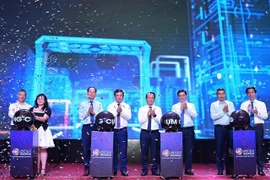
The strong interest from these leading firms has made Da Nang a national hotspot for investment in science and technology development. The city has successfully attracted the Lab-Fab project – a small-scale laboratory combined with an advanced semiconductor packaging production facility – invested by VSAP LAB Joint Stock Company. With a total investment of 1.8 trillion VND (68.8 million USD), the project is expected to become operational in January 2026.
In addition, Da Nang is home to a data centre project developed by the Da Nang International Data Centre Joint Stock Company in the Da Nang Hi-Tech Park. With a scale of 1,000 racks and a total investment of nearly 800 billion VND, the project aims to establish a regional data centre and a larger-scale data hub in Da Nang, utilising modern technology solutions.
Nguyen Thanh Hong, Director of the municipal Department of Science and Technology, said that viewing infrastructure development as the prerequisite , the city has prioritised the implementation of many technological infrastructure projects. Among them is the AI Lab project, which focuses on investing in modern machinery and equipment to create a favourable environment for research, development, and testing of products and technologies.
Furthermore, the Da Nang Innovation Space project provides an environment for innovation, including co-working areas, incubation facilities, shared technical and office equipment, and IT infrastructure, to support startups and project development.
Room expanded for sci-tech development
At the Vietnam Blockchain and Artificial Intelligence Week 2025 – Super Vietnam 2025, Chairman of CMC Corporation Nguyen Trung Chinh stated that the digital economy will be a key driver, contributing to around 20% of Vietnam’s GDP in 2025 and potentially reaching 30% by 2030, laying the groundwork for a shift in the country’s economic model.
In this trend, Da Nang holds significant advantages thanks to its favourable conditions for AI and blockchain-based development.
Specifically, the city boasts a strategic location with seaports and an international airport, offering convenient connectivity, while its technological infrastructure is well-developed. In addition, it has a skilled workforce, supported by universities offering AI and blockchain training. It has also continuously ranked among the best performers in the Provincial Competitiveness Index (PCI) and Digital Transformation Index (DTI).
Notably, the enforcement of various special mechanisms and policies has significantly enhanced Da Nang’s appeal to technology enterprises and investors. According to the National Assembly's Resolution 136/2024/QH15 on the urban administration organisation and the pilot implementation of several special mechanisms and policies for the development of Da Nang, the city is entitled to apply seven groups of policies related to science, technology, and innovation.
Reality has shown that the development and issuance of special mechanisms serve as a competitive edge, creating strong momentum for scientific, technological, and innovative activities in the city. This helps to attract high-quality human resources, startups, and technology corporations, positioning Da Nang as magnet for innovation and a hub for emerging technologies, said the Director of the municipal Department of Science and Technology.
Additionally, Hong noted that after Quang Nam province was merged into Da Nang in early July, the newly-formed city has gained more room for science and technology development and enterprise attraction. More land will be available, enabling the formation of large-scale manufacturing and testing-packaging complexes. The merger also facilitates the creation of a more complete supply chain, allowing for the expansion of R&D centres, AI and chip design and training hubs, as well as production facilities, logistics, and supporting industries./.