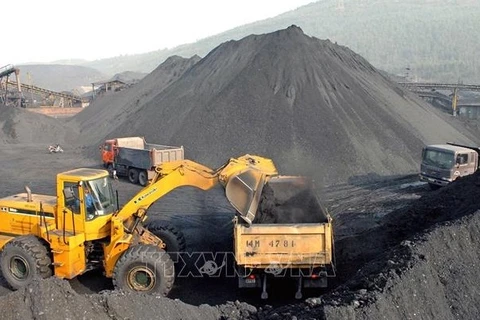
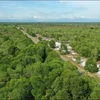
Vang Danh coal mine, with more than 5,000 employees, is one of the biggest mines in the northern border province of Quang Ninh (Photo: VNA)
 The plan aims to bolster socio-economic development, national mineral reserves, defence, security, and natural disaster prevention.
These aims are set out in Decision No. 334/QD-TTg, approving the Geological and Mineral Strategy to 2030, with a vision towards 2045.
The main goal of this strategy is to complete the investigation and assessment of strategic and important minerals on the mainland and in coastal waters and islands, as well as detect and investigate minerals in deep sea and offshore areas.
The strategy also aims to explore minerals such as coal, uranium, titanium-zircon, rare earth, apatite, copper, nickel, tin, bauxite, glass sand, and other minerals by 2045 while balancing the exploitation and national mineral reserve for a number of strategic, important, and large-scale minerals.
The strategy also focuses on the strict management, economical and efficient use of mineral resources, investing in mining and mineral processing technology, forming an advanced and modern mining industry that goes in line with environmental protection and a circular, green economy, climate change adaptation and towards carbon neutrality. It is also expected to end fragmented and out-of-date mineral mining and processing establishments that pollute the environment.
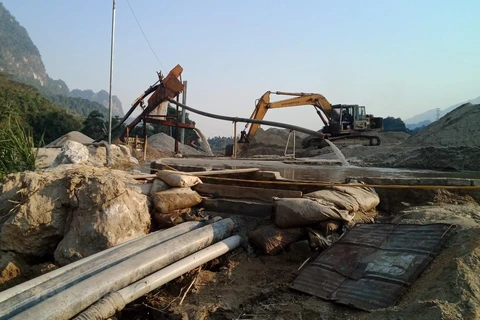
 Illustrative image (Photo: VNA)
 The specific objectives of the strategy include completing 85 per cent of the geological and mineral mapping area at the scale of 1:50,000 of the mainland by 2030; complete the investigation and assessment of mineral potential in promising structures in the North Central and South Central regions.
Another goal of the strategy is to investigate, evaluate and map geological hazards, environmental geology of the provinces in the mountainous and coastal areas of the Mekong Delta; survey and mapping of geological heritage nationwide; complete investigation and mapping of environmental geology of areas containing toxic and radioactive minerals; investigation and assessment of sand, gravel and construction materials in river basins.
It also includes forming mineral processing industrial parks with advanced technology and scale commensurate with the potential of each mineral, synchronised with regional infrastructure development.
The strategy also aims to develop technology for deep processing of minerals, promote cooperation in scientific and technological research, technology transfer, training and development of human resources in geology and minerals in order to mainly serve the needs of the economy, and strive towards forming an advanced and modern mining and mineral processing industry associated with a circular economy model, a green economy equivalent to that of advanced countries in Asia by 2045.
According to the development orientation, in terms of geology, priority shall be given to implementing and completing the mapping of mineral geology at the scale of 1:50,000 of the mainland and islands, marine mineral geological survey at the scale of 1:500,000, investigating, discovering and locating areas with mineral potential, especially strategic and important minerals.
The strategy also focuses on investigating and forecasting geological hazards in mountainous and midland provinces and establishing a comprehensive remote sensing identification technology system for areas with potential risks of geological hazards, zoning risks, synthesise and form a geological hazard risk management model to serve disaster prevention and mitigation work.
In terms of minerals, the strategy aims to review and locate national mineral reserve areas, balancing between planned use demand and long-term reserve for socio-economic development, defence and security assurance, and environmental protection. Exploration activities will have to comply with the planning, suitable to the potential of each type of mineral.
The mining industry will have to comply with the planning, use advanced technology and equipment, suitable to each potential type of mineral, and maximise the recovery of useful ingredients while ensuring environmental protection. For minerals with large and concentrated reserves, mining projects must be conducted while using advanced technology, modern equipment, and sustainable environmental protection.
The strategy emphasises the research and use of advanced technology in exploiting construction materials and ensuring the balance and harmony between export and import, ensuring domestic demand, and supplying raw materials for processing projects./.
VNA