Government steering committee set up to drive Vietnam’s sci-tech, innovation development

It is tasked with studying and proposing the Government and the PM national strategies, policies, and solutions for developing science, technology, innovation and digital transformation. Besides, it is in charge of overseeing the implementation of project No. 06 on developing the application of population data, identification, and e-authentication data, as well as administrative reform efforts.

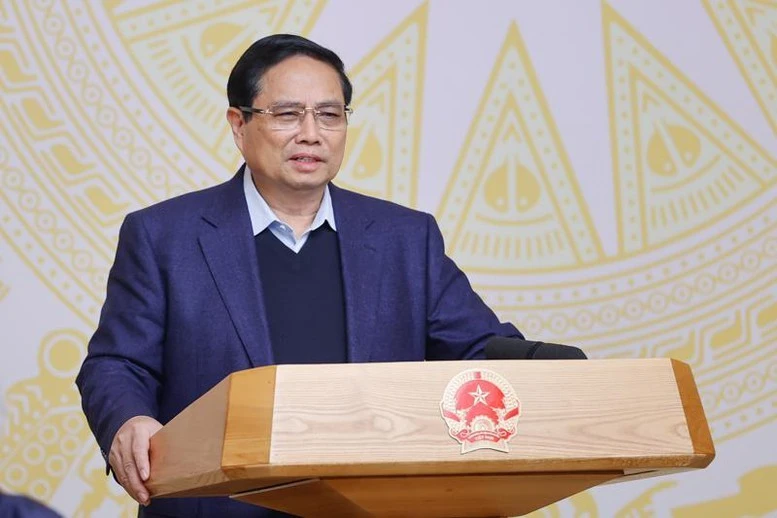
Prime Minister Pham Minh Chinh serves as head of the Government steering committee for the development of science, technology, innovation and digital transformation. (Photo: VNA)

Hanoi (VNA) – Prime Minister Pham Minh Chinh on March 13 signed a decision on establishing a government steering committee for the development of science, technology, innovation and digital transformation, and Project 06.

PM Chinh chairs the committee, with Permanent Deputy Prime Minister Nguyen Hoa Binh serving as his standing deputy. Other deputy chairpersons are Deputy Prime Minister Ho Duc Phoc, Deputy Prime Minister and Minister of Foreign Affairs Bui Thanh Son, Deputy Prime Minister Nguyen Chi Dung, Minister of National Defence General Phan Van Giang, Minister of Public Security General Luong Tam Quang, Minister of Science and Technology Nguyen Manh Hung, and Minister of Home Affairs Pham Thi Thanh Tra.

The committee’s members include a number of ministers and heads of ministerial-level and government agencies.

soqg-1656668075992180130409.jpg
Illustrative photo (Photo: Internet)

It is tasked with studying and proposing the Government and the PM national strategies, policies, and solutions for developing science, technology, innovation and digital transformation. Besides, it is in charge of overseeing the implementation of project No. 06 on developing the application of population data, identification, and e-authentication data, as well as administrative reform efforts.

A key responsibility is coordinating the Government's action programme to implement the Politburo’s Resolution No.57-NQ/TW dated December 22, 2024 which focuses on breakthrough development in science, technology, innovation, and national digital transformation. Additionally, the committee is accountable for speeding up and inspecting the implementation of related inter-sectoral strategies, programmes, mechanisms, policies, and solutions.

Three subcommittees are set up to better focus on the work, with one for project No.06 implementation led by the Minister of Public Security, another for science, technology, innovation, and digital transformation headed by the Minister of Science and Technology, and one for administrative reform directed by the Minister of Home Affairs.

The Ministry of Science and Technology serves as the standing agency for the steering committee, responsible for developing working plans and regulations and ensuring necessary conditions for the committee's operations.

Funding for the committee and its subcommittees is sourced from the state budget allocated to the Ministries of Science and Technology, Public Security, and Home Affairs, along with other legal sources./.

VNA

See more

Deputy Prime Minister Nguyen Chi Dung receives a delegation of Seoul Semiconductor Co., Ltd. led by its CEO Lee Chung-hoon in Hanoi on January 16. (Photo: Government Portal)

Vietnam seeks stronger sci-tech cooperation with international partners

Informing the UN official about some of Vietnam’s achievements in sci-tech development, innovation, and digital transformation, Deputy PM Nguyen Chi Dung highlighted that the country and the UN have recorded progress in their sci-tech relations, with cooperation in strategic areas matching global trends and bilateral cooperation demand.

The ASEAN Digital Awards 2025 ceremony is held in Hanoi on January 15 (Photo: VietnamPlus)

Vietnam wins three awards at ASEAN Digital Awards 2026

In the digital startup category, MedCAT’s Idus platform, developed by MedCAT, won the gold award. Designed for reading, classifying and structuring documents, the platform has been applied in banking, public administration and healthcare, supporting automated insurance claims processing, smart healthcare services and the development of personal electronic health records.

Illustration of part of the digital technology and mixed-use park project in Hanoi Tay Tuu and Phu Dien wards. (Photo: FPT)

Hanoi breaks ground on digital technology, mixed-use park

The digital technology and mixed-use park in Hanoi is envisioned as a key nucleus of the capital’s innovation ecosystem, aligned with its goal of becoming a major national hub for science, technology and the digital economy.

Illustrative photo (Photo: Ampshireflag)

Promoting cooperation aligned with ASEAN digital priorities

The sixth ASEAN Digital Senior Officials’ Meeting (ADGSOM) and related meetings took place from January 12 to 14 in Hanoi. Delegations exchanged views and reviewed progress in priority cooperation areas, focusing on enhancing coordination and harmonisation of digital policies across ASEAN.

The Au Lac AI Alliance officially announces the inaugural Au Lac Grand Prize on January 12. (Photo: VNA)

Au Lac Grand Prize launched to honour Vietnamese-made AI

The competition is open to all Vietnamese citizens, regardless of age, place of residence or professional background, provided the submitted product or solution is legally protected intellectual property developed and owned by Vietnamese individuals or entities and used in compliance with the law.

An expert speaks at the International Conference on Semiconductors (ICOS) 2026 (Photo: VNA)

ICOS 2026 highlights pathways for Vietnam’s semiconductor development

This was the first international, specialised semiconductor conference held in central Vietnam and the first time the country hosted a large-scale academic forum dedicated exclusively to this sector. Organised in line with international standards, it featured plenary sessions, technical presentations and industry forums, reflecting major research trends shaping the semiconductor sector.

Resolution No.57: People should be put at centre of AI governance

Resolution No.57: People should be put at centre of AI governance

Assessing the role of AI, Minister of Science and Technology Nguyen Manh Hung emphasised that it is an “intellectual infrastructure.” More than an applied technology, AI is increasingly becoming a form of national infrastructure, comparable to electricity, telecommunications or the Internet.

In Vietnam, 5G technology infrastructure has begun to be widely deployed by domestic network operators (Photo: VNA)

5G technology expansion expected to boost Vietnam’s digital economy

The Ministry of Science and Technology reported that by 2025, 5G had been commercialised nationwide, covering more than 90% of the population. Viettel alone has deployed 30,000 5G base stations, achieving 90% outdoor coverage and 70% indoor coverage, exceeding its commitments to the Government.