Hanoi promotes hi-tech flower farming for green growth

Many high-tech flower farms have adopted automated irrigation systems, light and temperature regulation, and have achieved relatively high productivity.

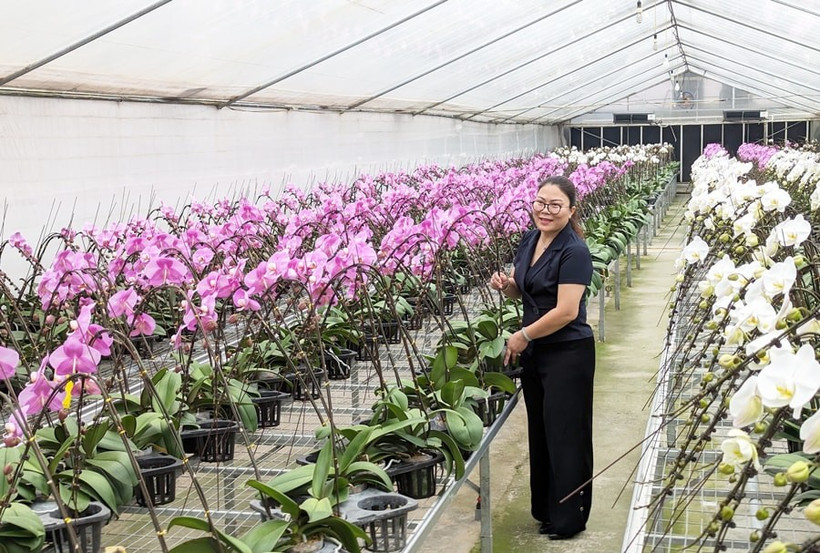
The high-tech orchid cultivation model of Dan Hoai Cooperative generates considerable economic value. (Photo: hanoimoi.vn)

Hanoi (VNA) – Hanoi is promoting hi-tech flower cultivation by expanding greenhouse and net house production areas, applying new varieties and advanced techniques, and converting low-yield rice fields into flower-growing zones to foster green, climate-resilient agriculture combined with eco-tourism.

Effective models emerging

According to the Hanoi Agricultural Extension Centre under the Municipal Department of Agriculture and Environment, the city currently has more than 3,000 ha of flower-growing areas, including about 47 large-scale flower production zones covering over 1,800 ha in districts such as Tay Ho, Me Linh, Dan Phuong, Thuong Tin, and Gia Lam. High-quality flower cultivation accounts for over 30% of the total area, with several varieties such as orchids, lilies, and chrysanthemums already being exported.

Many high-tech flower farms have adopted automated irrigation systems, light and temperature regulation, and have achieved relatively high productivity. The average production value ranges from 500 million (18,900 USD) to 1.5 billion VND (56,9000 USD) per hectare per year, with some models earning up to 2.2 billion VND per hectare annually.

The use of smart management systems, greenhouse and net house technologies, and water-saving irrigation helps farmers actively manage production, enhance competitiveness, and meet strict market demands, thereby increasing profits compared with traditional flower cultivation.

Ngo Minh Truong from My Hung commune said his family has developed a 2,500-sqm orchid garden applying hi-tech methods since 2019, now growing nearly 80,000 orchid pots of 30–40 colourful varieties. Hi-tech flower cultivation not only brings higher economic efficiency but also produces high-quality, diverse, and stable products. This helps farmers compete better domestically and internationally while reducing chemical use and optimising resources, contributing to environmental and public health protection, he said.

Developing farm-based models linked with tourism

Despite positive results, hi-tech flower production still faces challenges due to high investment costs, production risks, small-scale operations, and limited branding among cooperatives and enterprises, making it difficult to expand market reach.

To replicate and expand hi-tech flower cultivation suitable to Hanoi’s soil conditions, Nguyen Thi Thuy, owner of Me Linh F-Farm, suggested that the city continue offering preferential credit policies to help businesses and cooperatives invest in infrastructure, greenhouses, and production facilities. She also emphasised the need for science and technology transfer, as well as support for building local flower brands and labels to boost consumption.

Nguyen Manh Phuong, the Deputy Director of the Hanoi Department of Agriculture and Environment, stated that in the near future, the department will enhance collaboration with local communities to offer training on greenhouse flower cultivation techniques aimed at achieving high productivity and economic efficiency.

The department will also guide farmers on disaster prevention and climate change adaptation. Additionally, there will be a gradual transition from low-yield rice cultivation to flower farming, especially in riverbank areas. This initiative will also promote flower farming in connection with experiential tourism.

The department will collaborate with relevant units within the Ministry of Agriculture and Environment to enhance research and breeding of new flower varieties that are suitable for the local climate, soil conditions, and consumer preferences. Local authorities will partner with industry associations to build brands, establish planting codes, and create digital maps for ornamental plants.

These efforts are expected to increase product value per unit area, create jobs, improve farmers’ incomes, promote exports, and drive agricultural restructuring, while beautifying the landscape and protecting the environment./.

VNA

See more

The International Agriculture Trade Fair AgroViet 2025 opens on November 12 in Hanoi. (Photo: VNA)

AgroViet 2025 promotes Vietnamese agriculture in digital era

The exhibition features nearly 250 booths showcasing a wide variety of agricultural products. Key highlights include Vietnam’s major export items in agriculture, forestry, and fisheries, OCOP products rated three stars or higher, regional specialities, handicrafts, and organic and eco-friendly goods. It also includes modern machinery, equipment, and materials for agricultural production and post-harvest processing.

At the Vietnam Foodexpo 2025 in Ho Chi Minh City. (Photo: VNA)

Vietnam Foodexpo 2025 hosts nearly 400 local, foreign exhibitors

Products span fresh agricultural goods like fruits, tea, coffee, pepper, cashews, plus seafood, processed and functional foods, beverages, confectionery, and dairy products. Manufacturers are also showcasing processing equipment, preservation and packaging technology, and food safety innovations.

At the opening ceremony of the Vietnam Industry and Technology Week 2025. (Photo: VNA)

Vietnam Industry and Technology Week 2025 kicks off

For the first time, the five largest industry and technology trade shows have been brought together in a premium exhibition space, creating a platform for strategic trade promotion and connecting knowledge, technology, and the business community, driving forward the journey of innovation and global integration.

Vietnam launches first homegrown mini electric truck GIO Tano 250 (Photo: VNA)

Vietnam unveils first locally made mini electric truck GIO Tano 250

The Tano 250, Vietnam’s first multifunctional mini electric truck designed and manufactured entirely domestically, promotes low-emission, low-noise mobility in urban and agricultural settings. With an estimated retail price starting at 35 million VND ( nearly 1,330 USD), it aims to make green transport more accessible to everyday users.

Deputy Prime Minister Bui Thanh Son speaks at the US-Vietnam Business Summit 2025. (Photo: VNA)

Vietnam highly values win-win economic, commercial cooperation with US: Deputy PM

Son expressed his confidence that with a 30-year foundation of cooperation and increasingly high political trust, along with the support of the business communities, Vietnam and the US will continue to write a brighter new chapter in the Comprehensive Strategic Partnership for peace, cooperation, and prosperity of both nations and the world.

Competent forces of Ninh Binh province inspect a fishing vessel at Ninh Co fishing port (Photo: VNA)

Ninh Binh province strictly deals with IUU violations

Local authorities have strictly prohibited “three-no” fishing vessels — those without registration, technical inspection or licences — from setting sail, while intensifying enforcement against other violations in fishing.

An overview of the workshop (Photo: VNA)

Project empowers women entrepreneurs to tap into global e-commerce market

Overall, more than 600 women-led enterprises benefited from the project’s training, while 13 partner organisations enhanced their expertise in supporting women in e-commerce. Between June and September 2025, the 32 participating firms recorded over 455,000 buyer searches and 85,000 page views, indicating increased visibility and growing confidence in the global digital marketplace.

A booth at the trade promotion fair. (Photo: VNA)

Red River Delta trade promotion fair opens in Hung Yen

A trade promotion fair for localities in the Red River Delta opened on November 10 in the northern province of Hung Yen, aiming to foster regional connectivity, promote sustainable development and enhance brand of regional products.

Tan Thuan Export Processing Zone, Ho Chi Minh City (Photo: VNA)

Foreign investors ready to pour capital into HCM City

Administrative reform remains HCM City’s top priority. The city aims to cut at least 30% of procedures, reduce processing times and costs, and shift from a “management mindset” to a “service mindset” to better support the business community.