Increasing investment in cultural industries: A step toward sustainable growth

Vietnam is increasingly recognising the importance of cultural industries in driving economic growth while preserving the nation’s cultural identity.

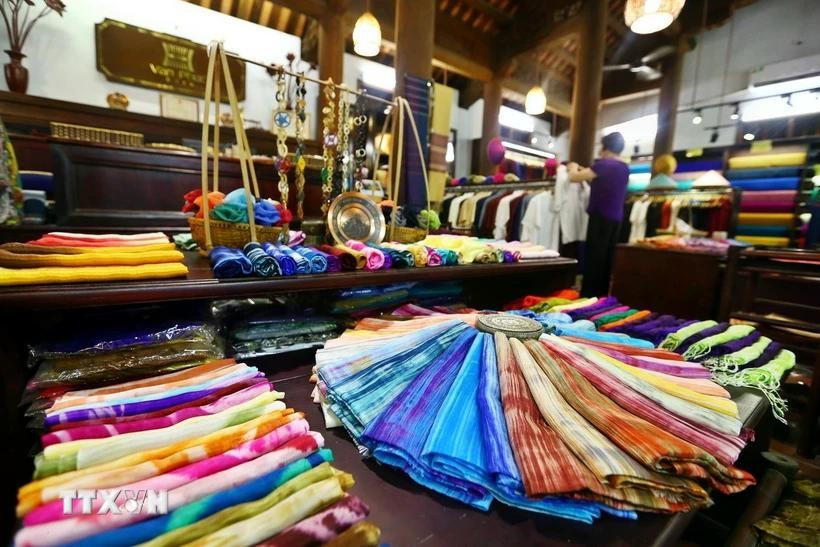
Van Phuc silk products (Photo: VNA)

HCM City (VNA) – In a bid to meet its ambitious goals for 2025 and beyond, the Government has issued Resolution No. 01/NQ-CP outlining strategic measures for socio-economic development, with a strong focus on fostering professional, modern, and creative cultural and entertainment industries.

Unlocking potential, resources

Vietnam is increasingly recognising the importance of cultural industries in driving economic growth while preserving the nation’s cultural identity. Many localities are tapping into their unique cultural assets to develop industries that highlight the country’s rich history, art, and traditions. In Ho Chi Minh City, for example, authorities are prioritising the development of eight key cultural industries, including film, to create a vibrant and internationally competitive sector.

The city’s film industry alone includes over 930 enterprises, employing more than 9,000 people and contributing roughly 0.43% to the city’s GRDP. With more than 100 active filmmakers, Ho Chi Minh City is making strides in becoming a global hub for film production. To further this goal, the city has applied for membership in UNESCO Creative Cities Network (UCCN)’s City of Film, an effort to integrate the city more deeply into the global creative economy.

In the Mekong Delta region, provinces are leveraging their cultural tourism and handicraft industries to fuel growth. Vinh Long boasts a wealth of historical sites, traditional craft villages, and folk cultural practices, such as “hat boi” (classical opera) and “don ca tai tu” (southern (amateur singing)). The province has invested significant resources into preserving these cultural treasures, allocating more than 30 billion VND from the local budget to restore cultural sites and promote tourism. The local handicraft sector, which includes pottery, basket weaving, and hat-making, is also seeing growth, contributing to both the domestic market and international tourism.

Meanwhile, authorities of Can Tho city, another key locality in the Mekong Delta region, are focusing on developing its cultural tourism infrastructure, with 640 accommodation facilities already in place. The city’s mix of ecological tourism, agricultural experiences, and cultural activities has positioned Can Tho as a key tourism hub in southern Vietnam. The goal is to attract both domestic and international visitors, creating a dynamic regional tourism ecosystem.

Increasing investment in cultural development

But investment isn’t just about building infrastructure - it’s also about fostering creativity and entrepreneurship. In HCM City, local authorities are not only focusing on attracting investors but are also creating a supportive environment for artists and creators.
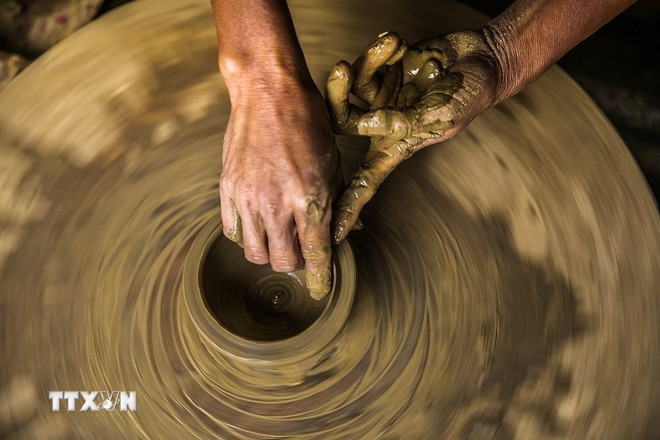
gom.jpg
The process of molding and shaping Bat Trang ceramic products is always the most difficult step, and must be carried out by skilled craftsmen with skillful hands. (Photo: VNA)

Vice Chairwoman of the municipal People’s Committee Tran Thi Dieu Thuy said that policies that provide tax breaks, land use benefits, and funding for cultural startups are part of the city’s plan to build a sustainable cultural ecosystem. The goal is for the cultural industries to grow at an annual rate of 12% by 2030, contributing 7-8% to the city’s GRDP.

Similarly, in Ca Mau, a province in the southernmost part of the country, the focus is on developing sustainable cultural tourism and promoting local craftsmanship.

Nguyen Minh Luan, Vice Chairman of the provincial People’s Committee said that by preserving its historical and natural landmarks, Ca Mau aims to develop tourism that’s both economically viable and culturally meaningful. The province is also working to integrate its unique culinary traditions into the tourism experience, highlighting local flavours that reflect the region’s rich cultural heritage.

In Vinh Long, according to representatives from the provincial People's Committee, the region is continuing to invest in developing its cultural industries by enhancing infrastructure and equipment for local cultural facilities. The province is also rolling out the "contemporary heritage Mang Thit" project, which aims to preserve traditional brick and ceramic craft villages while promoting cultural tourism and traditional handicrafts. Additionally, Vinh Long is exploring policies to provide financial, tax, land, and creative incentives for artists and businesses in the cultural sector./.

VNA

See more

Lasantha Somaratne, head of Strategic Business Development at Sri Lanka’s Hayleys PLC (Photo: VBA)

Photos highlight Vietnam – Sri Lanka friendship journey

A representative of Hayleys PLC said the photos recall meaningful milestones in the development of Vietnam – Sri Lanka relations, and that images capturing high-level visits and bilateral exchanges illustrate the depth of a relationship built on mutual trust, respect, and shared cultural values.

Delegates perform the opening ceremony ritual at the event held at the Thang Long imperial citadel on the evening of May 8. (Photo: VNA)

Hanoi gains two more craft villages in World Crafts Cities network

The recognition of Chuyen My and Son Dong craft villages as members of the World Crafts Cities network represents international acknowledgement of the cultural value, artisanal techniques, creativity and sustainable vitality of Vietnam’s traditional craft villages, he said.

SEA Games silver medallist Do Huy Hoang (right) will face Filipino fighter John Dave Almanza in the MMA Pro 56kg category. (Photo: Lion Championship)

LION Championship 31 to feature international fighters

The Vietnam Mixed Martial Arts Federation (VMMAF) has announced that LION Championship 31 (LC 31) will take place at 8 pm on May 9 in Hanoi, featuring nine exciting bouts, including several involving foreign fighters.

Vietnam GameVerse 2026 brings together more than 300 representatives from regulatory agencies, game developers, publishers, and leading industry experts from Vietnam and abroad. (Photo: VNA)

Vietnam GameVerse 2026 aims to elevate local gaming industry globally

Carrying the theme “Do local, go global”, this year’s event promotes a development approach rooted in Vietnamese creativity and innovation as the foundation for expanding local gaming products into international markets. Organisers expect the event to draw around 60,000 participants.

Visitors at a food stall in Da Nang (Photo: VNA)

Da Nang Food Tour Festival 2026 scheduled for May 20-24

This year’s festival will feature more than 100 booths and 70 street food stalls. A highlight will be the “Flavours of Da Nang” street parade on May 20 afternoon along Pham Van Dong beach, recreating central Vietnam’s street-food atmosphere. The opening ceremony is scheduled on May 21 morning at Bien Dong Park, blending an art show with culinary showcases.

In March 2025, the Ministry of Culture, Sports and Tourism recognises “the knowledge of coffee cultivation and processing in Dak Lak” as a national intangible cultural heritage. (Photo: nhandan.vn)

Dak Lak forum spotlights Vietnam’s coffee heritage ambitions

Nearly 40 research papers and presentations from Vietnamese and international scholars and experts were featured at the event, covering topics ranging from economics, culture, and heritage to processing technology, global value chains, and sustainability

Vietnam’s craft villages get major makeover

Vietnam’s craft villages get major makeover

Amid Vietnam’s push to redefine progress beyond pure GDP growth, the Politburo’s Resolution 80-NQ/TW delivers a sharp message that culture is no longer a sidekick, but must lead and shape national development.

Men’s three-cushion carom defending champion Cho Myung Woo of the Republic of Korea (left) competes against Yoneyama Satoru of Japan in Group A at the 14th Asian Carom Championship. (Photo: VNA)

14th Asian Carom Championship kicks off in Ho Chi Minh City

Organised by the Ho Chi Minh City Billiards & Snooker Federation, the tournament features four events: men’s three-cushion carom, women’s three-cushion carom, men’s one-cushion carom, and the men’s U22 three-cushion category.

The opening ceremony of the VNG IRONMAN Vietnam 2026 and the VNG IRONMAN 70.3 Da Nang 2026. (Photo: VNA)

Da Nang launches Southeast Asia’s largest IRONMAN week

Speaking at the ceremony, Deputy Director of the municipal Department of Culture, Sports and Tourism Tao Viet Hai described the event as a major milestone in Da Nang’s sports and tourism development. For the first time, the city will host the full-distance IRONMAN Vietnam while also staging the 10th edition of IRONMAN 70.3 Da Nang.

Players at the Vietnam (in white) – Yemen match on May 7. (Photo: VFF)

Vietnam edge Yemen in AFC U17 Asian Cup opener

At the 2026 AFC U-17 Asian Cup, Vietnam are drawn in Group C alongside the Republic of Korea (RoK), the UAE and Yemen. Under the fixture schedule, Vietnam will face Yemen on May 7, the RoK on May 10 and the UAE on May 14.

A performance at the Thang Long - Hanoi Festival 2025 (Photo: VNA)

Thang Long - Hanoi Festival 2026 to return in September

Co-hosted by the municipal People’s Committee, the Department of Culture and Sports, and domestic and foreign agencies, the whole spectacle is meant to honour the city’s millennia-old heritage while reafffirming its strategy of establishing culture as a development engine.

An installation by Le Huu Hieu at the 61st Venice Art Biennale in Italy (Photo courtesy of Venice Art Biennale)

Vietnam lacquer artists debut at Venice Biennale

Vietnam's appearance at the Venice Art Biennale 2026 is not only a symbolic milestone for the country's fine arts scene but also a new chapter in the integration of Vietnamese art into the global landscape.

A performance at the art programme to welcome the New Year 2026. (Photo: VNA)

Spreading Vietnamese cultural identity in digital space

In the context of deep international integration, cultural identity serves as both a “shield” against assimilation and a defining marker of a nation’s image. Protecting and promoting uniquely Vietnamese cultural values has therefore become a pressing task, particularly in an increasingly complex digital environment.