Indonesia pledges to reduce 1.02 billion tonnes of CO2 by 2030

The Indonesian government has pledged to reduce greenhouse gas emissions by 41 percent, equivalent to over 1.02 billion tonnes of CO2 by 2030.
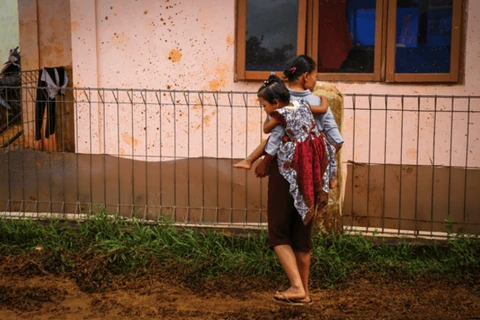
Indonesia pledges to reduce 1.02 billion tonnes of CO2 by 2030 ảnh 1Indonesia pledges to reduce 1.02 billion tonnes of CO2 by 2030. (Photo: theguardian.com)
Jakarta, June 7 (VNA) - The Indonesian government has pledged to reduce greenhouse gas emissions by 41 percent, equivalent to over 1.02 billion tonnes of CO2 by 2030.
Deputy Minister of Environment and Forestry Alue Dohong said, in the country’s Nationally Determined Contribution (NDC) document, Indonesia is committed to reducing greenhouse gas emissions by 29 percent with business as usual (BAU) and by up to 41 percent with international assistance by 2030.
He stressed that 29 percent is equivalent to 826 million tonnes of CO2 and 41 percent is equivalent to more than 1.02 billion tonnes of CO2 by 2030.
The Indonesian government and other members of the international community had approved the Paris Climate Agreement and had prepared an NDC that covers a projected potential for reducing greenhouse gas emissions, he added./.
VNA
See more

Rescuers search for victims following the earthquake in Flores, Indonesia, on August 15, 2026. (Photo: Xinhua/VNA)

Indonesia earthquake death toll rises, 2,000 evacuated

The earthquake struck off Flores Island near Mbay town in Nagekeo district, East Nusa Tenggara province, triggering strong aftershocks. Several houses and other structures were damaged, while landslides disrupted roads in some areas.

Cambodia moves to keep pace with growing EV market

Cambodia moves to keep pace with growing EV market

A report from the Ministry of Public Works and Transport showed that as many as 6,174 new EVs were registered in the Southeast Asian country during the first half of this year, bringing the total number of officially registered EVs to 15,239.

China-ASEAN trade up over 18% in H1

China-ASEAN trade up over 18% in H1

Trade in intermediate goods, including parts, components and production inputs, rose 24.5% to 2.86 trillion CNY during the period, accounting for around two-thirds of total bilateral trade.

The Petronas Twin Towers in Kuala Lumpur, Malaysia. (Photo: Xinhua/VNA)

Malaysia eyes becoming ASEAN’s AI hub

Malaysia possessed the fundamentals to emerge as ASEAN's digital and AI hub, including its strategic location, strong connectivity, growing digital ecosystem and rising investor confidence, said Digital Minister Gobind Singh Deo.

Malaysia is pursuing a vision of becoming one of the Asia-Pacific’s leading air connectivity hubs. (Illustrative photo: AFP/VNA)

Malaysia eyes regional air transport hub status

Stronger connectivity was essential for the movement of capital and goods, while helping deepen Malaysia's economic ties with major regional centres, said Transport Minister Anthony Loke.

A perspective of the passenger terminal at Long Thanh International Airport in its first phase. (Photo: ACV)

Vietnam, India emerge on Asia-Pacific aviation map

Vietnam is considered one of the most promising markets in Southeast Asia in terms of international visitor numbers and travel demand. The country plans to increase the number of airports to 30 by 2030 to meet the needs of its rapidly growing economy.

At the press conference (Photo: VNA)

Lao Digital Week 2026 slated for October in Vientiane

The event will serve as a major information technology and digital innovation platform, with sidelines events including the Lao Digital Forum; seminars on e-government, digital economy, the fourth industrial revolution and smart technologies.

A Facebook post on the official page of Pasaxon newspaper. (Photo: VNA)

Lao media spotlights late NA President’s deep bond with Vietnam

The article stressed that, regardless of the position he held, Xaysomphone Phomvihane devoted to building a prosperous country and a united society. He maintained a particularly deep concern and sincere affection for the special Laos-Vietnam relationship.