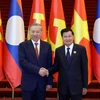
Indonesian President Joko Widodo (L) and his Vietnamese counterpart Vo Van Thuong. (Photo: VNA)
 The leader was seen off at Cat Bi InternationalAirport in Hai Phong by Deputy Minister of Foreign Affairs Do Hung Viet, ViceChairman of the Hai Phong municipal People’s Committee Nguyen Duc Tho, VietnameseAmbassador to Indonesia Ta Van Thong, and Indonesian Ambassador to Vietnam Denny Abdi,among others.
During his visit, President Widodo laid a wreath in tribute to President Ho Chi Minh at his mausoleum in Hanoi and fallen combatants at theMonument to Heroes and Martyrs in the capital city.
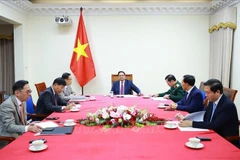
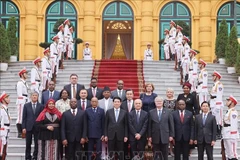
Following the official welcome ceremony, he held talks with President Vo Van Thuong, witnessed thesinging of cooperation documents, met with the press and attended a banquethosted by the Vietnamese leader.
The President had a meeting with Prime Minister Pham Minh Chinh,and the two leaders co-chaired a high-level business dialogue. He also met withChairman of the National Assembly (NA) Vuong Dinh Hue.
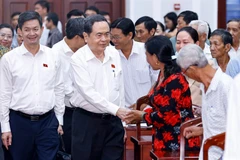
At the talks and meetings, the host leaders stressedthe importance Vietnam attaches to the traditional relationship and strategic partnershipbetween the two countries.
They highly valued achievements that Indonesia hasrecorded in both home and external affairs under the leadership of PresidentWidodo over the past two tenures, and congratulated Indonesia on its successfulperformance of the G20 Presidency in 2022, and ASEAN and the ASEANInter-Parliamentary Assembly (AIPA) Chairmanship last year.
The leaders noted their hope that Indonesia willsuccessfully organise its upcoming general election and further develop, forpeace and cooperation in the region and the world.
For his part, President Widodo expressed his delight to visit Vietnam for the second time in his capacity as the President of Indonesia, andthanked Vietnam for supporting Indonesia in performing the ASEAN Chairmanshipin 2023, saying Indonesia wishes to enhance its traditional friendship andcooperation with Vietnam – its only strategic partner in the Association of Southeast Asian Nations (ASEAN).
Both sides rejoiced at the strong, dynamic developmentof the bilateral strategic partnership, saying Indonesia is Vietnam’s thirdlargest trading partner in ASEAN, while Vietnam is Indonesia’s fourth biggesttrading partner in the group. Despite the COVID-19 pandemic, two-way tradestill grew significantly, from 9 billion USD in 2019 to nearly 14 billion USDlast year.
For future cooperation orientations, the leadersconsented to foster political trust through delegation exchanges and contacts,the effective implementation of bilateral cooperation mechanisms, and the earlybuilding of the 2024-2028 action programme.
Given the significant cooperative outcomes over thepast nearly 70 years, the two countries should early lift their strategicpartnership to a new level, they said.
The leaders witnessed the exchange of an MoU oncooperation in information and communications technology, and another on cooperation in fishing.
Within the visit, the two Presidents watched a martialarts and musical programme performed by athletes, soldiers, and artists of theVietnam People’s Army in Hanoi./.
VNA