IOM helps improve border guards’ capacity of combating trafficking in persons

The International Organisation for Migration (IOM) and the Department of Drug Control and Crime Prevention of the Vietnam Border Guard on May 30 held a workshop to launch the “Training Curriculum on Counter-Trafficking and Victim Protection” and to wrap up the project “Frontline training for Border Guards in Border Areas of Vietnam”, funded by the Bureau of International Narcotics and Law Enforcement Affairs (INL) of the US Department of State.
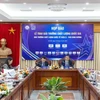
IOM helps improve border guards’ capacity of combating trafficking in persons ảnh 1IOM’s Chief of Mission Park Mihyung (second from left) speaks at the workshop (Photo: VNA)
Hanoi (VNA) – The International Organisation forMigration (IOM) and the Department of Drug Control and Crime Prevention of the VietnamBorder Guard on May 30 held a workshop to launch the “Training Curriculum onCounter-Trafficking and Victim Protection” and to wrap up the project“Frontline training for Border Guards in Border Areas of Vietnam”, funded by theBureau of International Narcotics and Law Enforcement Affairs (INL) of the USDepartment of State.

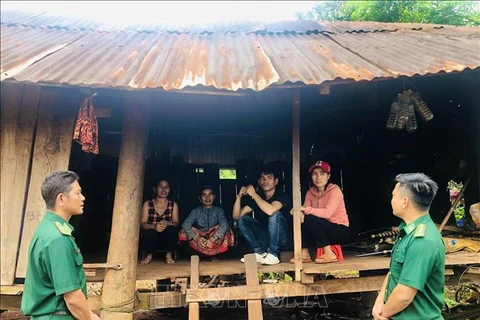
Participants at the workshop agreed that the Vietnam BorderGuard plays an important role in the fight against trafficking in persons (TIP)and the provision of protection and support for trafficking victims. Overseeing4,639km of land borders and 3,444km of coastlines, the Border Guard is at theforefront of cross-border crime prevention and control.

After three years of implementation, the project hasachieved a number of significant outcomes that profoundly enhanced thetechnical capacity of Vietnam's border guards, especially frontline officers inhotspot border areas, to better detect, investigate and handle TIP cases, aswell as identify, protect and assist trafficking victims.

Within the framework of this project, the trainingcurriculum on counter-trafficking and victim protection for frontline officerswas developed by the Vietnam Border Guard High Command and approved by theMinistry of Defence for use in training. The Training Curriculum was disseminated to border guard stations and border guard academies in 12 target provinces and was used to conduct 12training workshops for 436 frontline Border Guard officers in 12 targetprovinces in the northern and southern regions. The project also creates aforum for the officers to exchange effective methods, professional skills andpractical experiences that have been successfully applied in retracing,investigating and prosecuting TIP cases.

“I am a strong supporter of this project from the verybeginning and IOM is very proud to cooperate with the Department of DrugControl and Crime Prevention of the Vietnam Border Guard to contribute to enhancingcapacities of Vietnam Border Guard officers, who are at the frontline toreceive, protect and identify returning trafficking victims. Facilitating safe andorderly cross-border human mobility for migrants, while maintaining bordersecurity, supporting border guards’ engagement is one of the criticalcomponents in IOM’ mandate,” Park Mihyung, IOM’s Chief of Mission stated.

“Trafficking in persons is a complex global problem thatrequires a coordinated response. This project is a significant part of IOM’swork to support the Government of Vietnam to just strengthen its bordermanagement, but also contribute to the comprehensive effort under the nation’sHuman Trafficking Prevention and Control Programme 2021-2025 and the NationalImplementation Plan for the Global Compact for Safe, Orderly and RegularMigration (GCM), of which Vietnam is an active member," she added.

IOM also coordinated with Department of Drug Control andCrime Prevention to conduct end-of-training assessments at six hotspotprovinces including An Giang, Kien Giang, Tay Ninh, Ba Ria – Vung Tau, Cao Bangand Lang Son. The assessment results not only provided valuable information onthe ongoing trends and modus operandi of TIP criminals and irregular migrationactivities in border areas but also revealed the challenges that border guardsand victim support agencies must face in implementing processes and proceduresfor the investigation of TIP cases as well as trafficking victim protection andsupport.

The frontline officers who participated in the assessmentalso contributed useful intervention ideas and recommendations to addressongoing obstacles for consideration by IOM and the DDCCP in future cooperation./.
VNA
See more

Staff members of the Hanoi Public Administrative Service Centre handle administrative procedures for local residents. (Photo: VNA)

Hanoi: 95% of administrative procedures to be handled from home

The plan targets that at least 80% of administrative procedures under the city’s authority will be provided as fully online public services, while more than 95% of applications will be received and processed entirely online. By June 30, 2026, about 80% of administrative procedures are expected to be restructured based on integrated data systems, with the figure rising to 95% by the end of the year.

Delegates at the SEAN Future Forum NextGen Workshop 2026 held in Jakarta, Indonesia on March 9 (Photo: VNA)

Vietnam contributes youth perspectives to AFF NextGen initiative

The ambassador expressed confidence that fresh perspectives, innovative thinking and lessons drawn from the workshop will be proposed to AFF 2026, representing the voice of the younger generation in shaping ASEAN’s future in line with their aspirations.

A young volunteer donates blood during the 2026 Red Sunday programme. (Photo: VNA)

Nearly 5,000 people join blood donation campaign in Ho Chi Minh City

According to health authorities, Vietnam collected nearly 1.75 million units of blood in 2025, with 98% from volunteer donors, equivalent to around 1.75% of the population participating in blood donation. Large-scale campaigns such as Red Sunday have played a key role in achieving these results.

More than 30 kilogrammes of various drugs trafficked from Cambodia to HCM City were seized in a police operation in March 2025. (Photo: VNA)

Ho Chi Minh City aims to become drug free by 2030

Every commune, ward or residential area in Ho Chi Minh City is expected to meet official drug-free standards by the end of 2029, while schools, hospitals, government offices, businesses and social organisations across the city are to remain free of drug activity.

Military forces take a resident from a flooded area. Photo: VNA

Da Nang, Oxfam join hands to support flood victims

In the coming time, the Da Nang Red Cross Society will continue to coordinate with Oxfam to implement support activities in Nong Son commune, helping residents overcome difficulties and stabilise their livelihoods.

Training on response to reservoir incidents (Photo: VNA)

Central Civil Defence Fund established to bolster disaster response

The Central Civil Defence Fund is authorised to receive, manage and use voluntary contributions from domestic and foreign entities and individuals, plus transfers from provincial civil defence funds in line with the PM’s decisions and allocations from relevant state financial sources outside the state budget, all earmarked for incident and disaster response and recovery efforts.

Vietnamese women shine in the traditional Ao dai (Photo: VNA)

March shines with elegance of “Ao dai”

In early March, scenes of women in flowing Ao dai taking spring photos by lakes, parks, offices, temples and historical sites have become a familiar sight on the streets of Hanoi. Social media is also filled with images and stories surrounding the elegant attire, which has become a symbolic signal of the season dedicated to honouring women.

Hanoi voters learn about candidates’ biographies and action programmes. (Photo: VNA)

Hanoi thoroughly prepares for NA, People’s Council election

According to the municipal Election Committee, the capital city has established election committees in 126 communes and wards. In addition, 11 electoral boards for National Assembly deputies, 31 electoral boards for the city-level People’s Council, 831 commune-level electoral boards and more than 4,000 polling teams have been set up to serve the election process.