Japanese PM wraps up official visit to Vietnam

Prime Minister Ishiba Shigeru and his spouse, along with a high-ranking Japanese delegation, left Hanoi in the morning of April 29, concluding his three-day official visit to Vietnam at the invitation of Prime Minister Pham Minh Chinh and his spouse.

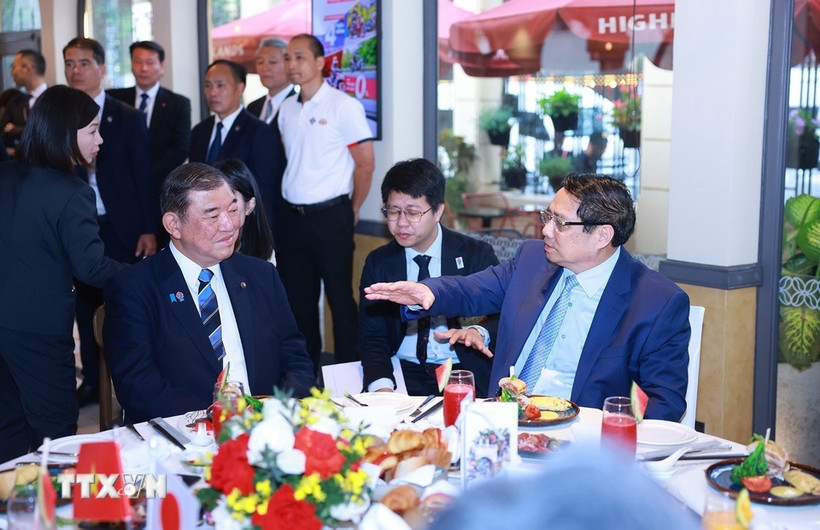
Prime Minister Pham Minh Chinh (right) and Japanese counterpart Ishiba Shigeru have breakfast and enjoy Vietnamese coffee together on April 29. (Photo: VNA)

Hanoi (VNA) – Prime Minister Ishiba Shigeru and his spouse, along with a high-ranking Japanese delegation, left Hanoi in the morning of April 29, concluding his three-day official visit to Vietnam at the invitation of Prime Minister Pham Minh Chinh and his spouse.

During his stay in Vietnam, Ishiba and his spouse laid a wreath at the President Ho Chi Minh Mausoleum and at the Monument of Heroes and Martyrs on Bac Son street, near the mausoleum.

Party General Secretary To Lam met with PM Ishiba, while President Luong Cuong and National Assembly Chairman Tran Thanh Man also held meetings with the Japanese leader.

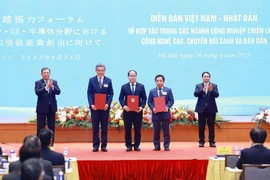
PM Chinh chaired the official welcome ceremony, bilateral talks, and a state banquet in honour of PM Ishiba. The two leaders witnessed the signing of several cooperation documents between ministries and agencies of both countries, held a joint press conference, and announced key outcomes of their discussions. They also delivered important speeches at the Vietnam–Japan Cooperation Forum on strategic industries, high technology, green transition, and semiconductors.

At meetings and events, Vietnamese leaders warmly welcomed the Japanese PM’s visit, which coincided with Vietnam’s 50th anniversary of the Liberation of the South and National Reunification. They emphasised the significance of the visit in opening a new chapter in the development of the Comprehensive Strategic Partnership between Vietnam and Japan, and congratulated Japan on the Osaka Kansai Expo 2025.
bao-tang-lich-su.jpg
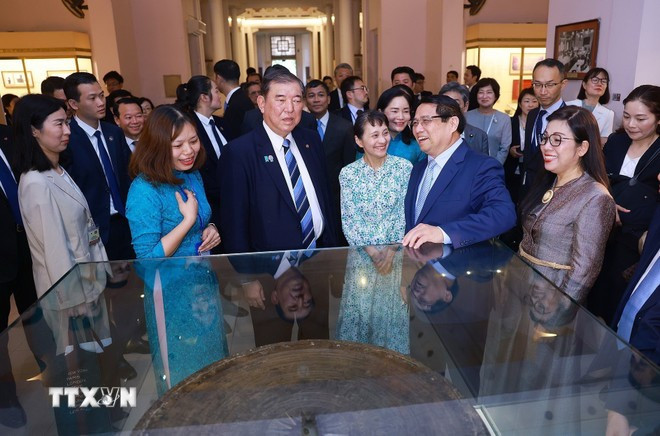
Prime Minister Pham Minh Chinh (second from right) and Japanese Prime Minister Ishiba Shigeru (C) and their spouses visit the Vietnam National Museum of History. (Photo: VNA)

Ishiba expressed his delight at returning to Vietnam after 35 years, and for the first time as Prime Minister, coinciding with the celebration of April 30 victory. He expressed admiration for President Ho Chi Minh and Vietnam’s struggle for national liberation. Ishiba thanked the Vietnamese Party, State, and people for their warm hospitality, affirming Japan’s commitment to standing alongside Vietnam in the new era, supporting Vietnam's economic growth, self-reliant development, and national industrialisation and modernisation.

Both sides expressed their satisfaction with the comprehensive development of the Vietnam–Japan Comprehensive Strategic Partnership nearly two years after it was elevated to a new level. They discussed and reached broad consensus on major directions and measures to further deepen ties based on the principles of "sincerity, affection, trust, substance, effectiveness, and mutual benefit" across five key pillars: political relations; economic cooperation and human resources connectivity; security and defense; science, technology, and green transformation; and collaboration at multilateral forums.
japanese-pm.jpg
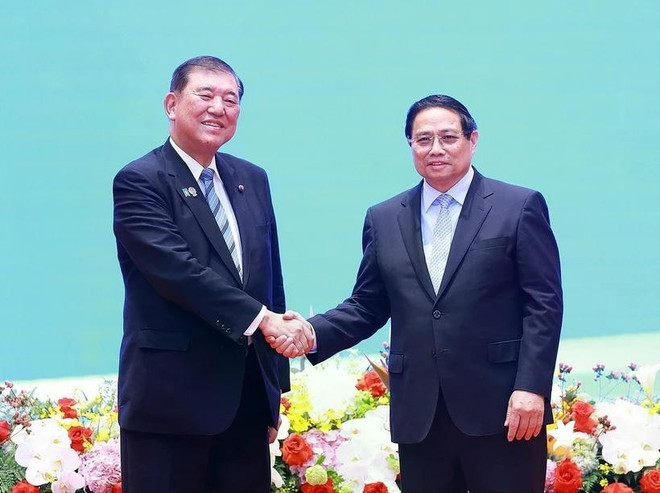
Prime Minister Pham Minh Chinh (right) and Japanese counterpart Ishiba Shigeru at the Vietnam-Japan Business Forum. (Photo: VNA)

Vietnam and Japan agreed to closely coordinate at regional and international forums such as the United Nations and ASEAN, particularly in light of the rapidly evolving global situation, contributing to peace, stability, cooperation, and development in the region and the world.

On this occasion, the two countries issued a Vietnam–Japan Joint Communique.

As part of the visit, PM Chinh and his spouse joined PM Ishiba and his spouse for breakfast, enjoying Vietnamese coffee and visiting the Vietnam National Museum of History.

PM Ishiba visited the Vietnam–Japan University under the Vietnam National University, Hanoi – a symbol of bilateral educational cooperation – as well as the Thang Long Industrial Park, where he toured Canon Vietnam’s factory and interacted with representatives of Japanese enterprises.

Madame Ngo Phuong Ly, spouse of Party General Secretary To Lam, and Madame Ishiba Yoshiko participated in a traditional Hanoi green rice cake-making activity. Madame Le Thi Bich Tran, spouse of PM Chinh, and Madame Ishiba Yoshiko visited the Vietnam National Village for Ethnic Culture and Tourism.

Madame Ishiba also toured the Vietnam Women's Museum and visited several educational institutions with ties to Japan in Hanoi.

PM Ishiba’s official visit to Vietnam concluded successfully, opening a new era of closer, more effective bilateral relations, serving the interests of both peoples, and contributing to regional and global cooperation and development./.
VNA

See more

Prime Minister Le Minh Hung (R) hosts the UK's Ambassador to Vietnam Iain Frew in Hanoi on May 20 (Photo: VNA)

Vietnam attaches great importance to ties with UK: PM

Prime Minister Le Minh Hung suggested that the two countries work together towards raising bilateral trade turnover to 10 billion USD in 2026 and eventually 15 billion USD through expanded market access for each other’s goods.

Prime Minister Le Minh Hung (right) and Ambassador of the Democratic People’s Republic of Korea (DPRK) to Vietnam Ri Sung Guk at their meeting on May 20 (Photo: VNA)

Prime Minister receives DPRK Ambassador

Prime Minister Le Minh Hung affirmed that the Party, State and people of Vietnam always attach importance to and wish to continuously nurture and promote the Vietnam–DPRK relationship in a more substantive and effective manner in the new development era, in line with the common aspirations of the two peoples and contributing to peace, stability, cooperation and development in the region and the world.

Prime Minister Le Minh Hung (right) and Cuban Ambassador to Vietnam Rogelio Polanco Fuentes at their meeting on May 20 (Photo: VNA)

PM vows to deepen Vietnam-Cuba special ties

At a reception for Cuban Ambassador to Vietnam Rogelio Polanco Fuentes in Hanoi on May 20, Prime Minister Le Minh Hung stressed that the Party, Government and people of Vietnam always remember and treasure the solidarity and wholehearted support that the Party, Government and people of Cuba have extended to Vietnam during its past struggle for national liberation as well as the current cause of national construction and development.

Prime Minister Le Minh Hung has a phone conversation with New Zealand’s Prime Minister Christopher Luxon on May 20 (Photo: VNA)

PM holds phone talks with New Zealand counterpart

Prime Minister Le Minh Hung proposed six major orientations for future collaboration, including further strengthening political trust through increased delegation exchanges, high-level contacts and bilateral cooperation mechanisms, and promoting more substantive defence and security cooperation through enhanced exchanges and stronger naval and maritime security capabilities.

National Assembly Chairman Tran Thanh Man addresses the working session on May 20 (Photo: VNA)

NA leader urged more substantive, professional deputy affairs work

National Assembly Chairman Tran Thanh Man asked the NA Committee for Deputy Affairs to shift strongly from procedural consultation to strategic consultation, moving beyond the mindset of merely “following procedures correctly” towards policy design, process standardisation, quality control and forecasting.

General Secretary of the Communist Party of Vietnam Central Committee and State President To Lam speaks at the working session in Hanoi with the Party Central Committee’s Commission for Policies and Strategies and relevant agencies on assessing national development resources. (Photo: VNA)

Top leader orders decisive action to unlock idle resources for growth

Public resources must lead and activate private resources, while public investment should stimulate broader social investment. FDI, meanwhile, should move from quantity-based attraction toward quality-based absorption linked with technology transfer and stronger domestic linkages, said top leader To Lam.

Prof. Dr. Nguyen Xuan Thang speaks at the event. (Photo: VNA)

Editorial team meets to begin review of 100-year Party leadership

Politburo member Prof. Dr. Nguyen Xuan Thang described the review as a major strategic political task, adding that the process must deliver historical depth, theoretical vision, and strategic foresight to guide Vietnam toward fast and sustainable development in the decades ahead.

NA Chairman Tran Thanh Man speaks at the working session with standing members of the NA's Committee for Economic and Financial Affairs in Hanoi on May 20. (Photo: VNA)

NA Chairman asks for enhanced policy advisory to support double-digit growth target

National Assembly (NA) Chairman Tran Thanh Man has demanded the NA's Committee for Economic and Financial Affairs to enhance its policy advisory capacity, stressing that robust and evidence-based policymaking is essential to achieving the country’s ambition of double-digit economic growth while safeguarding macroeconomic stability.

Prime Minister Le Minh Hung (R) and Ambassador Rick Switzer, Deputy US Trade Representative, in Hanoi on May 20, 2026. (Photo: VNA)

Prime Minister receives Deputy US Trade Representative

The Vietnamese Government will continue to work closely with the US side to soon finalise the agreement, thereby further deepening economic, trade, and investment cooperation as the main driving force for bilateral relations, said Prime Minister Le Minh Hung.

Minister of Foreign Affairs Le Hoai Trung (R) and Swedish State Secretary for Foreign Affairs Dag Hartelius in Hanoi on May 19, 2026. (Photo: VNA)

Vietnam sees Sweden one of leading European partners in innovation, green development

Discussing regional and international issues of mutual concern, both sides affirmed their support for multilateralism and free trade, as well as the peaceful settlement of disputes and conflicts in line with international law and the UN Charter. They also stressed the importance of maintaining peace, stability, security, safety, and freedom of navigation and overflight in accordance with international law, particularly the 1982 United Nations Convention on the Law of the Sea (UNCLOS).