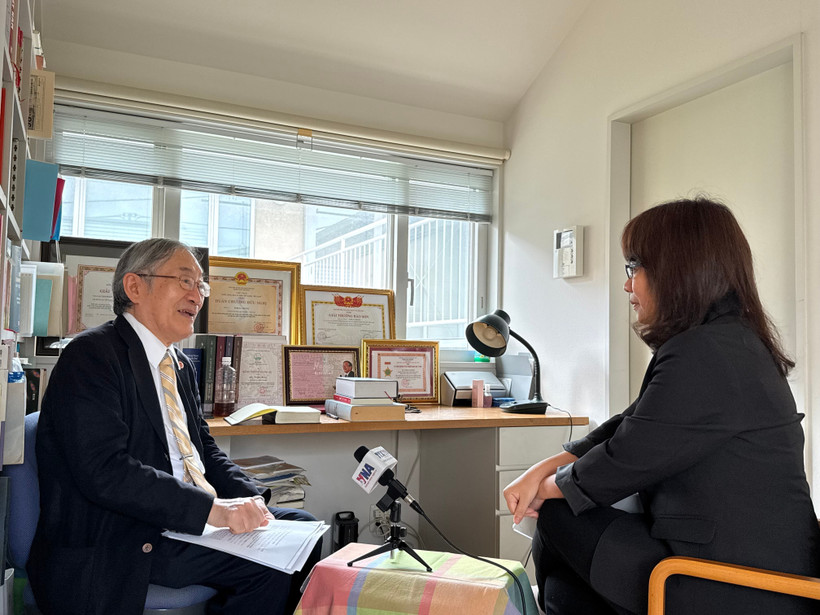
Tokyo (VNA) – The 14th National Congress of the Communist Party of Vietnam (CPV) is expected to mark a new stage of development for Vietnam in a new era, with national reconciliation and unity serving as the decisive factors for the country to move further forward, said Professor Furuta Motoo, Rector of the Vietnam–Japan University.
Speaking to Vietnam News Agency (VNA) correspondents in Japan, Furuta noted that world history over recent decades shows it is relatively easy to stir up ethnic tensions or conflicts, yet extremely difficult to build and sustain unity among peoples. Against this backdrop, he said he has devoted considerable research to the CPV’s ethnic policies, with the aim of gaining deeper insight into the valuable experience of the CPV in fostering solidarity among ethnic groups in Indochina in general, and in Vietnam in particular.
Assessing the current political role and standing of the CPV, the professor said the Party is not only the ruling force but also the political nucleus of Vietnam’s political system, playing a decisive role in the country’s renewal and development.
He emphasised that a defining characteristic of the CPV is its sensitivity to the aspirations, will and sentiments of the people, encapsulated in the principle of “taking the people as the root.” As long as this tradition is upheld, the CPV will continue to play an essential role in Vietnam’s political life, he said.
With the 14th National Congress approaching, Furuta expressed his expectation that it will serve as an important milestone, opening up a new phase of development for Vietnam. He highly appreciated orientations that stress national reconciliation and unity, describing them as key factors enabling Vietnam to advance further in its next stage of development. According to him, while the 20th century saw Vietnam make its historical mark through victories in struggles for national independence and reunification, the challenge in the 21st century lies in healing the lingering consequences of war, strengthening social consensus and unity, and thereby consolidating Vietnam’s position on the international stage.
Regarding future development directions, Furuta said the 14th National Congress is expected to chart a clear roadmap for Vietnam to achieve a modern industrial base and upper-middle-income status by 2030, and become a developed, high-income nation by 2045. In foreign affairs, he expressed hope that the CPV will take concrete steps to enhance Vietnam’s soft power by leveraging culture, education and technology to raise the country’s international standing in an era of knowledge-based competition.
Political stability enables Vietnam to maintain a peaceful environment conducive to investment and international cooperation. Vietnam’s foreign policy of independence, self-reliance and multilateralism enables the country to balance relations with major powers and boost its international credibility, Furuta said
Sustaining political stability is also a prerequisite for implementing long-term strategies such as digital transformation, green development and deeper international integration, he said.
Amid intensifying strategic competition among major countries, the CPV’s firm leadership helps Vietnam maintain strategic autonomy and play an active role in regional affairs, the professor noted./.