Khmer brocade weaving helps drive heritage-based economic development

Nestled at the foot of the majestic That Son mountain range, Van Giao - the brocade weaving village of Khmer people in An Cu commune, An Giang province - is not only a repository of centuries-old cultural heritage but is also emerging as a model for heritage-based economic development.

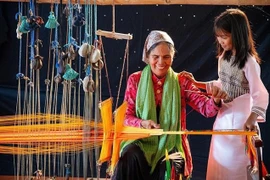
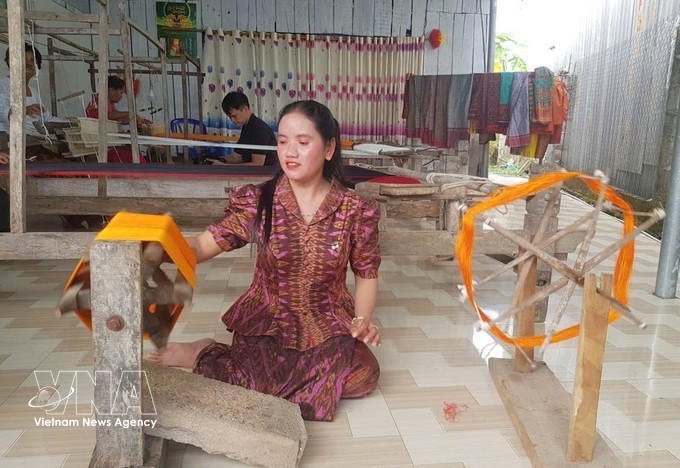
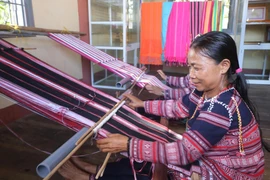
Brocade weaving is a cultural lifeblood for the Khmer community in the Bay Nui (seven-mountain) area of An Giang. (Photo: VNA)

An Giang (VNA) – Nestled at the foot of the majestic That Son mountain range, Van Giao - the brocade weaving village of Khmer people in An Cu commune, An Giang province - is not only a repository of centuries-old cultural heritage but is also emerging as a model for heritage-based economic development.

Preserving the traditional craft is no longer merely an act of nostalgia, it has become a strategy for community-based tourism and sustainable livelihoods in the southwestern border region.

National soul woven into every loom

Brocade weaving has long been a cultural lifeblood for the Khmer community in the Bay Nui (seven-mountain) area of An Giang. Through the skillful hands of women in the Van Giao, naturally dyed threads are transformed into textiles that embody the community’s worldview and spiritual beliefs.

From traditional handicrafts, the village has gradually innovated and developed the collective brand “Silk Khmer.” Notably, its “sarong” products have been certified as three-star OCOP items and recognised as typical rural industrial products in the southern region in 2023, opening up opportunities to access international markets.
vnanet-2-an-giang2-0402.jpg
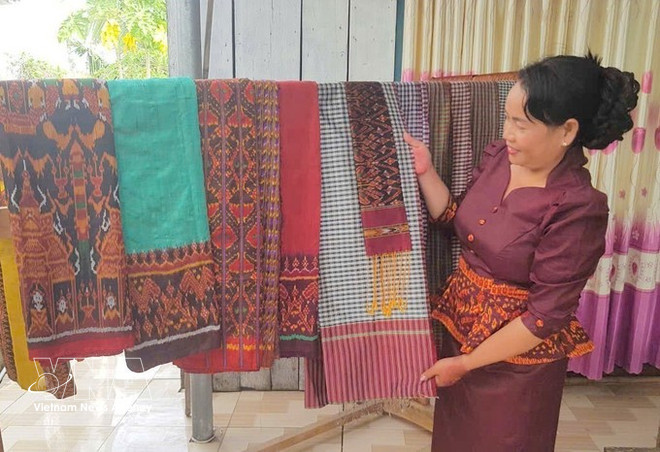
Neang Chanh Ty, head of the Van Giao Khmer brocade weaving cooperative (Photo: VNA)

Neang Chanh Ty, head of the Van Giao Khmer brocade weaving cooperative, said her family has practised the craft for three generations. For local Khmer people, brocade weaving is not just a livelihood, but a centuries-old cultural symbol passed down through generations. In the past, nearly every household had a loom, with women weaving fabric to make clothes, scarves and sarongs for their families. However, over time, the influx of cheap industrial products has sharply reduced demand for traditional brocade.

Facing the risk of decline, Khmer brocade weaving in An Cu commune was gradually revived in 1998 with support from Australia’s CARE organisation and the provincial Women’s Union. In 2002, Van Giao Khmer brocade weaving cooperative was officially established, helping its products gain strong domestic and international market acceptance thanks to diverse designs, refined colours and intricate patterns. The cooperative now comprises 36 households with 63 members, including two artisans and two skilled craftsmen, mainly based in Sray Skoth and Mang Ro hamlets.

Notably, in 2006, Van Giao Brocade Silk was granted collective trademark protection by the Intellectual Property Office of Vietnam under the Ministry of Science and Technology. A year later, in 2007, the Van Giao brocade weaving craft was officially recognised by the provincial People’s Committee as a traditional industrial handicraft.

Neang Soc Kun, a resident of Sray Skoth hamlet, said that since the revival of brocade weaving, local women have gained a stable source of income during the agricultural off-season. On average, each weaver earns about 3–5 million VND (115.6 USD – 192.7 USD) per month, depending on skill level, design complexity, and output.

Products from the village are now available in many foreign markets, including Japan, the Republic of Korea, Australia, and neighbouring Southeast Asian countries, underscoring the strong vitality of the national heritage in the context of international integration.

Unlocking tourism potential of craft village

Nguyen Duy Phong, Chairman of the People’s Committee of An Cu commune, said Van Giao is both a custodian of cultural heritage and a growing engine of the local economy, with craft preservation helping protect national identity while creating sustainable livelihoods for residents.

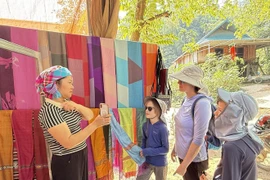
By providing hands-on experiences, the village has become a magnet for visitors, driving demand for the finely crafted and one-of-a-kind handicrafts of the Khmer brocade weaving community.

To boost its profile, travel agencies have added the village to An Giang’s tourism routes. By connecting famous spots like Ba Chua Xu Temple on Sam Mountain, Tra Su cajuput forest, and Cam Mountain tourist site with the craft village, they’ve created a vibrant and varied travel experience. Visitors can go beyond sightseeing to try brocade weaving, wear traditional ethnic clothing, learn about local customs, and buy brocade items as keepsakes. Phong shared that the communal authority plans to set up raw material areas, offer financial aid, provide vocational training, and ramp up promotion to make the village a standout tourism highlight of An Giang.

The locality will proactively coordinate with provincial departments and agencies to strengthen connectivity and promotion, expand markets for brocade products under the “Silk Khmer” brand of the village among domestic and international consumers and tourists, and develop sustainable tourism tours and routes linked to the craft village, he added./.
VNA

See more

Delegates and students pose for a commemorative photo. (Photo: baocantho.com.vn)

Four more Can Tho schools earn French education accreditation

The recognition of six schools under the Label FrancEducation programme is expected to create momentum for expanding education cooperation between French and Can Tho institutions, contributing to human resources development and friendship between the two countries.

A seminar at the programme (Photo: VNA)

Event promotes inclusion, empowerment for youth with disabilities

A key feature of the programme will be the dialogue “The Inspirers – Family Support on the Journey of Resilience”, where exemplary families and inspirational figures will share stories of overcoming adversity and spread messages of compassion, understanding and community responsibility in building an inclusive and humane society.

UN Resident Coordinator in Vietnam Pauline Tamesis (Photo: VNA)

South–South cooperation promotes rights, justice for women and girls

UN Resident Coordinator in Vietnam Pauline Tamesis commended Vietnam’s sustained commitment to gender equality, noting advances in budgeting, land use, social insurance and domestic violence prevention under the recent review of the Convention on the Elimination of All Forms of Discrimination against Women (CEDAW).

Party General Secretary To Lam presents Nhan Dan newspaper with the first-class Labour Order on March 11. (Photo: VNA)

Nhan Dan newspaper must act as ideological vanguard, shield, information sensor: Party chief

In a keynote address at a ceremony in Hanoi marking the 75th anniversary of the newspaper’s first issue on March 11, General Secretary Lam highlighted its more than seven decades of evolution while maintaining its role as the Party’s sharp ideological weapon, an effective information and communication channel for Party committees and authorities at all levels, and a trusted platform for Party members and people.

A poster celebrating the Election Day (Photo: VNA)

Final preparations underway for Election Day

In Hanoi, local authorities have increased the dissemination of election-related information through community loudspeaker systems, information boards, official websites and verified social media pages, helping officials, Party members and residents better understand their rights and responsibilities as voters.

NA Chairman Tran Thanh Man inspects a constituency in Dong Nai province. (Photo: VNA)

Dong Nai works to ensure workers cast vote on Election Day

With the utmost regard for citizens’ electoral rights and responsibilities, and in a spirit of creating optimal conditions for workers, especially those employed in industrial parks and non-state enterprises, the provincial leader has requested that no overtime be scheduled during voting hours.

Zambia's Minister of Agriculture Reuben Mtolo Phiri (first, left), learns about the OM19 rice variety grown at Tien Thuan cooperative in Thanh Quoi commune,, Can Tho city (Photo: VNA)

Can Tho shares agricultural transformation experience with Zambia

Rice production remains Can Tho’s key industry. Alongside maintaining production, Can Tho has encouraged value chain linkages among farmers, cooperatives and businesses, while accelerating the application of science and technology, mechanisation and digital transformation in farming.

Staff members of the Hanoi Public Administrative Service Centre handle administrative procedures for local residents. (Photo: VNA)

Hanoi: 95% of administrative procedures to be handled from home

The plan targets that at least 80% of administrative procedures under the city’s authority will be provided as fully online public services, while more than 95% of applications will be received and processed entirely online. By June 30, 2026, about 80% of administrative procedures are expected to be restructured based on integrated data systems, with the figure rising to 95% by the end of the year.

Delegates at the SEAN Future Forum NextGen Workshop 2026 held in Jakarta, Indonesia on March 9 (Photo: VNA)

Vietnam contributes youth perspectives to AFF NextGen initiative

The ambassador expressed confidence that fresh perspectives, innovative thinking and lessons drawn from the workshop will be proposed to AFF 2026, representing the voice of the younger generation in shaping ASEAN’s future in line with their aspirations.