Lai Chau leverages cultural heritage for sustainable tourism growth
The province is transforming its natural and cultural assets into key drivers of economic growth, aiming to make tourism a major pillar of its economy in the coming years.
Lai Chau province combines strategic location, rich natural resources, diverse cultural heritage and strong development ambitions. With improved planning, infrastructure and a more investor-friendly environment, the northern mountainous province is opening new opportunities for sustainable growth.
The province is transforming its natural and cultural assets into key drivers of economic growth, aiming to make tourism a major pillar of its economy in the coming years.
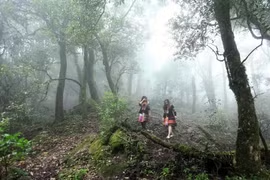
Lai Chau, Vietnam’s westernmost province, captivates visitors with its rich cultural heritage and spectacular mountain landscapes. Wrapped in clouds for much of the year and blessed with a climate that can deliver four seasons in a single day, its towering peaks have become both a challenge for adventurers and a symbol of the province’s wild natural beauty.
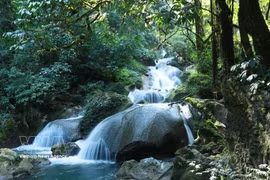
Situated at an altitude of 1,600-1,800m above sea level, Nam Luc Waterfall in Sin Ho commune, Lai Chau province, captivates visitors with its majestic beauty and strong potential for eco-tourism development.
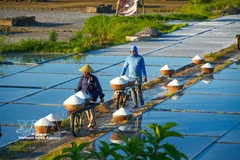
Under the scorching sun, salt farmers at Chau Ha salt field in Mai Phu commune, Ha Tinh province, work from early morning until late afternoon to produce pure white salt. But behind this generations-old trade are concerns over unstable incomes, weak demand and the risk of the craft fading as younger people seek other livelihoods.
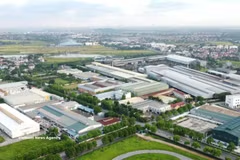
Foreign direct investment (FDI) is entering a new phase as green production, high technology and sustainable development increasingly shape global investment trends, creating opportunities for Vietnam to attract higher-quality projects and new growth drivers.
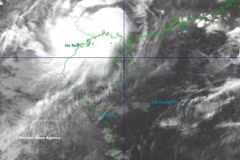
Storm Narra, the fourth to hit the East Sea this year, brought strong winds and heavy rains to northern Vietnam on early August 22, with some areas forecast to receive more than 500mm of rain as the storm moves slowly over the northern waters of the East Sea.
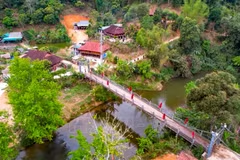
Not only known for its historical significance, Dien Bien also boasts unspoilt natural landscapes and a cool climate, creating favourable conditions for ecotourism. A range of green tourism models are taking shape, diversifying tourism products and enhancing the destination’s appeal.
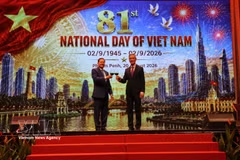
Overseas Vietnamese in Cambodia and Malaysia on August 20 celebrated the 81st anniversary of Vietnam’s National Day (September 2).
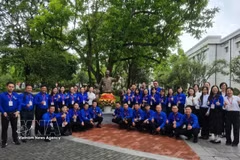
As part of the “Red Study Journey” programme for Vietnamese youth in China, a youth exchange was recently held in Nanning, Guangxi Zhuang Autonomous Region.
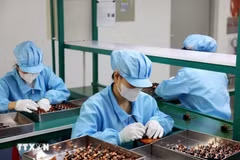
Developing the semiconductor industry is a long-term endeavour that requires consistent policies, sustained investment and strong cooperation at both domestic and international levels. With their respective strengths, Vietnam and Singapore can complement each other in building an integrated semiconductor ecosystem and a highly competitive value chain in the region.

In the digital age, cyberspace offers tremendous convenience. With just an Internet-connected device, people can communicate, study, do business and access information quickly, regardless of geographical boundaries.
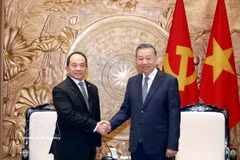
General Secretary of the Communist Party of Vietnam Central Committee and President To Lam on August 20 received Philippine National Security Adviser Eduardo S.L. Oban Jr., who is paying a working visit to Vietnam.
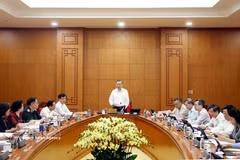
General Secretary of the Communist Party of Vietnam Central Committee and President To Lam emphasised the need for a leadership approach that links every task with clear targets, deliverables and accountability.
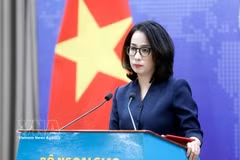
Vietnam remains resolute in preventing origin fraud and illegal transshipment of goods, while welcoming China’s efforts to facilitate travel for Vietnamese citizens, spokesperson of the Ministry of Foreign Affairs Pham Thu Hang said on August 20.
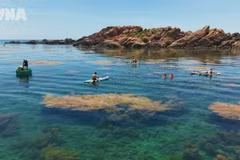
During the travel season, Nhon Hai fishing village in Quy Nhon Dong ward, Gia Lai province, has become an attractive spot for coral diving, basket-boat trips and excursions to Hon Kho. Community-based tourism has created new livelihoods, but rising visitor numbers are also putting pressure on the marine ecosystem, requiring a balance between economic development and conservation of natural resources.
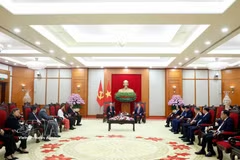
Vietnam always treasures Mexico’s role and position in Latin America, and considers the Mexican Labour Party a traditional and trusted partner of the Communist Party of Vietnam, said Party General Secretary and President To Lam.
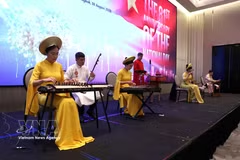
The Vietnamese Embassy in Thailand hosted a reception in Bangkok on August 18 to celebrate the 81st anniversary of the August Revolution and National Day (September 2), as well as the 50th anniversary of Vietnam-Thailand diplomatic relations.
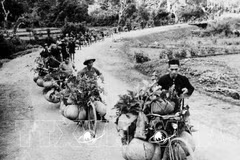
Not modern military hardware, but rudimentary weapons and even familiar farming tools used by ordinary people were present during the August General Uprising of 1945. More than 80 years later, these artefacts are preserved at the Vietnam Military History Museum, quietly telling their stories to younger generations.
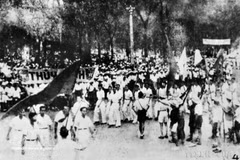
The 1945 August Revolution marked a historic turning point in Vietnam’s struggle for national independence, demonstrating the power of unity, self-reliance and strategic vision. Eighty-one years on, these enduring values continue to provide inspiration and momentum for Vietnam’s development in the new era.
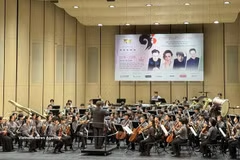
More than 100 young musicians from across Asia have gathered in Hanoi for two concerts by the Asian Youth Orchestra (AYO). Beyond presenting classical masterpieces, the performances at the Ho Guom Opera House highlight the power of music to connect people, bringing together young talents from different languages, cultures and musical backgrounds to find a common voice.
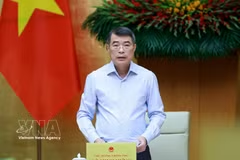
Prime Minister Le Minh Hung chaired the Government's August law-building session on August 18 to discuss 12 draft laws and resolutions scheduled for consideration and approval at the second session of the 16th National Assembly.
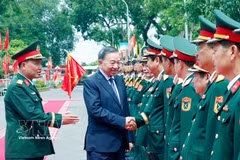
Party General Secretary and President To Lam, who is also Secretary of the Central Military Commission, paid a working visit to Infantry Division 308 of Army Corps 12 under the Ministry of National Defence in Hanoi on August 18.
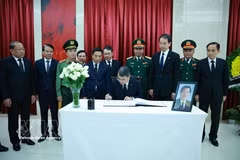
Prime Minister Le Minh Hung led a delegation representing the Party, State and Vietnam Fatherland Front to the Chinese Embassy in Vietnam on August 18 to pay respects to former Chinese Premier Zhu Rongji.