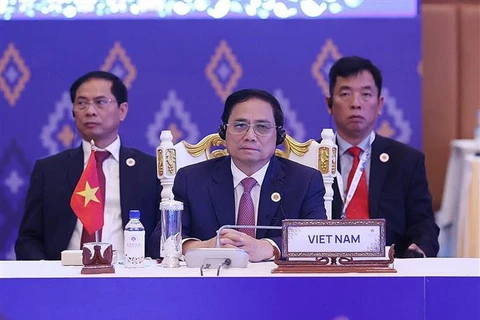
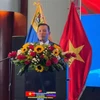
Lao Ambassador to Vietnam Sengphet Houngboungnuang (Photo: VNA)
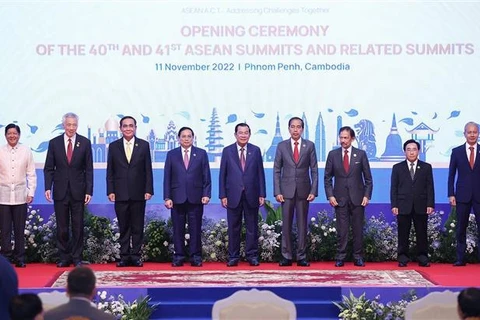
 In an interview granted to the Vietnam News Agency (VNA) on the occasion of the 40th and 41st ASEAN Summits and Related Summits which are taking place in Cambodia from November 10-13, the Lao diplomat highlighted the improvement in living standards and the narrowed development gap in the ten-member grouping.
Vietnam and Laos have supported each other in socio-economic development and investment promotion in respective countries, contributing to developing the bloc in a sustainable and stable manner, according to the ambassador.
The two countries have also played a proactive role in the drafting of many important documents in ASEAN, and especially in the building of the ASEAN Community with the three pillars of the Political-Security Community, the Economic Community and the Socio-Cultural Community.
Over the past time, apart from cooperation within the framework of ASEAN, the two countries have coordinated and cooperated closely in the ASEAN Sub-region, and participated in Mekong cooperation frameworks such as the Greater Mekong Sub-region and the Ayeyawady-Chao Phraya-Mekong Economic Cooperation Strategy (ACMECS), the ambassador said.
He noted that those important mechanisms have contributed to reducing poverty, raising people’s living standards, spurring economic growth, and promoting trade and investment ties as well as people-to-people exchanges between countries in the ASEAN region and the world at large.
The diplomat pointed out that over the past years and even in 2022, ASEAN member countries and other nations worldwide have faced a host of new security challenges like economic and financial crises, natural disasters, climate change, food shortage and the COVID-19 outbreak.
Against the backdrop, the ASEAN nations and their development partners have cooperated harmoniously and closely to cope with the challenges, supported each other in economic recovery, and worked together to further materialise the 2025 ASEAN Community Vision.
Despite the widespread outbreak of the COVID-19 pandemic, ASEAN has remained an important region with continuous, stable economic development, the diplomat continued, adding that the bloc attracted 174 billion USD in foreign direct investment (FDI) in 2021, up 42% year-on-year.
Many economic sectors in the region have posted marked recovery and development, particularly science-technology, digital economy and micro, small and medium-sized enterprises.
The tourism industry has recovered and been growing even stronger as the ASEAN member countries have adopted sound policies, he said, noting that visa exemption for citizens from the ASEAN member countries when travelling within the grouping is an important factor to restore the regional tourism sector.
To accelerate the implementation of ASEAN 2022’s theme – “ASEAN A.C.T: Addressing Challenges Together,” in the spirit of solidarity for sustainable development, the ambassador stressed the need to follow the bloc’s principles of consultation and consensus, or the ASEAN Way, with the involvement of all member countries.
The principles are the fundamental, which have been put into place since the foundation of the grouping, he stressed.
Sengphet Houngboungnuang also suggested ASEAN persistently maintain its centrality and the principles regarding cooperation with other countries as set in the ASEAN Charter, including those on expansion, inclusiveness and non-discrimination in cooperation with outside partners.
ASEAN should carry forward its important role by utilising its mechanisms to promote mutual trust and understanding, for the mission of peace, stability and cooperation, for development in the region and the world, he said./.
The diplomat pointed out that over the past years and even in 2022, ASEAN member countries and other nations worldwide have faced a host of new security challenges like economic and financial crises, natural disasters, climate change, food shortage and the COVID-19 outbreak.
Against the backdrop, the ASEAN nations and their development partners have cooperated harmoniously and closely to cope with the challenges, supported each other in economic recovery, and worked together to further materialise the 2025 ASEAN Community Vision.
Despite the widespread outbreak of the COVID-19 pandemic, ASEAN has remained an important region with continuous, stable economic development, the diplomat continued, adding that the bloc attracted 174 billion USD in foreign direct investment (FDI) in 2021, up 42% year-on-year.
Many economic sectors in the region have posted marked recovery and development, particularly science-technology, digital economy and micro, small and medium-sized enterprises.
The tourism industry has recovered and been growing even stronger as the ASEAN member countries have adopted sound policies, he said, noting that visa exemption for citizens from the ASEAN member countries when travelling within the grouping is an important factor to restore the regional tourism sector.
To accelerate the implementation of ASEAN 2022’s theme – “ASEAN A.C.T: Addressing Challenges Together,” in the spirit of solidarity for sustainable development, the ambassador stressed the need to follow the bloc’s principles of consultation and consensus, or the ASEAN Way, with the involvement of all member countries.
The principles are the fundamental, which have been put into place since the foundation of the grouping, he stressed.
Sengphet Houngboungnuang also suggested ASEAN persistently maintain its centrality and the principles regarding cooperation with other countries as set in the ASEAN Charter, including those on expansion, inclusiveness and non-discrimination in cooperation with outside partners.
ASEAN should carry forward its important role by utilising its mechanisms to promote mutual trust and understanding, for the mission of peace, stability and cooperation, for development in the region and the world, he said./.
VNA