Hanoi (VNA) – Vietnam stands at a promising juncture to pursue two-digit economic growth in the 2026–2030 period, provided that it accelerates structural reforms and renews its growth model, economists have said.
The restructuring of the economy, particularly public investment, along with the financial and banking systems, has been identified as a critical solution to achieving double-digit growth in the next development phase.
For 2025, Vietnam has set a GDP growth target of over 8%. Based on socio-economic performance in the first 11 months of the year, experts held that this goal is well within reach.
Economic expert Dr. Nguyen Minh Phong noted that an 8% growth rate in 2025 is entirely feasible. The possibility of achieving even higher growth of 8.3–8.5% will depend largely on performance in the final month of the year, but there are grounds for optimism. Traditionally, year-end months see faster disbursement of public investment, alongside surges in exports and consumption. The Government has also directed ministries and localities to ensure full disbursement of public investment capital in 2025, while the peak consumption season at the year-end provides an additional boost to growth.
According to a government report on the socio-economic development situation in 2025 and the 2021–2025 period, presented to the 15th National Assembly at its 10th session, Vietnam’s economy has demonstrated strong resilience to external shocks, maintaining growth among the highest in the world. GDP in 2025 is projected to grow by over 8% year-on-year, while average growth during 2021–2025 is estimated at 6.3%, exceeding the figure of 6.2% in the previous five-year period.
These results are particularly noteworthy given that in 2021 Vietnam’s economy was severely impacted by the COVID-19 pandemic, with GDP growth reaching only 2.55%. In contrast, the four-year period from 2022 to 2025 recorded average annual growth of 7.2%, surpassing the target range of 6.5–7%.
Alongside robust growth, the size of Vietnam’s economy has expanded significantly, from 346 billion USD in 2020 to an estimated 510 billion USD in 2025, lifting the country five places to 32nd globally. GDP per capita in 2025 is expected to reach around 5,000 USD or 1.4 times higher than in 2020, placing Vietnam firmly in the upper-middle-income group.
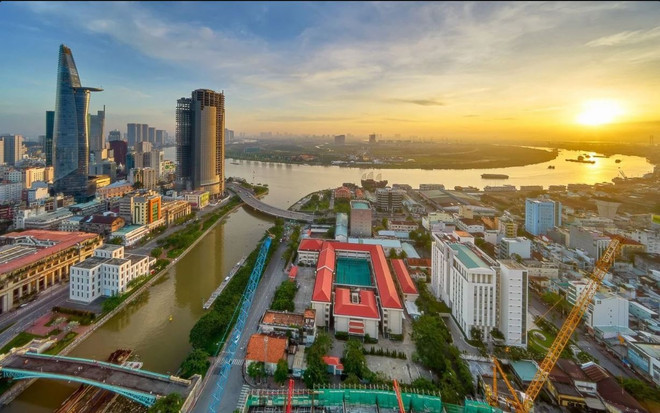
Economists viewed these achievements as an important foundation for Vietnam to set its sights on double-digit growth in 2026–2030, with the goal of becoming an upper-middle-income country by 2030 and joining the ranks of high-income economies by 2045.
Opportunities are opening wide, but challenges remain. Vietnam has continued to face headwinds from geopolitical tensions, rising trade protectionism, limited capacity of domestic firms in global value chains, as well as climate change, environmental pollution and increasingly extreme weather events.
To overcome these challenges, experts stressed the need to reshape development mindset and establish a new growth model. This means creating new growth drivers based on science and technology, innovation, digital transformation and green transition, while revitalising traditional drivers through more decisive and effective implementation.
Dr. Vo Tri Thanh, Director of the Institute for Brand and Competitiveness Strategy, said international experiences show that successful growth model transitions require a shift toward sustainable and inclusive development - from “brown” to “green,” from a purely real economy to one closely integrated with the digital economy - ensuring that the benefits are widely shared.
Meanwhile, Nguyen Quoc Anh, Deputy Director of the Institute of Strategy and Policy on Economic and Financial Affairs under the Ministry of Finance, emphasised the need to shift from extensive to intensive growth, with total factor productivity (TFP) as a core benchmark. Enhancing labour productivity through technology adoption, high-quality human resource training and modern governance will be decisive.
He also highlighted the importance of deep economic restructuring, removing long-standing bottlenecks in institutions, infrastructure and human capital. Digital, green and circular economy are seen as the key to deeper integration and global competitiveness, while the private sector must play a pioneering role in driving innovation-led, sustainable growth./.