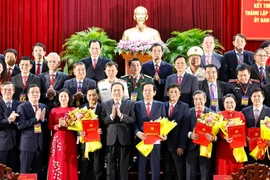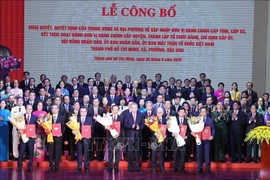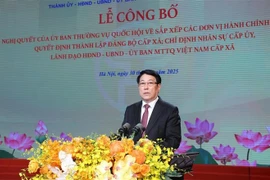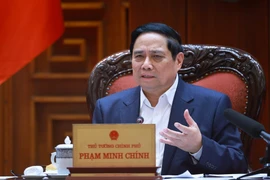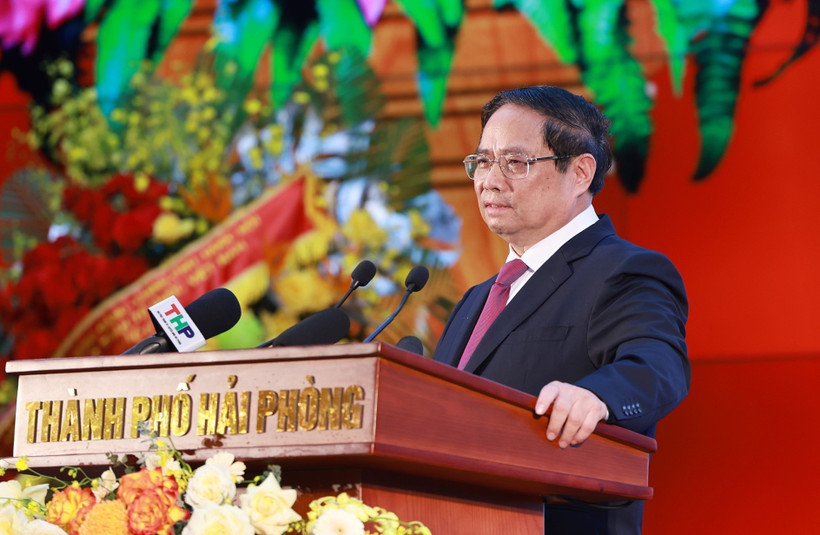
Hai Phong (VNA) - Prime Minister Pham Minh Chinh on June 30 attended a ceremony to launch the two-tier administration model of new Hai Phong city, which is formed by merging Hai Phong city and Hai Duong province - a move that he described as a significant millstone marking the start of a new but challenging development journey.
At the ceremony, resolutions and decisions on the organisation and personnel appointments of new Hai Phong city were announced, along with decisions on the establishment of the municipal Party Committee, and the mergence of commune-level administrative units.
Prior to the reorganisation of administrative units, Hai Phong city consisted of 15 district-level and 167 commune-level units, while Hai Duong province had 12 district-level and 207 commune-level units.
Under the new structure, Hai Phong and Hai Duong are merged to form an expanded Hai Phong city, eliminating the district level entirely. The newly merged city now has 114 commune-level administrative units and encompasses over 3,194 sq.km with a population of more than 4.66 million.
The new city's Party Committee is led by Le Tien Chau, member of the Party Central Committee, who had served as Secretary of the Party Committee of the old Hai Phong. Le Van Hieu, Permanent Deputy Secretary of the Hai Duong Party Committee and Chairman of the Hai Duong provincial People’s Council will serve as Chairman of the municipal People’s Council. Meanwhile, the municipal People’s Committee will be headed by Le Ngoc Chau, who used to be Chairman of the People’s Committee of Hai Duong.
Highlighting that the launching of the two-tier local administration model is a significant event and a festival of the nation, PM Chinh said that the mergence of Hai Duong and Hai Phong is a strategic move of historical importance, ushering in a new chapter of development for both the city and the broader Red River Delta, contributing to the country’s long-term prosperity.
The PM said that the decision to streamline administrative units by merging provinces and cities, eliminating district-level administrations, and consolidating commune-level units aims to build a leaner, more effective, and people-centred administrative apparatus that enhances efficiency, improves civil service quality, and is better aligned with the requirements of modern development and international integration.
The mergence creates a more expansive development space and optimises the use of land and population resources. By combining the distinct strengths of Hai Phong and Hai Duong, the new administrative unit can fully capitalise on its competitive advantages, he stated.
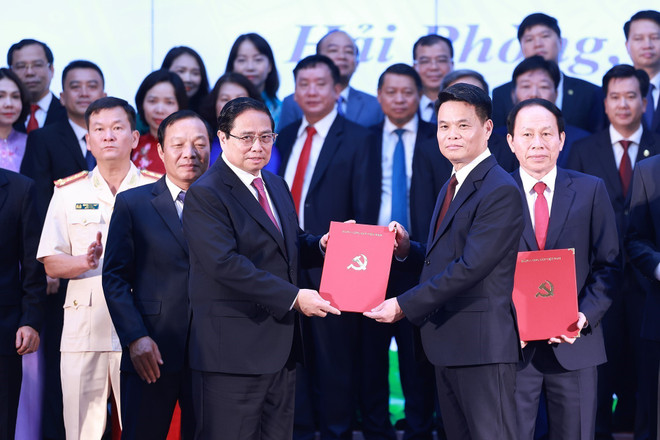
Prime Minister Pham Minh Chinh presents the Politburo's decision to appoint the new Deputy Secretary of the Hai Phong city Party Committee for the 2020-2025 tenure to Le Ngoc Chau. (Photo: VNA)
Hai Phong, he remarked, is a city steeped in heroic history, including its three legendary victories on the Bach Dang River. It has played a vital role in national defence, industrialisation, and economic modernisation, serving as a key hub for industry, trade, and logistics.
Hai Duong, historically known as the "Eastern land of scholars," has been a bastion of cultural and intellectual heritage, and is now emerging as an important centre for both industry and agriculture.
The formation of new Hai Phong city, the Government leader stressed, reflects long-term strategic mindset. It creates a new economic growth pole capable of leading regional development and contributing to the nation's future. The goal is to develop a major, modern, smart, and multifunctional urban area driving progress in industry, logistics, seaports, commerce, services, culture, education, science, and technology.
PM Chinh praised both Hai Phong and Hai Duong for their proactive, creative, and disciplined approach to implementing the Party, National Assembly, and Government’s directions. He highlighted the professionalism and scientific organisation displayed in the establishment of new Party and administration structures, the streamlining of administrative bodies, and the appointment of new leaders across levels.
He also noted that, despite the administrative transition, both localities had still focused on achieving socio-economic development goals. Economic growth in the first six months of the year in both Hai Phong and Hai Duong exceeded 11%, making a significant contribution to the country’s overall performance. The PM requested Party committees, administrations, the Vietnam Fatherland Front, mass organisations at all levels and the entire political system, along with the local military forces and people, to immediately get to work, and quickly consolidate and stabilise the organisational apparatus; and arrange a contingent of officials with sufficient integrity, capacity, and credibility, and worthy of their new roles and responsibilities.
He also emphasised the continued proper implementation of policies and benefits for public employees, civil servants, and armed forces personnel affected by the administrative unit reorganisation.
Essential conditions must be ensured so that agencies and units operate effectively, smoothly, and without disruption in state management and public service delivery to citizens and businesses, he said, stressing the need to accelerate digital transformation, simplify administrative procedures, provide high-level online public services, remove administrative boundary barriers in processing procedures, and guarantee the provision of healthcare, education, and training services.
In particular, PM Chinh urged Hai Phong city to give the highest priority to socio-economic development and ensuring national defence and security.
The city must review, supplement, and perfect the building of development strategies and planning schemes with a new vision. The main orientations include building a socialist model that is fast-growing, sustainable, modern, prosperous, civilised, happy, and rich in cultural identity; developing a multi-sector, modern, and globally competitive economic pillars and a model of high-tech industry, innovation, internationally oriented logistics services, and strategic, modern, and smart infrastructure that drives inter-regional connectivity and affirms its position as a national gateway for maritime and air transport; and developing high-quality human resources.
The Government leader expressed his confidence that building on the solid foundations laid by Hai Phong city and Hai Duong province over the years, the Party committees, authorities, Vietnam Fatherland Front committees, socio-political organisations, and the people of the newly formed Hai Phong city will continue to strongly uphold their revolutionary tradition, the spirit of bravery, determination to win, creativity, and aspiration to rise in building a model urban area characterised by green, smart, modern, and sustainable development.
He required the city to serve as an exemplar and leader in contributing to the cause of building and defending the Fatherland in the new era.
After the announcement ceremony, PM Chinh visited and inspected the operations of the local administration apparatus, particularly the handling of administrative procedures for citizens and businesses, in Hong An ward. He commended Hai Phong city in general and the ward in particular for their proactive and swift implementation of tasks to ensure that all agencies and units operate smoothly and without interruption, especially in providing public services to the people and enterprises.
He requested continued efforts to ensure that agencies and units operate effectively and efficiently, with a particular emphasis on accelerating digital transformation, providing high-level online public services, and eliminating administrative boundary barriers in the processing of administrative procedures./.