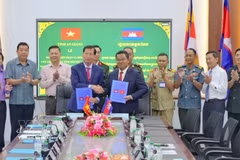
Hanoi (VNA) – A legal assistance project launched in November 2022 has delivered measurable results in Vietnam’s disadvantaged mountainous provinces, particularly Dien Bien and Lao Cai, officials told a conference co-hosted by the Ministry of Justice (MoJ), the World Bank (WB) and the Japanese Embassy in Hanoi on July 16.
Deputy Minister of Justice Nguyen Thanh Ngoc, in his speech, called this one of the ministry’s key projects to raise public legal awareness.
So far, 148 of the project’s 156 planned activity groups, or nearly 95%, are wrapped up. The rest are on track to finish by the end of July, with a four-month grace period to button up closing procedures.
Ngoc said the project backed research, surveys, international experience-sharing workshops and capacity-building training to sharpen institutional performance. It also funded qualified entities to deliver legal communications, consultations and direct assistance, with a focus on vulnerable groups under priorities jointly approved by the MoJ and WB.
Ensuring equal access to justice for all, especially ethnic minorities, the poor and vulnerable groups in the northern mountainous region, has always been a core and long-term priority, Ngoc said.
To build on the gains, he urged localities, particularly Dien Bien and Lao Cai, to pool resources so successful models and quick-response coordination outlive the project.
Dang Dinh Chung, Director of the Lao Cai provincial Department of Justice, said the number of residents receiving legal assistance rose steadily from 603 in 2023 to 680 in 2024 and 1,031 in 2025. In the first six months of 2026 alone, another 898 secured support.
According to him, service quality improved markedly. The success rate of legal support cases is estimated to have risen by roughly 10% from pre-project levels, while client satisfaction reached nearly 98%.
The project also equipped grassroots officials, village heads and respected community members with legal knowledge, making awareness campaigns and community mediation more effective.
Vu Thi Huong, Deputy Director of the MoJ’s Department of Law Dissemination, Education and Legal Aid, said legal support policies only matter when citizens know they exist, can tap into them, and receive quality service. That’s especially true for the poor, the disabled, ethnic minorities, children, domestic violence victims, and those battered by disasters and disease outbreaks.
She pointed to a nationwide legal aid hotline 1800 1233, and a mobile legal aid app as standout, breakthrough achievements of the project.
When the project wraps up, officials should look for ways to keep growing the hotline and app with the right funding and support while reinforcing public trust in the State’s humanitarian legal assistance policy, she added./.