Marine aquaculture looks towards sustainability

Although marine aquaculture provides descent incomes for farmers, they need more support in both policy and capital to stablise the sector and improve local incomes for the long term.

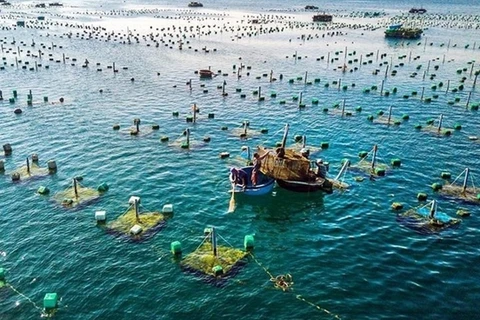
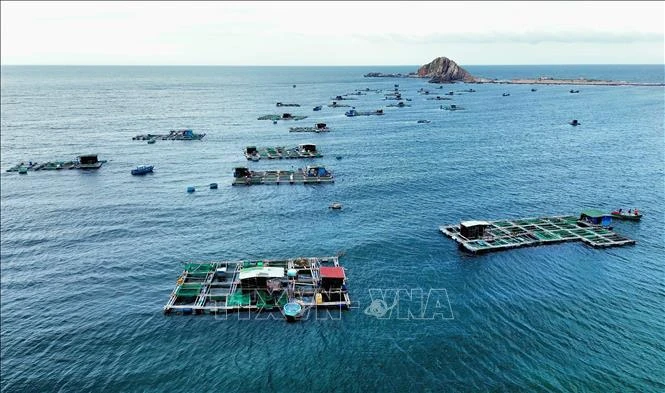
Cage fish farming in Ninh Hai district, Ninh Thuan province. (Photo: VNA)

HCM City (VNA) – Although marine aquaculture provides descent incomes for farmers, they need more support in both policy and capital to stablise the sector and improve local incomes for the long term.

Southern coastal localities have optimised all available water surface areas to make marine farming a large-scale, effective, and sustainable sector, meeting the demand of domestic and foreign export markets.

In 2020, Kien Giang province, one of the two southern localities, together with Ba Ria-Vung Tau, with the largest areas of water surface and farming cages, approved a project on effective and sustainable mariculture by 2030, according to Vice Chairman of the provincial People’s Committee Nguyen Thanh Nhan.

The project aims to promote industrial-level marine farming while ensuring sensitivity to the ecological environment associated with tourism development.

The efforts also encompass national defence and security in waters and islands, restructuring the sector while improving competitiveness, and raising people's income, the official said.

After nearly four years of implementation, the province now counts 3,870 fish cages with an output of 3,910 tonnes, mainly in Kien Hai district, Phu Quoc city, and a number of island communes in Kien Luong district and Ha Tien city.

Meanwhile, Ba Ria-Vung Tau is home to 14,062 cages with an average output of 7,900 tonnes each year, according to Pham Thi Na, Deputy Director of the provincial Department of Agriculture and Rural Development.

The provincial People’s Committee has issued an action plan on fisheries development by 2030 with a vision towards 2045, with the target of raising aquaculture output to 23,000 tonnes per year by 2030.

The province has also encouraged high-tech aquaculture that can serve both tourism and exports.In 2021, the Government approved the project on mariculture development till 2030 with a vision to 2045.

Its overall goal is developing a synchronous, sustainable, and eco-friendly marine aquaculture sector, producing branded products to meet domestic and export demand, generating jobs and improving income of coastal residents, contributing to protecting the security of the country’s seas and islands.

The project targets 280,000ha for aquaculture with an output of 850,000 tonnes and export revenue of from 800 million to 1 billion USD by 2025.

By 2045, mariculture will become an important part of the fisheries sector with modern management, contributing over 25% to the total output and earning more than 4 billion USD in export turnover.

Deputy Minister of Agriculture and Rural Development Phung Duc Tien said illegal fishing has remained a headache for the fisheries sector for years.

Therefore, marine aquaculture is expected to help address issues regarding the marine environment as well as illegal, unreported, and unregulated (IUU) fishing./.
See more

A perspective of the Quang Ninh 1 Wind Power Plant project (Photo: Quang Ninh provincial Department of Construction)

Quang Ninh gives nod to first offshore wind power plant

The project is expected to have a designed capacity of 50 MW and will be implemented in nearshore waters of the Co To special zone. It will be the first offshore wind power project in the province, playing a pioneering role in tapping Quang Ninh’s abundant renewable energy potential.

Viettel launches the Unitel Logistics brand in Laos. (Photo: VNA)

Vietnamese firms expand global footprint

The Government recently approved the “Go Global” programme for 2026-2030, which identifies the private sector as a key driving force in Vietnam’s international expansion process. It aims to help Vietnamese private enterprises strengthen their overseas presence in a comprehensive, effective and sustainable manner through international investment, business activities and deeper integration into regional and global supply and value chains.

Vietnam and Cambodia are seeking to strengthen supply chain connectivity and promote sustainable border trade at a trade promotion conference in Vietnam's Mekong Delta province of Dong Thap on May 15. (Photo: https://thoibaonganhang.vn/)

Vietnam, Cambodia eye stronger border trade, supply chain connectivity

Vietnam–Cambodia trade ties have grown rapidly in recent years, becoming one of the major pillars of economic cooperation in the Mekong sub-region. The two countries share a 1,137-km border and an increasingly developed network of international and secondary border gates, facilitating cross-border trade, logistics and investment.

Illustrative image. (Photo: VNA)

Three proposals to connect overseas Vietnamese resources with private economy at home

There are currently many Vietnamese IT specialists working in technology corporations, banks, start-ups and innovation ecosystems across Canada. With appropriate mechanisms in place, this workforce could become a technology bridge, helping Vietnamese enterprises access management expertise, technical solutions, international standards and partnership networks in North America.

The Nguyen Van Linh–Nguyen Huu Tho intersection fully opens both underpasses to traffic, helping ease congestion in the area. (Photo: VNA)

Ho Chi Minh City pushes for full public investment disbursement

Ho Chi Minh City was allocated a record 147.599 trillion VND (5.6 billion USD) in public investment capital for 2026, up 22.6% from last year and accounting for nearly 14.6% of the nation’s total public investment budget. However, disbursement by the end of April remained below the national average.

Visitors explore Quang Tri province’s OCOP products (Photo: VNA)

Quang Tri links OCOP products with tourism to expand farm produce markets

The central province currently has 160 OCOP products developed by cooperatives, cooperative groups and businesses, including two five-star and 31 four-star products. These locally distinctive products are gradually becoming "ambassadors" showcasing Quang Tri’s culture and identity to domestic and international visitors.

Work starts on Hanoi’s Red River Landscape Boulevard Axis project on December 19, 2025. (Photo: VNA)

Hanoi approves nearly 28-bln-USD Red River landscape boulevard project

Covering more than 11,400 hectares and requiring an estimated 736.96 trillion VND (nearly 28 billion USD), the project is expected to reshape urban development along both banks of the Red River over the coming decades while improving transport connectivity and public spaces in the capital.

Deputy Prime Minister Nguyen Van Thang and delegates perform the ground-breaking ceremony for the Northwest Dien Bien Phu New Urban Area, Resort and Sports Complex project. (Photo: VNA)

Vingroup launches largest-ever urban development project in Dien Bien

Under the master plan, the project will span more than 228.5ha and accommodate around 12,000 residents. It is designed under a “city within a city” model integrating residential areas, commercial and service facilities, resorts, schools, healthcare services, public spaces and sports infrastructure.