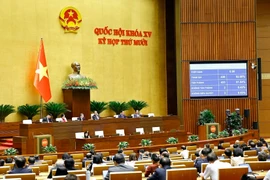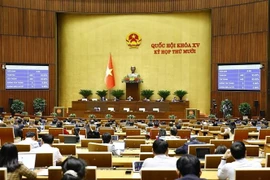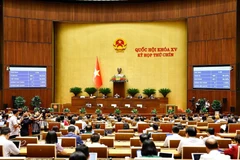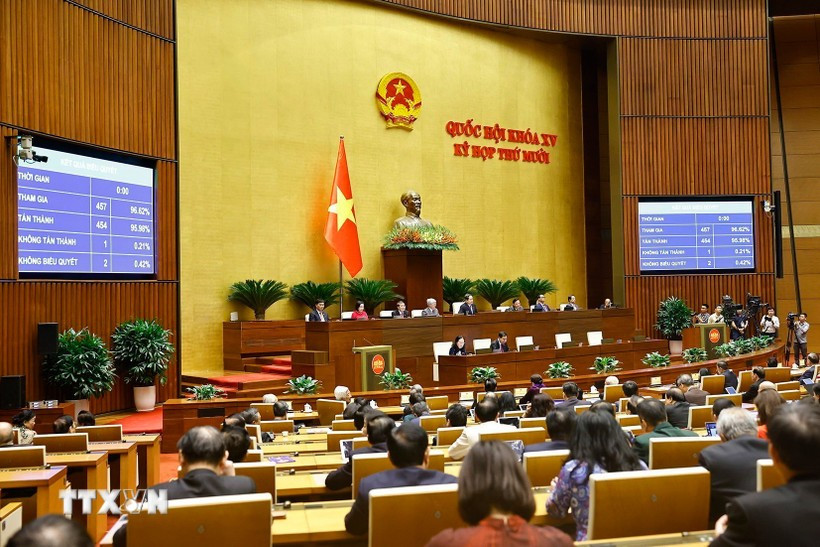
Hanoi (VNA) – With the adoption of an unprecedented number of laws and resolutions, the 10th session of the 15th National Assembly (NA) has left a particularly important imprint on the legislature’s tenure, affirming its role in shaping Vietnam’s institutional framework for a new stage of development.
During the session, the NA passed 51 laws and eight resolutions, accounting for approximately 30% of the total number of laws and resolutions adopted throughout the entire 15th tenure, making it the most productive sitting in terms of legislative output.
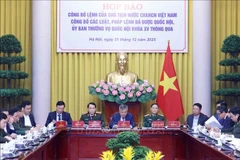
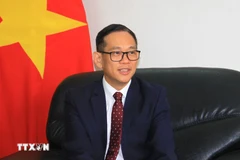
Speaking at a press conference on December 11 following the conclusion of the session’s final official working day, NA Secretary General and Chairman of the NA Office Le Quang Manh stressed that the 10th session had addressed numerous issues of special significance to the country’s long-term development orientation.
A record in law-making
According to Deputy Chairman of NA Office Nguyen Van Hien, the legislature worked continuously for 40 days, demonstrating responsibility, discipline and innovation. The deputies successfully completing the entire agenda set out at the beginning of the session.
He noted that the legislative workload was particularly heavy, with many laws amending or supplementing multiple existing legal documents. As a result, the total enacted or revised during the session was equivalent to around 75 laws, contributing substantially to the completion of the institutional reform agenda for the current term.
The laws and resolutions adopted at the session promptly institutionalised major Party guidelines and Politburo resolutions. Notable among them were groups of laws and resolutions related to education and training, aimed at implementing Resolution No. 71-NQ/TW on creating breakthroughs in education development, and those concerning healthcare, giving effect to Resolution No. 72-NQ/TW on strengthening the protection, care and improvement of public health.
In the field of science, technology and innovation, the NA passed a series of important laws, including the Law on Digital Transformation, the Law on Artificial Intelligence, the Law on High Technology, and the law amending some articles of the Law on Technology Transfer. These laws are part of a synchronised legal framework to guide and manage the development of emerging technologies, laying a solid foundation for science, technology, innovation and digital transformation to become the primary drivers of socio-economic growth in the coming period.
The legislature also adopted several resolutions on special mechanisms and policies to address bottlenecks in the implementation of the Land Law, as well as mechanisms tailored to accelerate development in major economic growth poles such as Hanoi, Ho Chi Minh City and Da Nang. These measures aim to provide greater flexibility in governance, enabling large cities to develop more rapidly while ensuring sustainability.
Beyond legislative work, the legislature made decisions on a wide range of important national issues. These included allowing the extension of the implementation and disbursement period for State budget funds for national target programmes for 2025 until December 31, 2026. They also included authorising the Government to approve the feasibility study report for phase 2 of Long Thanh International Airport independent of National Assembly for approval, and adopting solutions to terminate the Phuong Nam Pulp Mill Project, which has remained stalled for years.
The session also approved the separation of compensation, support and resettlement components of the North–South high-speed railway project into independent projects, a move expected to facilitate more effective implementation of this major national infrastructure initiative.
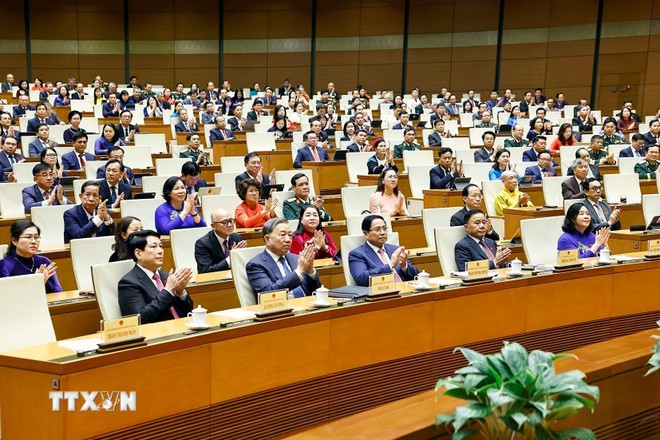
In addition, the National Assembly conducted a review of the 2021–2026 term performance of State bodies, decided on personnel matters within its authority, and carried out thematic supervision on the implementation of policies and laws on environmental protection since the Law on Environmental Protection 2020 took effect. Lawmakers also discussed and contributed opinions to draft documents to be submitted to the 14th National Party Congress.
NA deputies described the 10th session as historic in both scale and substance. Many noted that it encompassed all key functions of the National Assembly, from legislation and supervision to decisions on major national issues, reflecting the legislature’s growing professionalism and effectiveness.
Laying solid foundation for 16th tenure
Looking back on the 15th tenure, lawmakers agreed that the outcomes of the 10th session not only marked a high point of legislative activity but also laid an important foundation for the 16th National Assembly. Despite facing numerous challenges, including global economic fluctuations, natural disasters and administrative restructuring, the National Assembly maintained its role in perfecting institutions, enhancing supervision effectiveness and improving the quality of decisions on critical national matters.
Delegates also highlighted the strong spirit of responsibility and dedication among lawmakers, particularly in the final regular session of the term, which required intensive research and debate on a massive volume of documents. The increased application of digital tools and artificial intelligence was seen as helping deputies better manage the workload and improve the quality of their contributions.
Deputy Nguyen Thi Suu of the Hue said that the entire agenda of the session centred on three core policy pillars. These include perfecting institutions to ensure sustainable development, improving the quality of essential public services, and enhancing national competitiveness amid the increasingly complex impacts of the international situation, including mounting geopolitical, economic, defence, security and social challenges.
She stressed that the country must proactively adapt based on the principle of the Party’s comprehensive leadership, the State’s in-depth and multidimensional governance, and the joint participation of the people, society and the business community, with each stakeholder effectively fulfilling its respective roles and responsibilities.
With the three strategic breakthroughs identified by the 13th National Party Congress - institutions, infrastructure and high-quality human resources—being vigorously advanced, the legal and policy foundations laid during the 10th session are expected to bolster Vietnam’s confidence as it enters a new development era.
Lawmakers expressed confidence that, under the Party’s leadership and with close coordination between the National Assembly and the Government, the country has sufficient institutional capacity and social consensus to pursue rapid and sustainable growth, ultimately realising the goal of building a prosperous, civilised and happy nation./.