No discrimination between Vietnamese and foreigners during vaccination: spokesperson

There is no discrimination between Vietnamese and foreigners during the COVID-19 vaccination campaign, Foreign Ministry spokesperson Le Thi Thu Hang asserted, stressing that Vietnam’s pandemic prevention and control has been acknowledged by the international community.
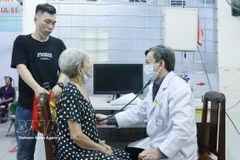
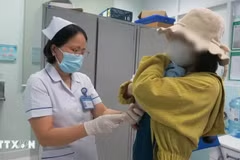
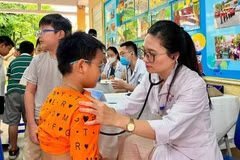
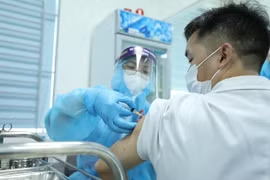
No discrimination between Vietnamese and foreigners during vaccination: spokesperson ảnh 1A medical checks body temperature of a woman (Photo: VNA)
Hanoi (VNA) – There is no discrimination between Vietnamese andforeigners during the COVID-19 vaccination campaign, Foreign Ministry spokespersonLe Thi Thu Hang asserted, stressing that Vietnam’s pandemic prevention andcontrol has been acknowledged by the international community.

Talking to the media at a regular press conference held online on June 24, Hang said that with a goaltowards herd immunity to make life return to normal, Vietnam has inoculatedmore than 600 members of foreign diplomatic missions, and United Nationsagencies in the country and their family members.

The Foreign Ministry is also coordinating with the Health Ministryto arrange vaccination for more than 50 reporters and press assistants atforeign press agencies' offices in Vietnam early next week, she added.

In the humanitarian spirit, the Vietnamese Government alwayscares for and supports foreigners living, studying and working in Vietnam sothey can live normally and safely, and receive medical care and intensivetreatment when necessary.

Foreign citizens will be vaccinated when Vietnam receivesmore vaccines, with the aim to create herd immunity to drive back the pandemic,Hang affirmed.

Commenting on the New York Times' article on June 2saying that Vietnam’s past achievement in the COVID-19 fight is a “luck”, the ForeignMinistry spokesperson stated that this is a completely subjective opinion.

According to her, since the COVID-19 outbreak, with the goalsof ensuring public health, preventing the spread of the disease and maintainingsocio-economic development, Vietnam has made strategic decisions, along with drasticand creative directions from the central to local levels.

The government has implemented many timely and drasticmeasures, including those applied for the first time in pandemic prevention andcontrol, such as preventing the spread of the coronavirus from outside byrestricting entry, quarantining all people entering the country, zoning out andstamping out outbreaks, tracing possible contacts with confirmed patients, andclosely monitoring quarantined people.

To proactively control the pandemic during the new normal,the Ministry of Health issued the 5K message of khau trang (facemask), khukhuan (disinfection), khoang cach (distance), khong tu tap (no gathering), andkhai bao y te (health declaration), and most recently the 5K plus vaccinemessage, to call on every Vietnamese citizen to follow in order to live safely with the pandemic.

With the determination, efforts and the engagement of theentire political system and people, especially the frontline forces, Vietnamhas overcome three waves of the pandemic.

“Using the experience and building on success in dealing with previous resurgence of outbreaks,along with the increasing understanding and capacity of medical workers andtesting capacity, Vietnam has step by step controlled the complicated fourth wave of outbreaks, and ensured the life as well as production activities of its people,”Hang stressed.

Vietnam is actively implementing the vaccination campaign, andpreparing the best conditions for planning and deploying the campaign nationwidein an appropriate, scientific and effective roadmap towards herd immunity.

“The results in Vietnam’s pandemic prevention and control overthe past times have been acknowledged and appreciated by the international community,the World Health Organisation and many countries. Public opinion and the press,including the US press, have recognized Vietnam as a role model in the pandemicprevention and control,” the spokesman emphasized./.
VNA

See more

An overview of the meeting between Deputy Prime Minister Pham Thi Thanh Tra and César Louis-Philip Marseille, Managing Director of VAMED Engineering GmbH of Austria and member of the Board of Directors of VAMED+WWH Group of Germany,in Hanoi on October 7. (Photo: VNA)

Deputy PM suggests studying long-term development of hospital ship model

Vietnam is one of VAMED’s important partners in Southeast Asia. The group plans to invest 1.2 billion EUR in Vietnam over the next five years, creating jobs for thousands of workers and promoting knowledge and technology transfer. It also wishes to expand cooperation through preferential credit projects, public-private partnerships (PPPs) and partnerships with private enterprises; and supply medical products from Austria and Germany for Vietnamese partners.

The Son Tra regional medical centre (Photo: benhviensontra.com.vn)

Da Nang: Satellite hospitals prove effective at grassroots level

The model is an important component of the roadmap to turn Da Nang into a specialised medical centre for the central and Central Highlands regions, with a number of key specialties, in line with the spirit of Politburo Resolution No. 72-NQ/TW dated September 9, 2025, on breakthrough solutions to strengthen the protection, care and improvement of people's health.

Illustrative image (Photo: daibieunhandan.vn)

Ho Chi Minh City digitises 99.4% of hospital records

As of July 2026, 163 of the city's 164 hospitals, or 99.4%, adopted electronic medical records, the report said. About 64% of public hospitals and 65% of private hospitals now run the technology across their entire operations

Yersin International Clinic in Ho Chi Minh City. (Photo: VNA)

Ho Chi Minh City eyes more foreign medical tourists

Director of the municipal Department of Health Tang Chi Thuong said a key prerequisite for attracting foreign patients is a strategy to develop centres of medical excellence. He proposed selecting hospitals and specialties with strong expertise for investment towards international standards, particularly in competitive fields such as cardiology, oncology, robotic surgery, assisted reproduction, paediatrics, dentistry, cosmetic medicine, specialised health check-ups, traditional medicine and rehabilitation.

A nurse from Children's Hospital No. 1, Ho Chi Minh City, collects a blood sample for HIV testing from an infant. (Illustrative photo: VNA)

Health cooperation adds fresh momentum to Vietnam-US relations

Through this MOU, the US Department of State, working with Congress, plans to provide 98.75 million USD in life-saving global health assistance over the next five years, including 21.385 million USD in dedicated Global Health Security funding, to support Vietnam’s transition to full country ownership of its HIV/AIDS and tuberculosis programmes while strengthening its capacity to detect and respond to emerging and re-emerging infectious disease threats.

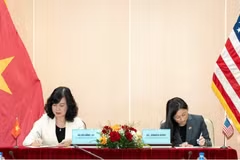
Minister of Health Dao Hong Lan and US Ambassador to Vietnam Jennifer McNamara Wick sign the memorandum of understanding on health cooperation. (Photo: US Embassy in Vietnam)

Vietnam, US launch five-year health cooperation

The cooperation will also support Vietnam in strengthening its healthcare capacity and gradually enhancing self-reliance in HIV/AIDS and tuberculosis prevention and control programmes, as well as in responding to emerging and re-emerging infectious diseases.

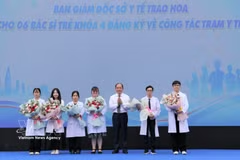
Director of the Ho Chi Minh City Department of Health Tang Chi Thuong (third, right) presents flowers to congratulate six young doctors who have volunteered to work at grassroots-level health stations (Photo: VNA)

Ho Chi Minh City strengthens grassroots healthcare workforce

Ho Chi Minh City's Department of Health on September 10 reviewed a pilot programme combining hospital-based practice with work at grassroots health stations and organised the fourth healthcare job fair, attracting nearly 1,000 candidates and 94 recruiters offering 806 positions.

Children undergo health screening. (Photo: Dong Da General Hospital in Hanoi)

Vietnam to screen students nationwide for five health risks from 2028

Vietnam will launch nationwide screening for five groups of school-related diseases and health conditions among students from preschool through high school from 2028, including overweight and obesity, refractive errors, spinal curvature, oral diseases and mental health disorders.