Employees manufacture car parts at the Sumi-Hanel Company at the Sai Dong B Industrial Zone in Hanoi (Illustrative image. Source: VNA)
Hanoi (VNS/VNA) - Non-equity modes (NEMs) trade is spreading in Vietnam and exposing the country to both opportunities and challenges, one expert believed.
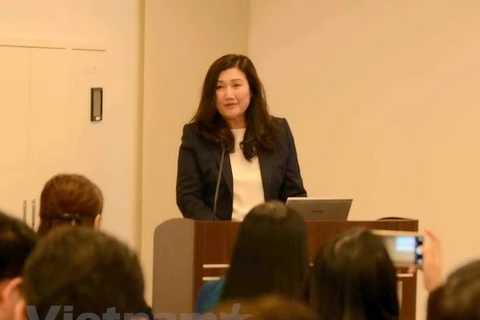
Shunji Karikomi from Waseda University in Japan was speaking at a seminar in Hanoi this week, themed “Non-equity modes (NEMs) in Vietnam, promoting new forms of trade between Japan and ASEAN,” co-organised by the Vietnam Trade Promotion Agency (Vietrade) and the ASEAN-Japan Centre (AJC).
Non-equity modes trade is a new form of trade carried out by transnational corporations (TNCs) when conducting international business, according to Karikomi.
“It is especially common for TNCs to enlarge in foreign direct investment when manufacturing overseas. However, even if TNCs do not engage in equity participation (investment), NEMs of international production are still carried out,” he told the seminar.
With the recent economic growth, NEM trade was widely promoted and ultilised in Vietnam in several forms such as international subcontracting in manufacturing industries, contract farming in agriculture and fishery, international franchising in fast food and retail stores, variations of build-own-operate transfer arrangements and other concessions in infrastructure projects and management contracts in international hotel chains, said Vu Ba Phu, Director of Vietrade.
Karikomi said one of the salient features of NEMs was that TNCs do not directly own the business activities of local firms but have indirect control of activities.
Non-procession by TNCs provided many potential opportunities for local companies. Using NEMs operations, Vietnamese firms can take part in global value chains, he said.
Diffusion of technology can promote technological enhancement and, through it, can promote the involvement of local firms in global value chains, he added.
Local firms can also expand their businesses by using the brands of TNCs. They do not have to consider brand value and management.
However, NEM contracts are not guaranteed for long periods. A TNC can use a NEM partner as a test case before full-scale entry, but it can also easily terminate the contract and withdraw if local firms in other countries are more competitive, as the sunk costs are minimal. In such cases, technology, market access, job creation and stable income do not continue over the long term, he said.
TNC’s technical and managerial support may be limited because of the non-capital relationship. TNCs offer only low-skilled work to NEM partners so workers’ skills improve very slowly. Local NEM firms face not only opportunities but also challenges.
“The issues are various, business continuity, characteristic NEM issues, capacity building, initiative and local embeddedness. If local NEM firms can strategically use TNC’s know-how and technological skills by linking with them, they can build capacities to deal with these challenges,” he said.-VNS/VNA
VNA