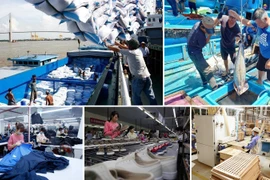
Hanoi (VNA) - The fruits of economic growth must be shared harmoniously, fairly, and equitably among all citizens, Party General Secretary To Lam told a conference reviewing the 2024 performance and setting 2025 tasks for the Government and local authorities in Hanoi on January 8.
As the Vietnamese Government gears up for carrying out its 2025 socio-economic development plan, it is clear that the focus extends beyond mere economic metrics. The Government is committed to fostering a society where cultural enrichment, social welfare, and the well-being of citizens are integral to the nation’s progress.
The 2025 socio-economic development plan embodies a holistic approach, focusing not only on economic growth but also on culture, social welfare, and life quality improvement. The Vietnamese Government is committed to effectively enforcing the policies concerning ethnic affairs, religions and beliefs, population, elderly care, youth development, gender equality, and women's advancement; creating a safe, friendly, and healthy living environment for children; building over 100,000 social housing units and eradicating temporary and dilapidated houses by the end of 2025.

This year, the country looks to secure per capita GDP of 4,900 USD, compared to the 4,700 USD in 2024.
Economists highlighted that per capita GDP is a critical indicator of a country's eonomic health, with Vietnam's figure from 121.72 USD in 1990 to the 2024 level illustrating vigorous development. The per capita GDP goal of 7,500 USD by 2030 underscores the Government's commitment to sustainable economic growth and improvement of citizens' life quality.
In 2024 alone, the Ministry of Labour, Invalids and Social Affairs provided subsidies for nearly 4 million people, including 1.394 million senior citizens, 1.667 million with disabilities, 16,000 orphan children or those who lost their caregivers, 150,000 children under 3 years old, and 80,000 single-parent individuals. Each month, some 2.25 trillion VND (88.6 million USD) was allocated for the implementation of social assistance policies.
Efforts in fast and sustainable poverty reduction also evidence the Government's vision for a “strong country for prosperous people”.
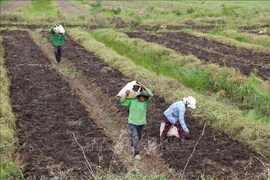
Vietnam's poverty rate has seen a dramatic decline, from 58.1% in 1993 to 9.88% in 2015, and further to 1.9% in 2024. The country aims to halve the number of poor and near-poor households in 2025 under the national multidimensional poverty standards compared to 2021. Investments in socio-economic infrastructure for all poor districts and particularly disadvantaged communes, especially in coastal and island regions, are also crucial to this goal.
Through various forms of support for the poor, over 1.7 million new houses have been built nationwide in recent years. The goal of the “450 days and nights” campaign, from October 2024 to the end of 2025, is to provide 200,000 houses using the state fund for those with meritorious service to the country, and about 88,000 units for the poor and ethnic minority people under the national target programmes. The campaign also looks to eliminate over 153,000 makeshift and dilapidated houses for poor and near-poor households.
A key highlight of the Government’s social welfare policy is the National Target Programme on Socio-Economic Development in Ethnic Minority and Mountainous Areas for the 2021 - 2030 period, and the Ethnic Affairs Strategy for the 2021 - 2030 period, with a vision towards 2045.
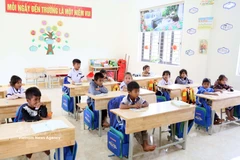
Early 2025 has already seen remarkable improvements in these regions, with 25 out of 52 centrally-run cities and provinces achieving a poverty reduction rate of over 3% annually among ethnic minorities. Additionally, the communities' average income more than doubled in five provinces since 2020, and preschool enrollment rates for five-year-olds have soared to over 98%.
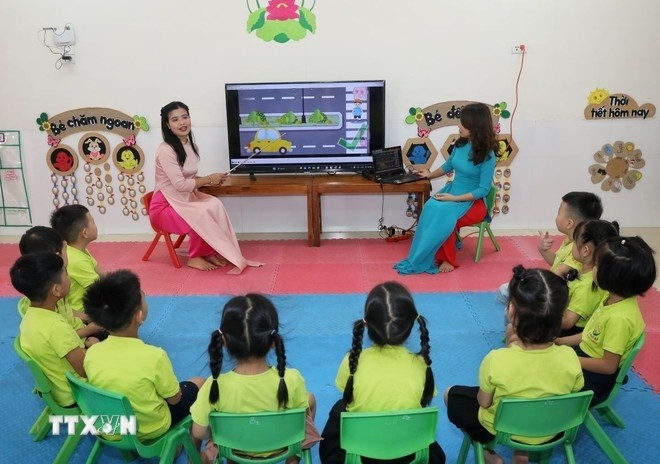
Vietnam's educational landscape is equally impressive. All 63 cities and provinces nationwide have now reached and maintained primary education universalisation. With 17-19% of its total budget invested in education, Vietnam is on par, or even above, many countries with a higher development level like the US (13%), Indonesia (17.5%), and Singapore (19.9%). When measured against GDP, Vietnam's education spending stands at a solid 4.9%. In 2024 alone, this commitment translated into a substantial outlay of nearly 381 trillion VND for education and training.
In healthcare, the Ministry of Health achieved and surpassed all three key socio-economic targets set by the National Assembly last year, with the number of doctors per 10,000 people reaching 14, the number of patient beds per 10,000 standing at 34, the health insurance coverage rate at 94.1%. Between 2019 and 2022, Vietnamese citizens enjoyed a stable average life expectancy, fluctuating between 73.6 and 73.7 years. In 2023, life expectancy of Vietnamese women increased to 77.2 years while that of men rose to 72.1 years.

The United Nations Development Programme (UNDP) once recognised Vietnam as one of the top countries globally in achieving the sustainable development goals and one of the best performers in Asia in meeting global goals.
Speaking about the fight against poverty in November 2024 at the G20 Summit in Rio de Janeiro, Brazil, Prime Minister Pham Minh Chinh stressed that Vietnam achieved the United Nations Millennium Development Goals a decade ahead of schedule, making it a success model in healing and restoring the wounds of war, eradicating hunger and reducing poverty.
Vietnam wishes to share valuable lessons: not sacrificing social welfare, progress, equity and the environment in pursuit of mere economic growth; placing people at the centre as the key focus and prioritising investment in human development, he said./.