Philippines: At least 11 dead after drinking lambanog

At least 11 people died and over 300 were hospitalised after consuming coconut wine or lambanog containing toxic methanol in the Philippines.
Philippines: At least 11 dead after drinking lambanog ảnh 1Hundreds of people have been taken to hospital after drinking the coconut wine. (Photo: AFP/VNA)

Hanoi (VNA) – At least 11 people died and over 300 werehospitalised after consuming coconut wine or lambanog containing toxic methanolin the Philippines.

Mayor Vener Munoz of Rizal town in Laguna province said on December 23 that 10died in separate incidents in his town after attending birthday and Christmasparties on December 20. Six others are in critical condition in a hospital inManila, he added. Many of the victims are being treated in a number ofhospitals in Manila.

A resident of Candelaria town in Quezon province also died and two othersslipped into a coma after drinking coconut liquor on December 22, localofficials said.

The Philippine presidential spokesperson Salvador Panelo expressed alarm overthe liquor poisoning, particularly during the time of merrymaking.

Laguna province’s Governor Ramil Hernandez has issued an order banning theselling of the liquor in the whole province in light of the poisoning incidents.

A police investigation is underway to track down the makers of the illicitliquor consumed by the victims.

The artisanal liquor, locally known as "lambanog," is created fromthe dripping nectar of the coconut flower. Using bamboo poles as bridges, localfarmers move from one tree to the next to collect the fresh coconut sap, amajor ingredient in producing the liquor.

Using a centuries-old tradition of natural fermentation and distillation, localproducers convert the sweet and frothy nectar into liquor.

In 2018 at least 21 people died in the provinces of Laguna, Rizal and Tarlac inthe northern Philippines after drinking the tainted liquor. The Food and DrugAdministration of the Philippines found the deadly liquor contains a high levelof methanol, a prohibitive additive in lambanog.

Some producers use a mixture of toxic chemicals instead of natural fermentationand distillation process to produce the distinct "lambanog" aroma./.
VNA

See more

A road is under construction in Dong Nai city, Vietnam. (Photo: VNA)

ADB: Southeast Asia needs 7.1 trillion USD in infrastructure investment by 2040

ADB estimates that the region will need an average of 476 billion USD in infrastructure investment annually during 2026–2040, equivalent to 8.7% of GDP. However, at current investment levels, government budget resources would cover only around 45% of this demand, leaving an annual financing gap of 264 billion USD.

Kyodo News publishes an article titled “Sculptures by Japanese, Vietnamese artists on display in Yokohama,” (Screenshot photo)

Japanese media widely cover top Vietnamese leader ’s visit

Japanese media have continued extensive coverage of General Secretary of the Communist Party of Vietnam (CPV) Central Committee and President To Lam’s activities in Japan, highlighting his meetings with representatives of leading financial institutions at the Tokyo Stock Exchange, witnessing of cooperation agreement signing and participation in cultural exchanges.

Thailand pushes for establishment of ASEAN emergency public health centre

Thailand pushes for establishment of ASEAN emergency public health centre

The draft agreement stipulates that ACPHEED will comprise three specialised centres based in three ASEAN member states. Vietnam will oversee the centre for prevention and preparedness; Indonesia will host the centre for detection and risk assessment; and Thailand will be responsible for the centre for response and risk communication.

Indonesia designates 31 mln ha of waters as conservation areas

Indonesia designates 31 mln ha of waters as conservation areas

Head of the Convention and Marine Resource Balance working team at the ministry’s Directorate of Ecosystem Conservation Ahmad Sofiullah said this week that it is a strategic effort to ensure the sustainability of Indonesia’s marine ecosystems.

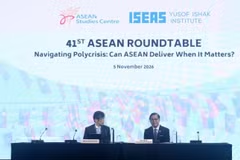
Thai Deputy Prime Minister and Minister of Foreign Affairs Sihasak Phuangketkeow (R) takes part in the Q&A session at the 41st ASEAN Roundtable. (Photo: VNA)

Thailand calls on ASEAN to proactively address polycrisis

Thai Deputy Prime Minister and Minister of Foreign Affairs Sihasak Phuangketkeow noted that no single member state could tackle challenges ranging from major-power competition and economic fragmentation to climate change and energy and food security on its own. Regional cooperation is therefore a strategic imperative, enabling ASEAN not only to overcome crises but also to sustain its development momentum.

Palm oil and palm oil-based products are among Indonesia’s promising export commodities. (Photo: VNA)

Indonesia to launch commodity export monitoring platform next year

DSI will draw on data from customs authorities, trade activities and the financial system, alongside contracts and documents uploaded by exporting companies. The platform will monitor the volume, quality, prices and destination markets of various commodities, as well as transactions between related parties.