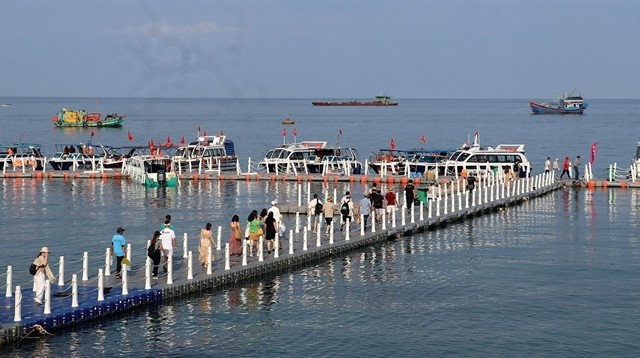
An Giang (VNS/VNA) - As Phu Quoc island gears up for APEC Economic Leaders Week 2027 and international maritime connectivity, An Giang province accelerates efforts to modernise key ports and terminals.
Phu Quoc, some 100km off the mainland, is now a special zone of An Giang province following recent regional restructuring, is being positioned as a strategic maritime hub within Vietnam’s long-term national development plans.
With a vision to transform into a world-class special economic zone, the island is placing strong emphasis on expanding and upgrading its seaport infrastructure.
This direction reflects both immediate development priorities and long-term goals to assert Vietnam’s maritime sovereignty and boost regional integration through enhanced connectivity.
Guided by the national master plan on seaport development, under Prime Ministerial Decisions issued in September 2021 and May 2024, Phu Quoc has been identified as part of Seaport Group 5, with ports capable of accommodating international cruise vessels up to 225,000 GT and cargo ships up to 30,000 tonnes.
The seaport planning encompasses not only passenger and freight capacity but also includes specialised functions such as handling liquid cargo, ferries and marine tourism, with considerable investment and regulatory coordination involved.
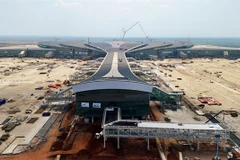
A major component of this transformation is the International Passenger Port with a total investment of over 1.6 trillion VND (approximately 65 million USD), which was put into service in February 2024 after nine years of construction.
However, international shipping companies are still awaiting updated digital nautical charts from the United Kingdom Hydrographic Office (UKHO), an essential step to bring the port into full alignment with global standards.
Meanwhile, An Giang province is assuming increasing responsibility for maritime assets.
An Thoi Port, a vital gateway on the island’s southern end, was formally transferred to provincial management in January 2025.
Following years of disuse, the port has deteriorated, and the absence of channel buoys has limited navigability.
Local authorities are now actively drafting new operational plans to revitalise this key asset in line with national objectives and expected increases in maritime traffic.
Adapting to global demand
The island’s construction sector is experiencing strong momentum, especially in preparation for APEC Year 2027.
According to Dao Huy Hiep, Deputy Director of the An Giang Department of Construction, Phu Quoc currently hosts 321 investment projects within zoned areas, of which 268 are under implementation or awaiting construction.
The annual demand for construction materials is projected to reach 7.5 million tonnes, including approximately 5 million tonnes dedicated to APEC-related projects, with an estimated 4.8 million cubic metres of stone needed.
With limited local sources, the transport of construction materials from the mainland is vital.
Inland waterway and marine transport play a pivotal role in bridging this gap, offering lower costs and reducing price disparities between the island and the mainland. As a result, temporary ports have gained growing importance.
Bai Vong area currently operates five such ports under provisional licences, servicing building material supply and ferry traffic.
While not part of the formal port system, these facilities are considered essential for maintaining momentum in local construction and logistics.
Meeting strategic goals
Despite notable progress, several bottlenecks remain.
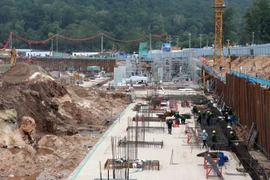
Vinh Dam Port, envisioned as a multi-purpose terminal, has completed only its initial construction phase.
Dredging, embankment works, and land clearance have yet to be approved or completed.
This port is critical for both passenger traffic and bulk construction material handling, with facilities designed to process between one and 1.5 million tonnes annually.
However, incomplete infrastructure continues to limit its potential.
Similarly, the planned terminal at Mui Dat Do, originally designed for general cargo, passengers, and luxury yachts, has been removed from port development planning due to its reallocation for facilities serving APEC 2027.
This re-prioritisation underscores the delicate balance between hosting major international events and advancing long-term infrastructure goals.
In response, An Giang has petitioned the Ministry of Construction to revise the national seaport development master plan to officially incorporate the temporary ports in Bai Vong, proposing an upgrade in capacity and functionality to meet increasing socio-economic demands.
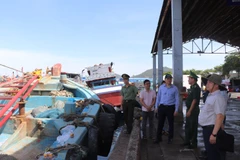
Deputy Minister of Construction Nguyen Xuan Sang, during a recent field visit, emphasised the urgency of activating the full potential of the International Passenger Port in An Thoi.
He called on provincial agencies and port authorities to coordinate closely in managing infrastructure safety, streamlining logistics, and ensuring that both passenger and cargo flows meet international expectations.
For An Giang province, Phu Quoc’s evolving port system is more than just an infrastructure project—it is the engine driving a new era of regional connectivity and national integration.
The planned improvements are expected to not only meet the island’s growing internal demands but also to position Phu Quoc as a maritime gateway for the Mekong Delta and a strategic location in Vietnam’s coastal economic development.
As the island looks towards the APEC Economic Leaders Week 2027 and beyond, its upgraded port system promises to be a cornerstone of its transformation into a modern, resilient and globally connected urban maritime centre./.
VNA