PM asks for accelerated implementation of Project 06

The directive states that the Politburo has identified "the development of science, technology, innovation, and national digital transformation as a key breakthrough, a main driving force for rapidly developing modern productive forces, perfecting production relations, innovating national governance methods, socio-economic development, preventing the risk of backwardness, and propelling the country to significant development and prosperity in the new era."

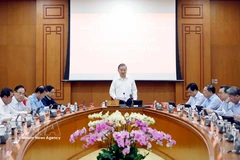
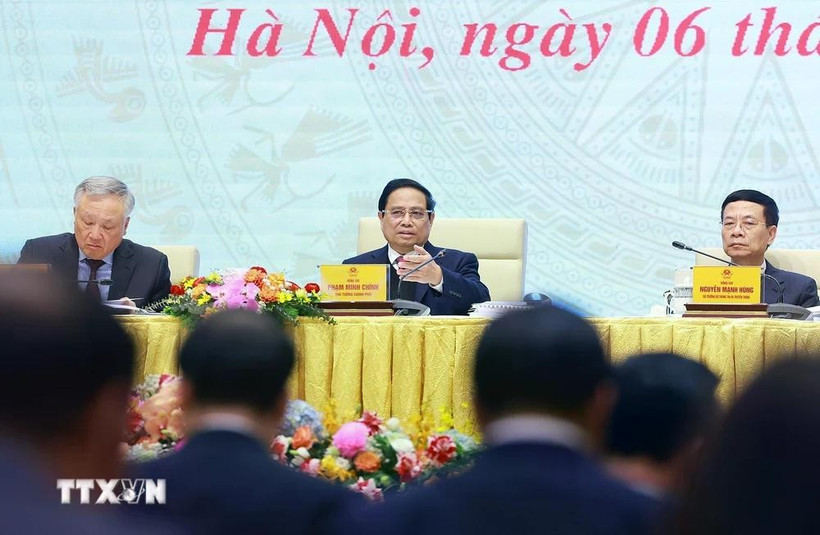
Prime Minister Pham Minh Chinh chairs a meeting to review the activities of the National Committee for Digital Transformation and Project 06. (Photo: VNA)

Hanoi (VNA) – Prime Minister Pham Minh Chinh has just signed Directive No. 07/CT-TTg on accelerating the implementation of the project on developing resident data, electronic identification and authentication applications to serve national digital transformation in the 2022-2025 period, with a vision to 2030 (Project 06) in ministries, sectors, and localities in 2025 and beyond.

The directive states that the Politburo has identified "the development of science, technology, innovation, and national digital transformation as a key breakthrough, a main driving force for rapidly developing modern productive forces, perfecting production relations, innovating national governance methods, socio-economic development, preventing the risk of backwardness, and propelling the country to significant development and prosperity in the new era."

To concretise this guiding viewpoint, it requires a high determination, great efforts, and more decisive actions from all sectors and levels in implementing Project 06, linked to building and developing the National Data Centre, harnessing the potential of data to serve the national digital transformation revolution.

PM Chinh requests ministries, ministerial-level agencies, government agencies, and provincial and municipal People's Committees to thoroughly understand and implement synchronously, systematically, promptly, and effectively the key tasks and solutions.

They were asked to focus on building and completing documents detailing approved laws and completing legal issues to serve the development of science and technology, innovation, and digital transformation.

Restructuring processes and reusing digitised data aim to ensure that people and businesses will not have to present, submit, or re-declare information and documents that have been digitised; prioritising measures to reuse digitised land data to reduce administrative procedures related to residency. Administrative units at the district and commune levels that have completed the resident data digitisation must use it immediately in the second quarter of 2025.

The PM also urged ministries, agencies and localities to upgrade and complete information technology infrastructure; complete the connection between the administrative procedure handling information system at the ministerial and provincial levels with the National Population Database in 2025.

Ministries and sectors must develop their digital transformation projects, ensuring connection with Project 06 and 11 utilities developed by the Ministry of Public Security.

Regarding data development, the PM asked ministries and agencies to complete the review and update of the National Data Strategy in the second quarter of 2025.

Completing the implementation of constructing, exploiting, and using National databases and specialised databases, particularly those on land, construction, insurance, finance, enterprises, labour, employment, healthcare, and education must be developed, exploited, connected with the National Population Database by August 2025. The data must be synchronised with the National Data Centre.

Additionally, the digitisation of internal business processes, documentation, and results of administrative procedure proccesses in areas related to people and businesses, must be completed in the third quarter of 2025.

PM Chinh assigned the Ministry of Public Security (MPS) to draft and submit to the Government for promulgation decrees detailing the Data Law to ensure effectiveness from July 1, 2025.

The MPS was asked to coordinate with other ministries and sectors to complete the development of specialised databases to upgrade and improve the quality of online public services. They are expected to complete the provision of electronic identification accounts for organisations to ensure that from July 1, 2025, all enterprises can carry out administrative procedures electronically.

The MPS partners with the Ministry of Finance to develop a set of indicators to assess the operational level, growth, and development of enterprises. A set of indicators to assess the satisfaction level of citizens and enterprises in online public services through VneID is expected to be completed in June 2025.
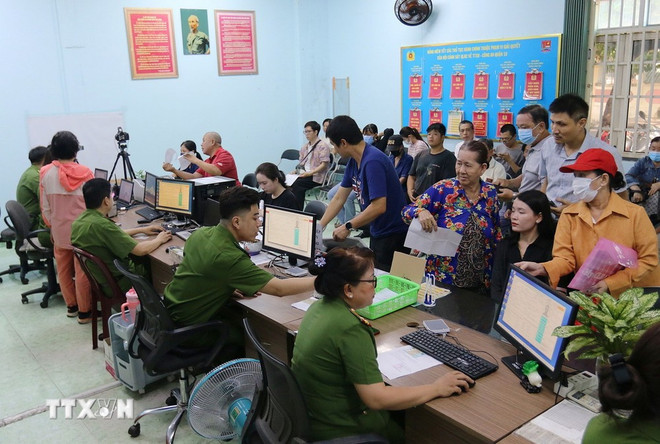
can-cuoc-cong-dan-1-4824.jpg
Ministries and agencies are asked to complete the review and update of the National Data Strategy in the second quarter of 2025. (Photo: VNA)

The ministry was requested to organise the issuance of identity cards and electronic identification for Vietnamese citizens abroad whose biometric samples (fingerprints, iris) were collected, and coordinate to issue birth certificates for Vietnamese children abroad online.

The PM assigned the Ministry of Justice to urge localities to promptly complete the digitisation of civil registration data.

Localities that have completed the digitisation must urgently coordinate with the MPS to connect, verify, and synchronise with the National Population Database to reduce and simplify administrative procedures.

The Government Office will lead the development of a set of indicators and information systems to serve the Government’s and Prime Minister’s direction and administration based on the regulations of the National Data Centre in 2025.

The Ministry of Health (MoH) was asked to coordinate with the MPS and related units to pilot the Health Data Coordination System at Bach Mai Hospital with medical facilities in Bac Ninh and Thai Nguyen provinces; Cho Ray Hospital with medical facilities in Binh Duong and An Giang provinces.

Simultaneously, the MoH will lead and coordinate with the Ministry of Finance and the Ministry of Science and Technology to guide hospitals on costs for investing in or renting information technology to implement digital transformation.

The Ministry of Foreign Affairs was asked to work with the MPS to study and propose solutions to reduce and simplify visa issuance procedures for foreigners and implement online visa issuance procedures for those who have biometric samples (fingerprints, iris) collected. The work is required to be completed in April.

Meanwhile, the Ministry of Construction will coordinate with the MPS to implement biometric technology solutions and the VNeID platform at all airports, seaports, and border gates to facilitate citizens by September./.


VNA

See more

Viettel Digital Talent and Viettel Future Changemakers are open for registration until March 15, 2026. (Photo: Viettel)

Viettel launches talent search to develop young workforce for core technologies

Unlike conventional internship or management trainee schemes, both programmes are designed and implemented directly by Viettel, integrating training with real-world work in a global technology group. Participants are entrusted with solving major challenges that directly impact Viettel’s research, production and business operations.

A close-up view of the UAVs used in the Can Gio - Vung Tau delivery route on Fenruary 12, 2026 in Ho Chi Minh City (Photo: CT UAV)

Vietnam’s first cross-sea UAV delivery route inaugurated

The event marked the debut of the country’s first cross-sea unmanned postal route, representing a pioneering step in smart mobility solutions aimed at boosting the digital economy and easing pressure on road transport infrastructure in Ho Chi Minh City.

According to the Vietnam National Authority of Tourism (VNAT), which cited the Google–Temasek–Bain & Company e-Conomy SEA 2025 report, tourism remains one of the key drivers of Vietnam’s economy. (Photo: VNA)

Digital transformation in tourism for comprehensive, sustainable growth

Vietnam is well positioned to become a leading digital tourism destination in the region. By capitalising on current growth momentum and implementing targeted support measures for small and medium-sized enterprises, the country can build a smart and sustainable tourism ecosystem aligned with global digital transformation trends.

Party General Secretary To Lam ( second, from left) visits an exhibition showcasing the government's achievements in science, technology, innovation, and digital transformation. (Photo: VNA)

Fund mechanisms positioned to unlock greater resources for innovation

Resolution No. 57-NQ/TW of the Politburo defines fund-based mechanisms as the core financial tool for advancing science, technology and innovation. Under the resolution, State budget funding for research and development is prioritised for allocation through funds, alongside reforms in financial management, expanded autonomy, streamlined procedures, and acceptance of the risks and time lags inherent in research activities. It also calls for the establishment of venture capital funds and science and technology development funds to steer, mobilise and unlock social resources for innovation.

UAV Cup PV GAS 2025 looks for solutions to boost the low-altitude economy (Photo: qdnd.vn)

Digital economy helps power breakthrough growth

The application of digital technologies, big data, artificial intelligence, e-commerce and digital platforms is creating new opportunities for businesses and citizens across production, business activities and social governance. Sectors such as e-commerce, digital finance, smart logistics and digital platform-based services are generating significant added value, while online public services, cashless payments, digital education and digital healthcare are increasingly improving quality of life and the transparency and efficiency of state management.

Camera manufacturing at Sunny Opotech Vietnam Co., Ltd. in Yen Binh Industrial Park in Thai Nguyen province. (Photo: VNA)

Resolution No. 57: Vietnam moves to create favourable legal framework for technology transfer

The Ministry of Science and Technology has sought feedback on a draft decree amending the Government's Decree No. 76/2018/ND-CP, aiming to strengthen the legal framework for technology appraisal and transfer, improve support policies for participating entities, and enhance risk management to ensure sustainable development, environmental protection and public health.

A visitor experience the robot receptionist at the Spring Fair 2026. (Photo: VNA)

Glorious Spring Fair 2026: technology underpins product quality

With the Politburo's rollout of Resolution No. 57-NQ/TW on breakthroughs in science, technology, innovation, and national digital transformation, along with Resolution No. 68-NQ/TW on developing the private economic sector, a key focus is on applying scientific and technological advances to produce essential consumer goods.

A large volume of goods of unclear origin is found in An Giang province (Photo: VNA)

PM orders tougher IP enforcement under new decree

The move aims to promptly combat, curb, and minimise IP violations; safeguard the legitimate rights and interests of citizens and businesses; build a transparent and healthy business environment; spread the nation’s image and prestige to advance rapid and sustainable development.

An overview of the seminar (Photo: VNA)

Vietnamese intellectuals in France join hands to advance science, technology at home

Held amid the nationwide efforts to implement the Resolution of the 14th National Party Congress and the Politburo’s Resolution No. 57-NQ/TW on breakthroughs in science, technology, innovation, and national digital transformation, the seminar served not only as an academic forum but also as a platform reflecting the sense of responsibility, intellectual engagement and aspiration to contribute among overseas Vietnamese intellectuals in the nation’s new development era.

The robotics team from Cau Giay Secondary School, Hanoi, performs at the event (Photo: VNA)

STEM Innovation Petrovietnam helps cultivate knowledge in technological era

The programme connected three sites in Hanoi, Nguyen Hue High School in Lao Cai, and Chau Thanh High School in Ho Chi Minh City, bringing together educators, students, representatives of businesses, and industry–energy engineers, and those directly supporting schools in implementing STEM (science, technology, engineering, and mathematics) education in practice.