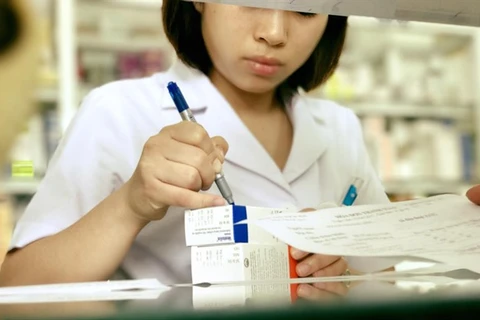
A worker checks medical mushrooms at the Agricultural Genetics Institute (Photo: VNA)
 Hanoi (VNA) – The lack of a master plan has been blamed for Vietnam having to import up to 80 percent of its processed pharmaceutical materials although the country has an abundant source of pharmaceutical materials and was one of top exporters of raw pharmaceutical materials in the 1980s.
Professor Dau Xuan Canh, Director of Vietnam Institute of Traditional Medicine, said Vietnam’s climate was believed to be very favourable for growing many categories of medicinal plants.
However, scattered development could result in losing the opportunity to fully develop the potential of the country’s pharmaceutical sector, he added. He spoke at a recent meeting on boosting the growth of the national pharmaceutical industry, as reported by Thoi bao kinh doanh (Business Times) newspaper.
For example, Vietnam is failing to exploit the potential of cinnamon trees that are widely planted in our country, he said. “We could turn it into processed pharmaceutical material to serve the domestic pharmaceutical industry, but we do not,” he said.
The United Nations Industrial Development Organisation (UNIDO) ranks Vietnam in the third of five levels of pharmaceutical sector development, reflecting the fact that the domestic pharmaceutical sector imports most of the processed pharmaceutical materials it needs.
Data from the Ministry of Investment and Planning showed that Vietnam ranks 16 of 22 countries in terms of pharmaceutical industry development, based on its total drug consumption worth about 4.8 billion USD each year. The Vietnam pharmaceutical market was also assessed to have the highest growth rate in the Southeast Asia region, equal to 17 percent each year, projected to reach around 10 billion USD by 2020.
However, most domestic pharmaceutical producers are small-scale and scattered in various areas of the country, the Ministry of Industry and Trade said. Only seven of 170 producers manufactured chemicals for the local pharmaceutical industry.
Minister of Health Nguyen Thi Kim Tien also admitted the paradox of the domestic pharmaceutical industry. She said Vietnam was an agricultural country with an abundant source of pharmaceutical materials, including minerals, animals and medicinal plants.
A report issued by the health ministry last year said Vietnam has 206 medicinal plants that could grow and provide 10,000-20,000 tonnes of pharmaceutical materials each year.
But sadly, most of processed pharmaceutical materials now are imported, Tien said.
Vietnam also imports all its anti-cancer chemicals at exorbitant prices while it has many trees containing anti-cancer drug precursors, such as red pine (taxus wallichiana zucc) and Madagascar periwinkle (catharanthus roseus), she said.
Solutions
At a recent workshop on development of the national pharmaceutical industry, Prime Minister Nguyen Xuan Phuc announced three major directions.
First, the role of pharmaceutical materials should be re-assessed on a national and provincial scale, and then a detailed plan should be formulated to boost it. "Developing the domestic pharmaceutical sector by domestic pharmaceutical materials should be a strategy of the health sector,” he said.
Second, the pharmaceutical sector was asked to serve domestic demand before turning to export. Authorised agencies were tasked with creating favouable conditions to encourage businesses to participate in the pharmaceutical sector, he said.
Last, the national pharmaceutical sector needs to be restructured, especially focusing on the processing and production stages, he said.
The PM ordered the health ministry to co-operate with the Vietnam Pharmaceutical Companies Association to make a list of 100 medicinal plants for extensive growing on a large scale.
The Ministry of Agricultural and Rural Development was tasked with responsibility to provide appropriate seedlings.
A supply chain consisting of farmers, businesses, scientists, State managerial agencies and commercial banks should be established so that the national pharmaceutical sector can be better developed, he said.-VNA
VNA