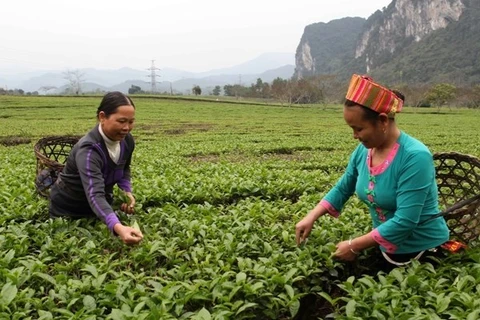
The family of Yaga, a K’ho ethnic minority in Tan Hoi commune, Duc Trong district, Lam Dong province is loaned 30 million VND to invest in coffee and pepper growing (Photo: Vietnamplus)
 Hanoi (VNA) - In addition to the increase in quantity, credit quality has also improved, with loans given to right people and overdue debt reaching only 0.4 percent, with almost no bad debt.
Social policy credit has come to all communes, wards and townships nationwide, with priority given to poor and ethnic minority households in remote and isolated communes, particularly difficult regions, and border and island areas.
However, the funding for this programme still faces many difficulties, so Deputy Governor of the State Bank of Vietnam Dao Minh Tu proposed the Government provide sufficient funding sources to help localities where many poor and ethnic minority households are living invest in transport infrastructure and value chain building.
Credit quality increases
From the government’s three credit programmes (for poor households, students and job generation), the Vietnam Bank for Social Policies has carried out over 20 social policy credit programmes and some projects entrusted by localities, domestic and foreign organizations and individuals.
Besides the increase in quantity, credit quality has also improved, with loans given to right people. While the bad debt of the economy is large, the overdue debt of this programme is only 0.4 percent and charged-off debt is only 0.33 percent, with almost no bad debt.
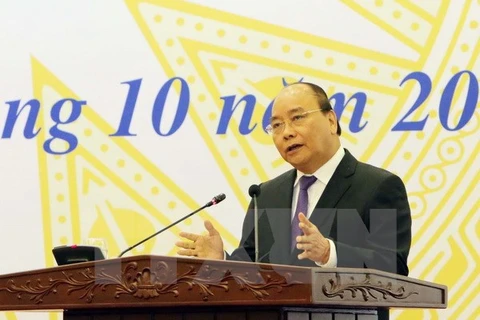
Speaking at a teleconference on the role and effectiveness of policy credit in the implementation of sustainable poverty reduction goals, Deputy Prime Minister Vuong Dinh Hue said the Vietnam Bank for Social Policies and policy credit are an important pillar of the National Target Programme on Sustainable Poverty Reduction.
Thanks to this pillar, in the period of 2015-2018, the number of poor households decreased very quickly, helping push back and prevent illegal credit or black credit, creating resources for localities to implement the National Target Programmes on new rural area building and sustainable poverty reduction in association with localities’ socio-economic development projects that improve people’s material and spiritual lives.
According to Hue, the credit policy for poor households is implemented the most widely, meeting a large amount of capital needs for the poor, having direct impacts and bringing in practical effects. It is a bright spot among poverty reduction policies. The policy has built good relations between the State and mass organizations and the poor, promoting the activeness and raising the responsibility of the poor.
It is proven by the fact that in the past years, the Farmers' Associations at all levels have always accompanied the Vietnam Bank for Social Policies to implement policy credit programmes for poor households and policy beneficiaries.
Vice Chairman of the Vietnam Farmers Association Nguyen Xuan Dinh affirmed that the introduction of policy credit to the poor and policy beneficiaries has motivated them to find ways to do business and use the money in the most profitable way, gradually reducing dependence to rise out of poverty.
Over the past five years, policy credit funds entrusted through the Farmers' Associations have helped over 3 million poor and near-poor households and policy beneficiaries get loans for production development; and 132,472 disadvantaged students have opportunities to pursue their study. The policy credit has helped create jobs for over 12,000 labourers, and build over 2 million clean water and environmental sanitation works and more than 115,000 houses for poor households, contributing to reducing the poverty rate in 2015 from 5.97 percent to 5.5 percent at the end of 2018 and building new-style rural areas.
Vice Chairman of the National Assembly's Council of Ethnic Affairs Nguyen Lam Thanh said that the policy credit programmes have given a facelift to ethnic minorities and rural areas. This is one of four important pillars for poverty reduction (land, labour, intellectual strength and economic infrastructure, and credit).
 Staff of the Vietnam Bank for Social Policies work with ethnic minority people (Photo: Vietnamplus)
 Gathering resources for the poor
In order to better implement the policy credit programmes, Deputy Governor of the State Bank of Vietnam Dao Minh Tu said that the central bank would continue to direct state-owned commercial banks to maintain the deposit balance at the Vietnam Bank of Social Policies to ensure capital for social policy credit programmes.
In addition, it will support banks in seeking capital sources, especially entrusted capital from international organizations and local funds for poverty reduction and job generation.
Deputy Prime Minister Hue asked localities to spend an appropriate part of the budget to supplement capital for credit programmes for social policy beneficiaries.
In 2020 and the 2021-2025 period, the annual credit growth of the Vietnam Bank for Social Policies must reach at least 10 percent and gradually rise to 12 percent, he said, adding the Vietnam Fatherland Front should expand the fund-raising campaign for the poor to call for donations from social organizations, businesses and individuals to add capital for social policy credit programmes./.