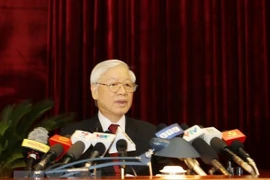
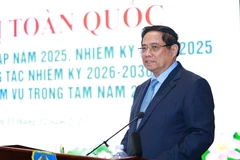
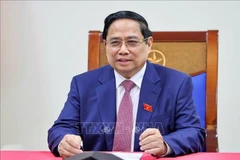
Finance Minister Dinh Tien Dung (Source: VNA)
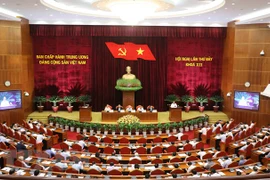
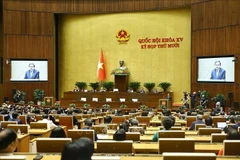
 Hanoi (VNA) – The 12th-tenure of theCentral Committee of the Communist Party of Vietnam (CPV) discussed salaryreform for officials, public servants, the armed forces and workers in theafternoon of May 9, the third day of its seventh plenary meeting.
The working session took place under the chair of Nguyen ThiKim Ngan, Politburo member and Chairwoman of the National Assembly.
Minister of Home Affairs Le Vinh Tan delivered a reportclarifying objectives, tasks and breakthrough solutions to implement the salarypolicy reform project.
He emphasised the need to employ drastic solutions regardingfinance and budget, personnel reduction, the restructuring of the contingent ofofficials and public servants, and the streamlining of the apparatus in thepolitical system in order to ensure operational efficiency.
Tan also stressed information work to raise public awarenessof salary reform, as well as the role of people, fatherland front and socio-political organisations in implementing the reform.
Members of the Party Central Committee (PCC) reached highconsensus on the issuance of a resolution on salary reform.
Be Xuan Truong, Deputy Defence Minister, applauded thefeasibility of the project, saying it matches the country’s development trendas well as salary policies of developed countries in the world.
He said among the solutions set forth in the project,resourcesmobilisation and personnel reduction are the most important, addingthat a ten-percent reduction in personnel each year could facilitate salaryreform.
Pham Hoai Nam, a delegate from the Naval Service, laudedthorough and scientific preparations for the project.
He said income and expenditure of officials in differentregions should be taken into account during the implementation of the project,explaining that socio-economic development in localities and regions is not thesame.
Ngo Dong Hai, deputy head of the PCC’s Economic Commission,highlighted breakthroughs of the project, noting that the problem lies in howto develop a modern salary system suitable to the country’s developmentperiods, and to make salary the main source of income of officials, publicservants, the armed forces, and workers, and a momentum for them to fulfilltheir assigned tasks.
Delegates suggested implementing four solutions, focusing onconsidering the salary in the public area is the basis to decide the basicsalary for other areas; and giving clear regulations on macro and micromanagement on salary policy to promote the role, responsibilities andmanagement ability of localities and organsations in the work.
They also gave solutions to effective implementation of the project, while stressingthe payment basing on job title, working position, and performance.
They stressed the need to devise mechanisms, regulations and directions to wellperform the project.
Attendees agreed that it is necessary to consistently build the payroll, andarrange staff in line with the job titles, give attention to building job titlestandards as a basis for building the payroll as well as the building of jobtitles and position projects, and replacing the examination for changing salarylevel with the appointment based on job requirements.
They said an effective public administration must be based on a contingent ofcivil servants and officials with good profession and virtue, and those withhigh-motivated spirit.
It is necessary to fully implement the remuneration regime so that civilservants will keep their mind on their work, and be assured of pursuing theircareer, they said.
Finance Minister DinhTien Dunglauded breakthrough measures in the salary reform policy scheme, ensuringtransparency, fairness and empowerment for units and localities in terms ofsalary payment based on labour results.
He said the ministrywill press on with the plan in accordance with the Party Central Committee (12th tenure)’s Resolutions No.18 and No.19, towards the goal of restructuring publicdebts to ensure safe and sustainable national finance in line with thePolitburo’s Resolution No.07.
Accordingly,development expenditure will account for nearly 26 percent of the total Statespending while regular spending and deficit will stay below 3.5 percent of thegross domestic product by 2020, and lower over subsequent years.
Spending for salary will increase by nearly 35-40 trillion VND (1.55 – 1.78billion USD) by 2021 and 2022.
By 2021-2022, theState budget deficit will make up 4-4.1 percent of GDP. If official developmentassistance (ODA) disbursement for 2016-2020 exceeds the plan by 2.4-2.5 percentof GDP, public debts will be around 64.5 percent of GDP, close to public debtlimit allowed by the National Assembly.
With the adjustmentof the lowest salary to 4.140 million VND per month from 2021, the State budgetwill need roughly 115 trillion VND by 2021 and 95 trillion VND by 2022, hesaid.
President of theVietnam General Confederation of Labour Bui Van Cuong said workers hold highexpectation on the Party’s important decisions on salary and social insurance.
In order to attractyoung and capable workforce, he lauded the plan to offer higher salary toqualified workers and prevent the situation that those with many working yearsare entitled to high salaries.
He said the State’spolicy of not interfering into enterprises’ salary policy is new andprogressive, adding that there should be specific regulations on theresponsibilities of trade unions and organisations representing workers fornegotiating salaries with workers in line with law.
In the near future,trade unions will sign collective labour agreements at the national andsectoral levels, and with employers.-VNA
The working session took place under the chair of Nguyen ThiKim Ngan, Politburo member and Chairwoman of the National Assembly.
Minister of Home Affairs Le Vinh Tan delivered a reportclarifying objectives, tasks and breakthrough solutions to implement the salarypolicy reform project.
He emphasised the need to employ drastic solutions regardingfinance and budget, personnel reduction, the restructuring of the contingent ofofficials and public servants, and the streamlining of the apparatus in thepolitical system in order to ensure operational efficiency.
Tan also stressed information work to raise public awarenessof salary reform, as well as the role of people, fatherland front and socio-political organisations in implementing the reform.
Members of the Party Central Committee (PCC) reached highconsensus on the issuance of a resolution on salary reform.
Be Xuan Truong, Deputy Defence Minister, applauded thefeasibility of the project, saying it matches the country’s development trendas well as salary policies of developed countries in the world.
He said among the solutions set forth in the project,resourcesmobilisation and personnel reduction are the most important, addingthat a ten-percent reduction in personnel each year could facilitate salaryreform.
Pham Hoai Nam, a delegate from the Naval Service, laudedthorough and scientific preparations for the project.
He said income and expenditure of officials in differentregions should be taken into account during the implementation of the project,explaining that socio-economic development in localities and regions is not thesame.
Ngo Dong Hai, deputy head of the PCC’s Economic Commission,highlighted breakthroughs of the project, noting that the problem lies in howto develop a modern salary system suitable to the country’s developmentperiods, and to make salary the main source of income of officials, publicservants, the armed forces, and workers, and a momentum for them to fulfilltheir assigned tasks.
Delegates suggested implementing four solutions, focusing onconsidering the salary in the public area is the basis to decide the basicsalary for other areas; and giving clear regulations on macro and micromanagement on salary policy to promote the role, responsibilities andmanagement ability of localities and organsations in the work.
They also gave solutions to effective implementation of the project, while stressingthe payment basing on job title, working position, and performance.
They stressed the need to devise mechanisms, regulations and directions to wellperform the project.
Attendees agreed that it is necessary to consistently build the payroll, andarrange staff in line with the job titles, give attention to building job titlestandards as a basis for building the payroll as well as the building of jobtitles and position projects, and replacing the examination for changing salarylevel with the appointment based on job requirements.
They said an effective public administration must be based on a contingent ofcivil servants and officials with good profession and virtue, and those withhigh-motivated spirit.
It is necessary to fully implement the remuneration regime so that civilservants will keep their mind on their work, and be assured of pursuing theircareer, they said.
Finance Minister DinhTien Dunglauded breakthrough measures in the salary reform policy scheme, ensuringtransparency, fairness and empowerment for units and localities in terms ofsalary payment based on labour results.
He said the ministrywill press on with the plan in accordance with the Party Central Committee (12th tenure)’s Resolutions No.18 and No.19, towards the goal of restructuring publicdebts to ensure safe and sustainable national finance in line with thePolitburo’s Resolution No.07.
Accordingly,development expenditure will account for nearly 26 percent of the total Statespending while regular spending and deficit will stay below 3.5 percent of thegross domestic product by 2020, and lower over subsequent years.
Spending for salary will increase by nearly 35-40 trillion VND (1.55 – 1.78billion USD) by 2021 and 2022.
By 2021-2022, theState budget deficit will make up 4-4.1 percent of GDP. If official developmentassistance (ODA) disbursement for 2016-2020 exceeds the plan by 2.4-2.5 percentof GDP, public debts will be around 64.5 percent of GDP, close to public debtlimit allowed by the National Assembly.
With the adjustmentof the lowest salary to 4.140 million VND per month from 2021, the State budgetwill need roughly 115 trillion VND by 2021 and 95 trillion VND by 2022, hesaid.
President of theVietnam General Confederation of Labour Bui Van Cuong said workers hold highexpectation on the Party’s important decisions on salary and social insurance.
In order to attractyoung and capable workforce, he lauded the plan to offer higher salary toqualified workers and prevent the situation that those with many working yearsare entitled to high salaries.
He said the State’spolicy of not interfering into enterprises’ salary policy is new andprogressive, adding that there should be specific regulations on theresponsibilities of trade unions and organisations representing workers fornegotiating salaries with workers in line with law.
In the near future,trade unions will sign collective labour agreements at the national andsectoral levels, and with employers.-VNA
VNA