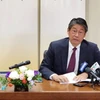
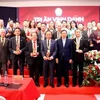
Secretary of the Ho Chi Minh Communist Youth Union Central Committee Nguyen Tuong Lam opens the seminar (Photo: doanthanhnien.vn)
 Hanoi (VNA) – The desire for devotion is the value that should be promoted among youngsters, heard a seminar held by the Ho Chi Minh Communist Youth Union (HCYU) Central Committee in Hanoi on December 7.
Participants at the event highlighted that young people need to have their own noble life purpose and aspirations to contribute to the community, the nation and humanity, bringing positive values to society. They also stressed the need for specific solutions to arouse their aspirations as well as create favorable conditions for them to devote.
Addressing the event, Prof. Dr. Hoang Chi Bao, former member of the Party Central Committee's Theoretical Council, said that the seminar’s theme “Youth devotion aspirations – Youth life purpose” reminds him of the image of the young Nguyen Tat Thanh (who was latter President Ho Chi Minh). He left Nha Rong Wharf in Sai Gon 111 years ago with only empty hands but a great desire for peace, independence and happiness for his nation. Prof. Bao also underlined President Ho Chi Minh’s thoughts and viewpoints on the role and mission of the youth – the future owners of the country.
According to Prof. Bao, in order to have the desire to make contributions, young people must first have a noble life purpose to arouse their ambitions and aspirations. Secondly, they need pure revolutionary sentiment along with faith in the Party, the people and the bright future prospects of the nation.
They also need to show good morality, qualifications, knowledge and education, as well as creative way of thinking, and need to have the attitude of a global citizen, he stressed.
The expert held that in order to build these qualities, it is necessary to create a really healthy environment to help stimulate the creativity of youth, in which youth organisations play an important role.
Bao’s ideas were shared by Vu Trong Kim, former member of the Party Central Committee and former First Secretary of the HCYU Central Committee. He underlined that the desire to dedicate will be a guideline for actions and goals for the youth to strive for and a motivation for them to become better themselves.
Meanwhile, Associate Prof. Dao Viet Hang from the Hanoi Medical University emphasised that dedication must be turned into specific actions. Each young person, depending on their ability, career, position, and aspiration to contribute should take specific actions with a common goal of bringing positive values and good things to the community.
Dr. Tran Van Mieu, an expert of youth affairs asserted that in order to encourage the youth’s desire for devotion, youth organisations should better implement democracy among young people. He underlined the need to stick to the motto of ensuring the youth know, understand, engage in the discussion and supervision activities, and enjoy the outcomes. More seminars, consultations and dialogues for youngsters should be held, he added.
Alongside, it is necessary to protect the legitimate rights and demands of the youth and their rights to access policies, laws and resources for their development, while encouraging them to join socio-economic development and environmental protection activities, according to participants.
The seminar was held on the thresholds of the 12th National Congress of the Ho Chi Minh Communist Youth Union, which will take place in Hanoi from December 14-16.
Themed "Aspirations - Solidarity - Mettle - Pioneering - Creativity", the congress is expected to saw the participation of 980 delegates representing 22 million HCYU members inside and outside the country, along with about 200 guests.
The two day-and-a-half congress will have five major sessions, focusing on youngsters’ desire to devote to the country, measures to strengthen the organisation of the Youth Union and Children’s Union and promote Vietnamese youth’s international integration./.