Solutions sought to land subsidence, saltwater intrusion in Mekong Delta region

Vietnamese and Dutch experts gave recommendations on measures to respond to land subsidence and saltwater intrusion in the Mekong Delta region during a scientific conference on January 12.
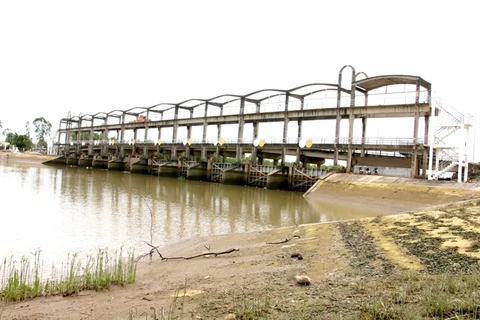
Solutions sought to land subsidence, saltwater intrusion in Mekong Delta region ảnh 1Ba Lai dam in Ben Tre (Photo: VNA)
Hanoi (VNA) – Vietnamese and Dutch experts gave recommendations on measures to respond to land subsidence and saltwater intrusion in the Mekong Delta region during a scientific conference on January 12.

Dr Laurent Umans, First Secretary for Water and Climate Change at the Embassy of the Netherlands in Vietnam said that natural resources in the Mekong Delta region play an important role in the livelihood of dozens of millions of people.

The over-exploitation of underground waters and sand, along with sea level rise and irregular flows has made land subsidence, coastal erosion and saltwater intrusion great challenges to the region, he noted, stressing that the Mekong Delta is affected by both climate and human factors. Increased saltwater intrusion has not only made the region lose millions of dollars annually due to shortage of fresh water and crop failure, but also been considered as a problem in land use planning.

Prof. Sepehr Eslami Arab, a Dutch water expert, held that the major reasons behind the worsening saltwater intrusion in the Mekong Delta region currently is human impacts, but in 2050, climate change will be the key factor.

He noted that the Mekong River is burdening 13 huge and at least 300 smaller hydropower dams. He advised Vietnam to act to minimise the exploitation of groundwater and sand, change farming method to adapt to saltwater intrusion and land subsidence and apply more technology solutions in water use.

Commenting on the land subsidence in Ca Mau, Dr. Nguyen Quoc Dinh from Vietnam Institute of Geosciences and Mineral Resources under the Ministry of Natural Resources and Environment said that the Government has been aware of the issue and designed suitable policies.
 
He underlined the need for Vietnam to continue defining reasons behind the problem and seek effective solutions. Initially, it is necessary to find alternative water resources to replace groundwater, avoiding overload in urban planning and change the agricultural structure, he said.

Participants at the event also gave proposals on strategic policies to deal with a number of issues, including measures to minimise groundwater and sand over-exploitation and the application of water saving technologies./.
VNA


See more

Many inland canals in Can Tho city dries up following a prolonged period of extreme heat. (Photo: VNA)

Government adopts action programme on environmental protection, climate resilience

The programme aims to translate the Party's orientations into concrete actions while strengthening environmental governance, enhancing climate resilience, and promoting a green, circular and low-carbon economy. It will serve as the basis for ministries, sectors and localities to formulate implementation plans for the 2026–2030 period, with a vision to 2045.

Dray Sap Waterfall lies within the UNESCO Dak Nong Global Geopark in Nam Da commune, Lam Dong province. (Photo: VNA)

Lam Dong steps up efforts to retain UNESCO global geopark status

Covering nearly 4,760 square kilometres across 22 communes and wards in western Lam Dong (equivalent to 73.1% of the former Dak Nong province's natural area), the geopark was shaped by millions of years of geological activity and successive volcanic eruptions.

A stump-tailed macaque (Macaca arctoides) is handed over to the Cam Lo–Dong Ha forest ranger station in Quang Tri province on January 27, 2026 (Photo: VNA)

Rare primate handed over to Phong Nha - Ke Bang National Park

A stump-tailed macaque (Macaca arctoides) was handed over to the Centre for Rescue, Conservation, and Development of Creatures under the Management Board of Phong Nha - Ke Bang National Park in Quang Tri province on July 21, for rehabilitation and eventual release into the wild.

Two Red Lories (Eos rubra) found among the 104 wild animals being kept without documentation proving their lawful origin in Phuoc Thanh commune, Tay Ninh province. (Photo published by VNA)

Criminal proceedings launched against case of illegal keeping, trading of 104 wild animals

They recorded a total of 104 wild animals, comprising 92 African spurred tortoises (Geochelone sulcata) of various sizes, six Red Lories (Eos rubra) and six Green-cheeked Parakeets (Pyrrhura molinae). Authorities said the animals are subject to management under Vietnam's forestry legal regulations and are listed in Appendix II of the Convention on International Trade in Endangered Species of Wild Fauna and Flora (CITES).

BUYO Bioplastics' biodegradable plastic products are made from brewer's grains and sugarcane bagasse. (Photo: nhandan.vn)

Vietnam urged to shift from plastic waste treatment to full life-cycle management

For years, efforts to tackle plastic pollution in Vietnam have focused mainly on waste collection, recycling and disposal. However, as sustainable development and green trade standards become increasingly important, specialists argued that a broader approach is needed, covering everything from product design and material selection to production, consumption and recycling.

Bang Mo volcano in Lam Dong province (Photo published by VNA)

Lam Dong optimises value of UNESCO Dak Nong Global Geopark

Alongside conservation, Lam Dong aims to tap the geopark's tourism potential through geological, ecological and community-based tourism. Infrastructure and tourism development projects must ensure that heritage values, landscapes and the natural environment are preserved.

Dr. Dang Trung Phuoc (left) is introducing the history and origin of the Pinhey sand dunes (Photo: VNA)

Vietnamese Canadian scientist revives forgotten ecosystems

From restoring an ancient sand dune ecosystem in Canada to promoting the conservation of Vietnam's coastal dunes, native forests and ecological corridors, Vietnamese-born scientist Dang Trung Phuoc has remained committed to using science to revive ecosystems long misunderstood or neglected. His quiet but sustained efforts reflect both a scientist's responsibility to the communities he serves and the enduring commitment of a Vietnamese expatriate to his homeland.

Police and military forces work together to rescue people and assist local residents in affected areas. (Photo: VNA)

PM orders proactive response to heavy rainfall in northern mountainous region

To minimise casualties and damage to public and private property, the PM instructed ministries, sectors and local authorities to strictly implement directions issued by Party General Secretary and State President To Lam, as well as the Government's directives on strengthening disaster prevention and response in 2026.

A view of the Ea So Nature Reserve in Dak Lak province (Photo: VNA)

Rare wild animals released into natural habitat in Dak Lak

Among them are two species classified under Group IB of Vietnam's protected wildlife list, namely the Bengal slow loris (Nycticebus bengalensis) and the Sunda pangolin (Manis javanica). Both are endangered forest species protected under Vietnamese law and are prohibited from commercial exploitation or use.