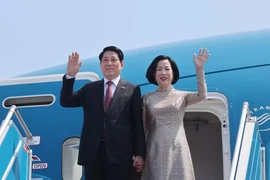
Hanoi (VNA) – The state visit to Egypt from August 3 - 6 by State President Luong Cuong, his spouse and high-ranking delegation of Vietnam marks an important diplomatic milestone for both nations, as it demonstrates a strong commitment to advancing bilateral relations, deepening political trust, and revitalising traditional friendship.
The trip is expected to create momentum for a new phase of cooperation, especially in economy and trade between Vietnam and Egypt, as well as with African countries.
Made at the invitation of Egyptian President Abdel Fattah El-Sisi and his spouse, this is the first state visit to Egypt by a Vietnamese head of state to Egypt in seven years, following the 2018 visit by then State President Tran Dai Quang.
A solid foundation for long-standing friendship
The Vietnam - Egypt diplomatic relationship spans over six decades since official ties were established on September 1, 1963. However, the foundation was laid much earlier by Vietnamese President Ho Chi Minh, who visited Egypt three times – in June 1911, June 1946, and September 1946.
Since the establishment of diplomatic relations, the Vietnam - Egypt traditional friendship has grown steadily. It has expanded across various sectors and is built on principles of equality, mutual respect, and mutually beneficial cooperation, serving the interests of both peoples.
The relationship has been strengthened through high-level visits and bilateral meetings at multilateral events and forums. These engagements have helped advance ties in multiple areas, including politics, economy, defence, parliament, and culture.
The two foreign ministries regularly hold political consultations. At the 10th session held in Egypt in November last year, both sides reaffirmed their commitments to traditional cooperation and discussed enhancing collaboration in emerging areas such as green energy, Halal food production, food security, trade, and investment, aiming to elevate their economic partnership to a new level.
Vietnam and Egypt also support each other in multilateral organisations such as the United Nations, the Non-Aligned Movement (NAM), the Association of Southeast Asian Nations (ASEAN), and the African Union (AU). Vietnam appreciates Egypt’s proactive role in promoting regional stability and security, and supports international efforts to advance dialogue and provide humanitarian aid in conflict-affected areas, contributing to peace and development in the world.
Both countries have expressed their readiness to act as bridges in strengthening cooperation between ASEAN and the Arab world, for peace, collaboration, and prosperity in their respective regions.
Untapped potential in economic, trade cooperation
Egypt stands out as one of Vietnam’s most important trading partners and a promising market in Africa. Notably, Egypt was the first North African country to officially recognise Vietnam as a full market economy in November 2013.
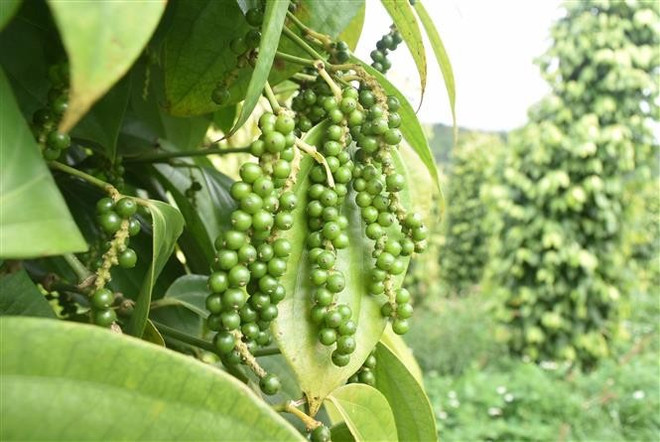
Bilateral trade reached 541.36 million USD in 2024, the highest among Vietnam’s trading partners in North Africa. Key Vietnamese exports to Egypt include computers and electronic components, machinery and equipment, seafood, agricultural products, textiles and garments, footwear, and textile fibers.
In terms of investment, Egypt currently has 22 registered projects in Vietnam with a total capital of approximately 2.78 million USD. Meanwhile, one Vietnamese enterprise is investing in Egypt with a total capital of 30 million USD, and a Vietnamese garment company is operating a joint venture with an Egyptian partner.
A memorandum of understanding on general cooperation was signed between the State Bank of Vietnam and the Central Bank of Egypt in July 2023. By the end of 2024, Vietnamese commercial banks had established 46 correspondent banking relations with banks in Egypt, with two-way transaction volumes reaching around 235 million USD, the highest figure recorded by Vietnam in the African region.
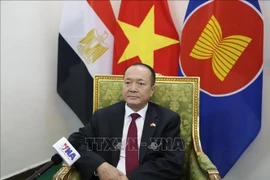
Vietnamese Ambassador to Egypt Nguyen Huy Dung highlighted the considerable potential for cooperation between the two countries, both bilaterally and multilaterally. He noted that Vietnam and Egypt possess complementary strengths, and with populations exceeding 100 million and strategic geopolitical positions.
According to the diplomat, Vietnam is a member of ASEAN, while Egypt is a key player in the Middle East-North Africa (MENA) region. Vietnam could leverage Egypt’s strategic location at the crossroads of Asia, Africa, and Europe to access the MENA market, while Egypt could see Vietnam as a gateway to the vast ASEAN market.
At a meeting on the sidelines of the 8th Future Investment Initiative (FII8) in Saudi Arabia in October 2024, Vietnamese Prime Minister Pham Minh Chinh and his Egyptian counterpart Mostafa Madbouly agreed to encourage mutual investment in areas such as electric vehicles, software development, renewable energy, solar power, green transition, and digital transformation. They also pledged to enhance cooperation in education, cultural exchange, and tourism, helping to deepen mutual understanding.
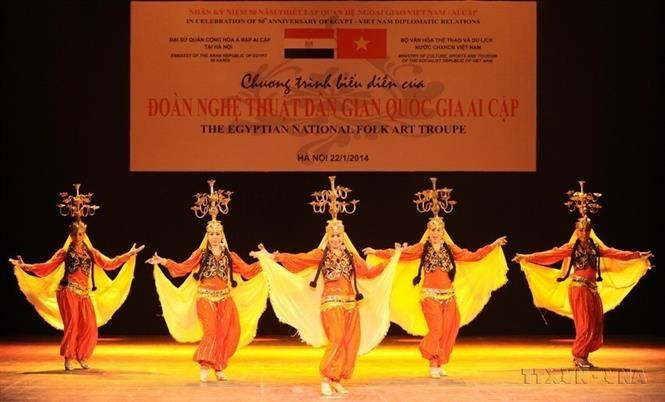
Cultural cooperation is also regarded as a vital pillar in the Vietnam–Egypt ties, playing a key role in fostering mutual awareness among the younger generations and strengthening cultural bonds between the two countries' people. On education, Egypt offers 12 annual Arabic language scholarships to Vietnamese students. The two countries have also advanced locality-to-locality cooperation in recent years, with friendship and cooperation agreements signed between Ninh Binh and Luxor in August 2018, and between Hanoi and Cairo in July 2023.
Ushering in a new era of development
According to Dung, the state visit by President Cuong, his spouse, and a high-level Vietnamese delegation, comes at a pivotal moment for both countries.
Vietnam is actively pursuing the foreign policy's objectives set out by the 13th National Party Congress, while pushing forward with institutional reforms and infrastructure development to serve the nation's progress, and preparing for the upcoming 14th Nation Party Congress. The country is also set to review its initiatives on the development of relations with Middle East–Africa countries for 2016–2025 and with the African Union for 2021–2025.
Meanwhile, Egypt is intensifying efforts to successfully implement its Egypt Vision 2030, reinforcing its regional and global position.
In this context, the visit represents a strategic diplomatic milestone for both countries. It is expected to leave a lasting impact on the development of Vietnam–Egypt relations as the two nations enter a new era of growth and development
During his trip, President Cuong is scheduled to hold talks with his Egyptian counterpart Abdel Fattah Al Sisi; meet with Prime Minister Mostafa Madbouly, Senate President Abdel-Razeq, and House of Representatives Speaker Hanafy El-Gebaly; and deliver a policy speech at the headquarters of the Arab League (AL).
On this occasion, the State President will also meet with staff of the Vietnamese Embassy and relevant agencies, along with representatives of the Vietnamese community in Egypt, according to Dung.
He stressed that leaders of both nations share the expectation that this visit will pave the way for elevating bilateral relations to a Comprehensive Partnership, thereby unlocking new areas of potential and creating broader space for cooperation. They are looking forwards to fostering a future of shared prosperity, while building and effectively utilising new cooperation mechanisms based on respect for international law, as well as each country's independence, sovereignty, territorial integrity, and political system./.