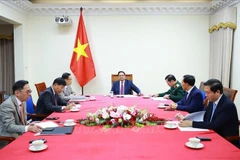
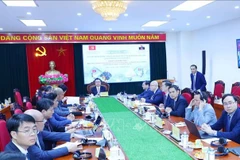
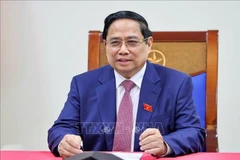
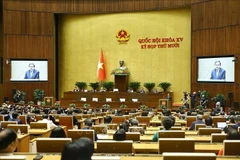
Vietnamese delegates at the meeting (Photo: qdnd.vn)
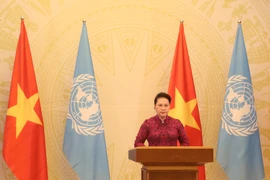
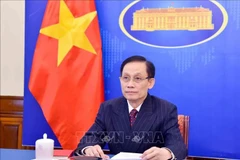
 Hanoi (VNA) – Vietnam lauds efforts of the international community, including the Inter-Parliamentary Union (IPU), in raising awareness and actions of parliaments, governments and people about peace and security issues caused by climate change, said permanent member of the Vietnamese National Assembly (NA)’s Committee for External Relations Le Thu Ha.
She was speaking at a meeting of the IPU’s Standing Committee on Peace and Security held virtually in Geneva on May 17, with representatives from 35 countries taking part.
In order to improve the efficiency of multilateral cooperation, especially increasing the role of parliaments and the IPU in face of threats and conflicts related to climate change, the Vietnamese side suggested parliaments continue maintaining strong political commitments and specific actions in the spirit of respecting international law, thus making practical contributions to global agendas on climate change prevention for the world peace and security.
Vietnam also highlighted the urgent need to provide support to developing countries to access financial resources, improve response capacity, develop new technologies and green energy, build effective and quality infrastructure in combination with generating jobs in adaptation with climate change.
She said Vietnam believes that responding to climate change needs to be suitable to conditions of each country, and be integrated into national development strategies and plans on the basis of inclusive development and equality, placing the people at the center, and further supporting the poor, disadvantaged people, women, and children. It is also necessary to have a national mechanism for monitoring and evaluating the implementation results and the improvement of climate change response capacity.
Parliaments of member countries need to make more efforts to establish specific, synchronous and substantive policies and laws for their national and global climate change issues. At the same time, Vietnam suggested the IPU set up global initiatives and programmes on developing a low-emission economy to create a foundation for policy dialogue, experience sharing and capacity building for countries, as well as the conditions to encourage private investment in sectors with low greenhouse gas emissions.
The Vietnamese NA call for participating parliaments to urge their governments to fulfil their post-2020 responsibility in reducing greenhouse gas emissions and making financial contributions, if they have yet to complete the mission; and to conduct post-2020 obligations.
The NA also recommended the parliaments actively restore economic development and relief activities to help those severely affected by climate change, ensuring that no one is left behind. Also the needed is the transformation of development models towards low carbon emissions to ensure sustainable recovery and create new jobs for workers via the promotion of digital transformation, renewable energy, smart agriculture, smart transportation and the establishment of a circular economy.
Participants at the event also adopted a resolution on parliamentary policy to improve peace and security against threats and conflicts caused by climate change and natural disasters./.