Vietnam has advantages for creative industries

Vietnam has advantages for creative industries to develop: specialist

Although creative industries remain modest in Vietnam, there are certain local advantages for them to develop in the country.
 Vietnam has advantages for creative industries to develop: specialist ảnh 1Participants at the workshop (Source: VNA)

Thua Thien-Hue (VNA) – Althoughcreative industries remain modest in Vietnam, there are certain localadvantages for them to develop in the country, according to a specialist fromVietnam’s Ministry of Labour, Invalids and Social Affairs (MOLISA).

Nguyen Thi Bich Thuy, Director of the Research Centre forFemale Labour and Gender under MOLISA’s Institute of Labour Science and SocialAffairs, was speaking at the workshop “Unlocking potential, creating style –APEC GIFTS (Gendered Innovation for Technology and Science) for Women in thecreative industry”, which was hosted by the Department of Gender Equality ofChinese Taipei in Hue city, the central province of Thua Thien-Hue, onSeptember 26.

Thuy said “creative industry” refers to a range of economicactivities that are concerned with the generation and commercialisation ofcreativity, ideas, knowledge and information. 

There are 12 sub-sectors under the term “creative industry”,including advertising, architecture, interactive leisure software, the art andantiques market, design, film and video, publishing, music, the performingarts, television and radio, software and computer games, and cultural tourism.

She noted that the creative industry generates about 2.2trillion USD in revenue or 3.3 percent the global GDP. Its revenue evensurpasses the entire GDP of India, 1.9 trillion USD.

The creative industries generated 29.5 million jobs, equivalentto 1 percent of the world’s active population. They also employ more peoplethan the automotive industry in the US, Europe and Japan combined.

She said Vietnam has not made the best use of intellectualproperty and local small- and medium-sized enterprises spend onlyabout 0.2 – 0.3 percent of their turnover on technological renovation.

The number of Vietnamese inventions proposed to the WorldIntellectual Property Organisation (WIPO) for recognition equal to 1/1,000 of Chinaand 1/5,000 of Japan. While the country’s software industry productivity isworth some 10,000 USD per person each year, the figure is 14,000 – 18,000 USDin China and 140,000 USD in the US.

However, Thuy also recognised certain advantages of Vietnam, includingthe large domestic market. The country has a young population with “commercial”sensitivity and a high level of digital technology, in addition to the richnessand diversity of regions and culture. Another advantage is that many newmanufacturing industries in the supply chain of the creative industries haveemerged.

Suggesting solutions to developing the creative industries, Thuy said it isnecessary to set up a specialised state management agency along with a numberof creative centres. She also highlighted the need for human resourcestraining, a supportive infrastructure system, a favourable legal system, andthe capacity to enforce intellectual property and copyright protection.

The workshop “Unlocking potential, creating style – APEC GIFTS forWomen in the creative industry” was a side event of the ongoing 2017 APEC Womenand the Economy Forum in Hue city.

Established in 1989, APECcomprises 21 economies which account for 39 percent of the world population, 57percent of the world GDP and 47 percent of the global trade, according tostatistics in 2014.

The APEC Year 2017 is takingplace in Vietnam under the theme “Creating New Dynamism, Fostering a SharedFuture”. The country used to host APEC events in 2006.-VNA


VNA
See more

Thailand diversifies oil sources to ensure energy security

Thailand diversifies oil sources to ensure energy security

Although the diversification of oil import sources has helped reduce the risk of domestic oil shortage, it has not immediately reduced energy costs because import prices depend on market mechanisms, transportation costs, foreign exchange rates and the terms of oil contracts.

ST Telemedia Global Data Centres (Thailand), an affiliate of Singapore Telecom, is developing three data cehtres in Thailand including this facility on Rama IX Road in Bangkok. (Photo: bangkokpost)

Thailand tightens regulations on data centres

The new rules focus on controlling investment scale, electricity and water consumption, environmental impacts, and preventing investors from reserving resource quotas beyond their actual needs.

A road is under construction in Dong Nai city, Vietnam. (Photo: VNA)

ADB: Southeast Asia needs 7.1 trillion USD in infrastructure investment by 2040

ADB estimates that the region will need an average of 476 billion USD in infrastructure investment annually during 2026–2040, equivalent to 8.7% of GDP. However, at current investment levels, government budget resources would cover only around 45% of this demand, leaving an annual financing gap of 264 billion USD.

Kyodo News publishes an article titled “Sculptures by Japanese, Vietnamese artists on display in Yokohama,” (Screenshot photo)

Japanese media widely cover top Vietnamese leader ’s visit

Japanese media have continued extensive coverage of General Secretary of the Communist Party of Vietnam (CPV) Central Committee and President To Lam’s activities in Japan, highlighting his meetings with representatives of leading financial institutions at the Tokyo Stock Exchange, witnessing of cooperation agreement signing and participation in cultural exchanges.

Thailand pushes for establishment of ASEAN emergency public health centre

Thailand pushes for establishment of ASEAN emergency public health centre

The draft agreement stipulates that ACPHEED will comprise three specialised centres based in three ASEAN member states. Vietnam will oversee the centre for prevention and preparedness; Indonesia will host the centre for detection and risk assessment; and Thailand will be responsible for the centre for response and risk communication.

Indonesia designates 31 mln ha of waters as conservation areas

Indonesia designates 31 mln ha of waters as conservation areas

Head of the Convention and Marine Resource Balance working team at the ministry’s Directorate of Ecosystem Conservation Ahmad Sofiullah said this week that it is a strategic effort to ensure the sustainability of Indonesia’s marine ecosystems.

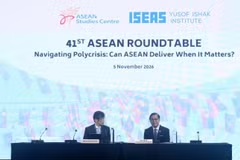
Thai Deputy Prime Minister and Minister of Foreign Affairs Sihasak Phuangketkeow (R) takes part in the Q&A session at the 41st ASEAN Roundtable. (Photo: VNA)

Thailand calls on ASEAN to proactively address polycrisis

Thai Deputy Prime Minister and Minister of Foreign Affairs Sihasak Phuangketkeow noted that no single member state could tackle challenges ranging from major-power competition and economic fragmentation to climate change and energy and food security on its own. Regional cooperation is therefore a strategic imperative, enabling ASEAN not only to overcome crises but also to sustain its development momentum.