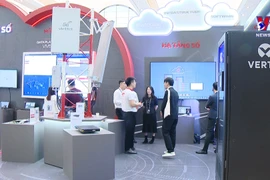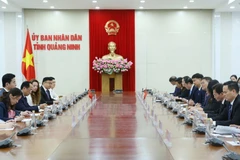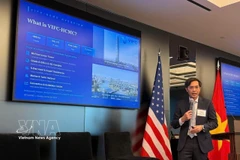
Davos (VNA) - The Ministry of Planning and Investment and the Ministry of Foreign Affairs, in collaboration with Sovico Group, organised a seminar themed “Digital Infrastructure - Green Energy: Rising in the Intelligent Age” with leaders of Vietnamese and international businesses on the sidelines of the 55th Annual Meeting of the World Economic Forum (WEF) in Davos, Switzerland, on January 22.
The event saw the presence of several Vietnamese ministers, and leaders of Vietnamese and global enterprises in the fields of high-tech, energy, telecommunications, and finance-banking, such as Sovico Group, VNPT, Mitsubishi Heavy Industries, TikTok, Cisco APJC, and the International Telecommunication Union (ITU).
Participants explored investment potential in digital infrastructure and green energy in Vietnam, proposed collaboration on investing in a green data centre and digital transformation, promoted international cooperation in renewable energy, and provided recommendations to build Vietnam into a regional hub for technology and finance.
Addressing the seminar, Minister of Planning and Investment Nguyen Chi Dung, authorised by Prime Minister Pham Minh Chinh, said that Vietnam well recognise that digital infrastructure and green energy are not only development goals but also means to realise its aspiration of becoming a high-income country by 2045.
Regarding the country's socio-economic situation after nearly 40 years of renewal, Dung noted that many leading global groups are planning to expand their investments in Vietnam, reflecting a new wave of investment, particularly in high technology, electronics, semiconductors, clean energy, transport, and infrastructure sectors.
He emphasised that digital infrastructure is the foundational element for Vietnam to achieve its goal of becoming a stable and prosperous digital nation, pioneering in experimenting with new technologies and models. It helps fundamentally and comprehensively reform the government's management and operations, business and production activities, and the way people live and work, while fostering a safe, humane, and widespread digital environment. Through these efforts, Vietnam seeks to achieve the dual goal of developing a digital government, digital economy, and digital society, alongside building Vietnamese digital technology enterprises capable of expanding globally.
To develop digital infrastructure and meet the burgeoning demand for connectivity and data processing, as well as network monitoring and cybersecurity functions, Vietnam will focus on building and expanding high-quality broadband infrastructure nationwide, developing 5G mobile network infrastructure, expanding domestic, regional, and international Internet connectivity, and developing infrastructure for Internet of Things (IoT) network connections, he said.
Notably, Vietnam has been promoting the foundational conditions for high-tech industries, with a focus on high-quality human resources as a core element. By 2030, Vietnam aims to train and upskill a workforce of hundreds of thousands of high-tech engineers, including 50,000 specialists in the chip and semiconductor sectors, to meet the growing demands of the country’s modernisation efforts, Dung stressed.
At the same time, to achieve green energy transition, the country has been working tirelessly to implement energy transition initiatives aimed at realising its greenhouse gas emission reduction targets, reflected through the development of policy frameworks, strategies, and master plans, the minister stated.
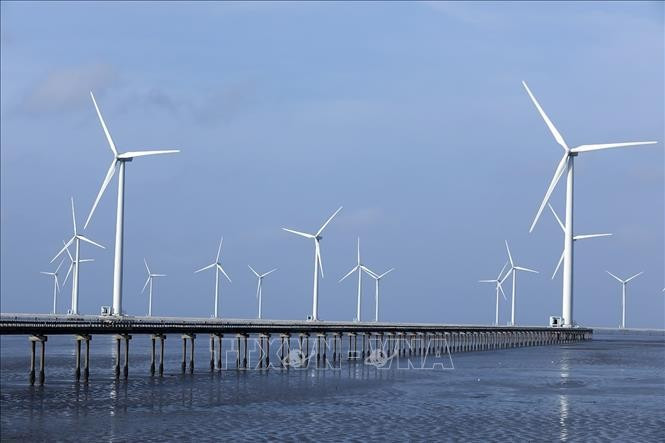
Vietnam has become one of the leading Southeast Asian countries in renewable energy development, particularly solar and wind power, with a commitment to achieving net-zero emissions by 2050. This presents significant opportunities for international businesses to invest in the country's green energy transition, Dung noted.
According to the minister, the country has passed the revised 2024 Electricity Law and approved the National Power Development Plan VIII to encourage the private sector, especially foreign investors, to participate in energy projects. These legal updates provide a solid foundation for future collaboration in renewable energy.
As Vietnam is improving its investment policies and legal framework, it is becoming an increasingly attractive market for digital infrastructure and green energy development. However, Dung stressed that unlocking the sector's full potential requires continued investment, innovation, and deeper global partnerships.
Vietnam is inviting both domestic and international businesses, scientific organisations, and individuals to join in advancing digital infrastructure and green energy projects. The government is also encouraging the use of cutting-edge technologies to tackle environmental and social challenges, as well as participation in joint initiatives aimed at driving digital transformation and sustainable development.
In the coming time, Vietnam will focus on promoting internal resources and proactively integrating internationally, focusing on digital economic transformation, digital infrastructure, green growth, green energy, science and technology development, and innovation. To create deep integration and more effective participation in the global supply chain, Dung said that Vietnam will promote investment in developing strategic infrastructure, important projects, and spread quickly into the economy to reduce costs and enhance competitiveness.
Dung said that the Vietnamese Government is committed to creating all favourable conditions to develop digital infrastructure and green energy. In particular, it will promote policies to encourage investment, with a transparent and favourable environment for businesses to invest in digital technology and renewable energy; step up international cooperation to learn from experience, receive technology and expand cooperation with international partners in this field; and focus on developing human resources to prepare a high-quality workforce, ready to meet the needs of the digital era and energy transition.
He emphasised that the Vietnamese Government will always accompany, listen, support and create favourable conditions for the business community in general and foreign investors in particular to invest successfully, sustainably and for a long-term in Vietnam./.