Vietnam issues ISO standards to realise net zero commitments

The Directorate for Standards, Metrology and Quality under the Ministry of Science and Technology has issued International Standardisation Organisation (ISO) standards regarding climate change adaption as a practical action to realise Vietnam’s net zero commitments.
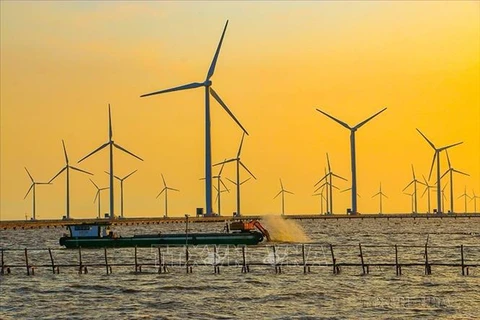
Vietnam issues ISO standards to realise net zero commitments ảnh 1A corner of Bac Lieu Wind Power Plan in the southern province of Bac Lieu (Photo: VNA)
Hanoi (VNA) - The Directorate for Standards, Metrology and Qualityunder the Ministry of Science and Technology has issued InternationalStandardisation Organisation (ISO) standards regarding climate change adaptionas a practical action to realise Vietnam’s net zero commitments.

The standards named TCVN ISO 14090:2020 contain principles, requirements andguidelines to instruct organisations and sectors to adapt to climate change.They can be applied to every organisation of all sizes, local, regional,international, and at all types of business, corporation, sector, and naturalresource manager.

Thestandards can assist in the development of climate change adaptation standardsfor specific sectors or factors.

Thestandards were issued after Vietnam made a commitment to net zero emissions by2050. The introduction of the standards on climate change adaptation isconsidered one of the practical actions to achieve the commitment.

At the27th Conference of the Parties to the United Nations Framework Convention onClimate Change (COP27), held in Sharm El-Sheikh, Egypt, on 11 November 2022,the International Organisation for Standardisation announced a new global guidethat includes guiding principles for achieving net-zero.

Underthe guidelines, reducing emissions at the source is believed to be the mosteffective way to achieve net-zero.

To dothat, countries are advised to improve energy efficiency, switch to renewableenergy sources and innovate processes to reduce waste.

Foremissions that cannot be eliminated, carbon offsetting is a possible solution.They involve investing in projects that remove or reduce greenhouse gases inthe atmosphere.

Theguidelines say that the involvement of stakeholders - employees, customers,investors and the community is key to the successful implementation of anet-zero strategy.

Rightafter the guide was issued, the directorate disseminated it to organisationsand businesses to help them identify and manage risks, as well as seize allopportunities that climate change can bring.

Accordingto a United Nations report, Vietnam ranks 6th among the countries suffering themost from extreme weather. Over the past 20 years, Vietnam has sufferedhundreds of natural disasters causing loss of human life and materials.

Vietnam'sproactive commitment of net zero to the world not only helps reduce the risk ofcatastrophic climate change, extreme weather phenomena, and sea level rise,loss of biodiversity; disruption of food and water supplies, but also protectshuman health, promotes innovation and economic growth; enhances energysecurity; and conserves ecosystems and biodiversity./.
VNA

See more

Sarus cranes at Tram Chim National Park (Photo: VNA)

Return of sarus cranes: Hope takes wing in Dong Thap wetland

Beneath the wide Mekong Delta sky, Tram Chim National Park is racing against time, pouring heart and science into a decade-long (2022–2032) plan to rescue the Eastern sarus crane – an elegant, scarlet-headed bird listed as endangered on the International Union for the Conservation of Nature (IUCN) Red List and a living emblem of both the park and all of Dong Thap province

French Ambassador Olivier Brochet speaks at the press conference in Hanoi on December 11 to mark the 10th anniversary of the Paris Agreement on climate change and highlighting the COP30 outcomes. (Photo: VNA)

International community ready to support Vietnam in energy transition, climate response

In a video message to the press conference, UN Resident Coordinator in Vietnam Pauline Tamesis said the UN is ready to support Vietnam in building a pipeline of projects capable of absorbing financing mobilised under the Political Declaration on establishing the Just Energy Transition Partnership (JETP), as well as from global climate finance sources, including the Green Climate Fund and the Loss and Damage Fund.

Forest rangers in Son La province apply technological devices and software to forest management, monitoring, and protection. (Photo: nhandan.vn)

Digital technology application enhances forest management, protection

With a total forest area of over 14 million hectares, including more than 10 million hectares of natural forests, forests exist in all 34 provinces and cities across the country. Given the large area and limited workforce, applying digital solutions in forest management and protection has become a top priority for the forestry sector.

Sunda pangolins (Manis javanica), also known as the Javan pangolin, are listed in Group IB – critically endangered and strictly protected from all commercial exploitation (Photo: VNA)

Quang Ngai releases rare pangolin back into nature

Initial verification showed that the animal weighed 3.7kg and measured over 60cm. It was identified as a Sunda pangolin (Manis javanica), also known as the Javan pangolin, listed in Group IB – critically endangered and strictly protected from all commercial exploitation.

Residents of Tuyen Quang province take part in the One Billion Trees Programme. (Photo: VNA)

Tree-planting programme exceeds one-billion-tree goal

The total comprises 573.9 million scattered trees and 865.2 million trees grown in concentrated plantations, equivalent to 429,125 hectares of forest. Provinces posting the strongest results include Phu Tho with 177.9 million trees, Lao Cai with 108.8 million, and An Giang with 98.5 million.

Construction activity is one of the causes of air pollution in Hanoi. (Photo: VNA)

Hanoi takes urgent measures to curb air pollution

The city requires the enhanced application of advanced technologies and remote monitoring systems, including satellite remote sensing, drones, and AI-integrated traffic cameras, to monitor, detect, and strictly address the illegal burning of garbage, straw, and agricultural by-products.

The World Bank delegation holds working session with Can Tho city People's Committee and relevant units (Photo: VNA)

World Bank delegation surveys Can Tho urban resilience project

The project is jointly financed by the WB with up to 250 million USD and a 10-million-USD non-refundable grant from the Swiss State Secretariat for Economic Affairs (SECO), along with counterpart funding from the Vietnamese Government. Its goal is to build a climate-resilient and sustainable city that can drive socio-economic growth across the Mekong Delta, mitigate flood vulnerability in central Can Tho, and improve inter- and intra-regional transport connectivity.