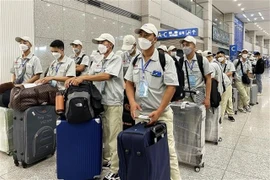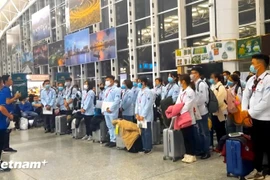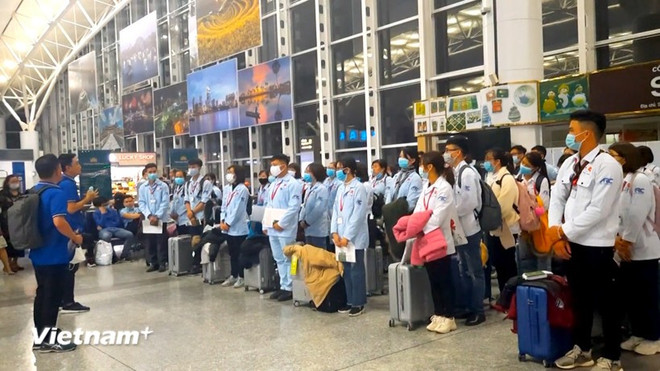
Hanoi (VNA) - The year 2025 is regarded as a pivotal one for Vietnam’s overseas employment sector, with more than 120,000 workers sent abroad in the first ten months, reaching 93.2% of the annual target. Alongside these positive results, however, traditional labour markets such as Japan, the Republic of Korea and Taiwan (China) are facing new challenges, underscoring the need for comprehensive measures to enhance quality and overall effectiveness.
According to Vu Truong Giang, Acting Director General of the Department of Overseas Labour Management, 2025 is the first year in which several key resolutions of the Politburo have been put into implementation, providing strong momentum for the sector. Over 45 years, millions of Vietnamese workers have been sent to work abroad, contributing a substantial source of foreign currency to the national economy.
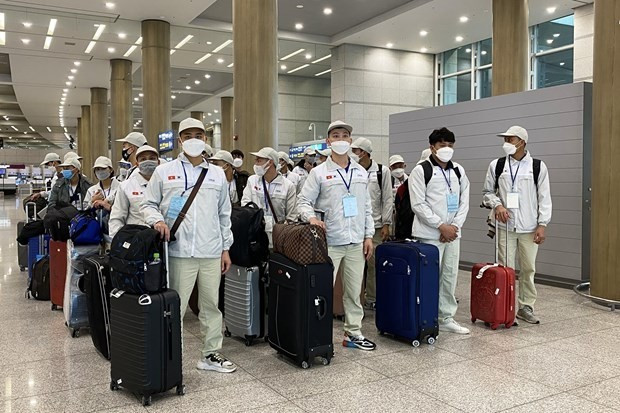
Figures for the first ten months of 2025 show that more than 120,000 workers went overseas, with Japan remaining the largest market at over 55,000, followed by Taiwan (China) with more than 47,000 and the Republic of Korea with nearly 10,000. European markets such as Germany, Romania, Hungary and Russia have remained stable.
By the end of 2025, the total number of Vietnamese workers employed overseas during the 2021–2025 period is estimated at around 636,000, equivalent to 127.3% of the original plan of 500,000. At present, about 860,000 Vietnamese workers are employed abroad, remitting an estimated 6.5–7 billion USD annually, making an important contribution to national foreign currency inflows.
The sector, however, faces mounting challenges. International labour competition is intensifying as countries such as the Philippines, Indonesia, India and Bangladesh step up their overseas employment policies, placing growing pressure on Vietnamese workers.
Giang noted that foreign language skills and vocational competence among a segment of Vietnamese workers still fall short of the requirements of developed markets, forcing enterprises to invest more heavily in training. Many companies also face difficulties in accessing information on immigration laws in new markets in Europe and the Americas.
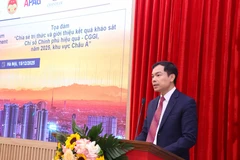
Deputy Minister of Home Affairs Vu Chien Thang attributed the recent slowdown in overseas employment to multiple factors, including global economic difficulties, tighter immigration policies in some countries, shortcomings in management mechanisms and violations in labour dispatch activities.
To address these issues, the Ministry of Home Affairs will roll out a range of coordinated measures. These include cutting cumbersome administrative procedures and increasing transparency in processes, agreements and costs so that workers can more easily access information.
Another key solution is to step up communication on international agreements, procedures and mechanisms, helping the public clearly distinguish between commercial and non-profit labour contracts and avoid exploitation by brokers.
In addition, the Deputy Minister stressed the need to strengthen education and training to improve vocational skills and professional conduct, enabling workers to perform effectively while complying with host-country laws and avoiding becoming a burden on receiving countries. The ministry will also coordinate with the Ministry of Foreign Affairs and consular authorities to protect citizens and respond promptly to violations or risks.
In addition, the Deputy Minister stressed the need to strengthen education and training to improve vocational skills and professional conduct, enabling workers to perform effectively while complying with host-country laws and avoiding becoming a burden on receiving countries. The ministry will also coordinate with the Ministry of Foreign Affairs and consular authorities to protect citizens and respond promptly to violations or risks.
The Ministry will also further promote digital transformation through the development of national applications such as DOLAB-JICA and online job exchange platforms, providing workers with more choices.
Thang emphasised that, if implemented in a coordinated manner, these measures will bring about significant improvements in both the quality and scale of Vietnam’s overseas employment sector./.