A view of Phu Quoc island in Kien Giang (Illustrative image. Photo: VNA)
 Hanoi (VNA) - Vietnam has long been persistentand consistent in safeguarding its national sovereignty in the East Sea throughpeaceful measures on the basis of international law to maintain peace,stability, security and cooperation at sea for the legitimate interests of allparties.
Early during the Nguyen Dynasty (1802-1945), the feudaladministration sent teams to Hoang Sa (Paracel) and Truong Sa (Spratly)archipelagoes to make surveys, plant landmarks and draw maps as well as rescueVietnamese and foreign vessels in trouble in the waters.
During the dynasty, a Hoang Sa flotilla was formed and sentto Hoang Sa to exploit sea products on a yearly basis. In 1816, Nguyen Anh, orGia Long King, ordered the erection of a flagpole affirming sovereignty overHoang Sa.
Throughout history, sea and islands have always played animportant role in national construction and defence. The Party and State of Vietnamhas issued many policies and plans for maritime economic development, ensuringnational defence and security, and safeguarding sovereignty, rights andjurisdiction of the country over seas and islands.
Resolution 09-NQ/TW on Vietnam maritime strategy towards2020, which was issued on February 2, 2007, sets a target to make Vietnam acountry strong of sea and rich from sea in line with ensuring nationalsovereignty at sea.
The introduction of the strategy was an important stepforwards to help the country optimise the resources for the expansion ofmaritime economic sectors. Based on the strategy, the Government, sectors andlocalities have implemented many action programmes and specific projects toexploit maritime resources with fruitful results.
However, amidst complicated and unexpected developments inthe region and the world, especially competition among world powers anddisputes among coastal states, along with environmental pollution, climatechange and sea level rises, Vietnam has issued a new resolution on sustainablemaritime economic development towards 2030, with a vision to 2045.
The resolution clarified the goal of turning Vietnam into astrong coastal country; reaching criteria of sustainable maritime economicdevelopment; forming maritime ecologic culture; adapting to climate change andsea level rises; preventing maritime environmental pollution and degradation aswell as coastal erosion and salinity; and recovering and preserving importantmaritime ecosystems.
It also defines new scientific and technology advances asdirect factors promoting the sustainable growth of the maritime economy.
The East Sea has a strategic role and position for Vietnam,and is of interest to many countries. Development in the sea has become morecomplicated with escalating tension.
At the 34th ASEAN Summit in Bangkok in June,Prime Minister Nguyen Xuan Phuc highlighted the need to look into illegal landreinforcement and militarisation, the prevention of legal resource exploitationat sea, and even threats to thelives and property of fishermen.
Vietnam always encourages dialogue and cooperation, whilestaying straightforward and responsible to avoidthe developments that may harmthe peaceful environment, security and stability in the region, he stated.
Additionally, at the recent 52nd ASEAN ForeignMinisters’ Meeting in Bangkok, Deputy PM and Foreign Minister Pham Binh Minhstressed the ASEAN principles on the East Sea and called on all parties tostrengthen trust, not to conduct militarisation and actions complicating thesituation and escalating tension, not to use or threaten to use force, and uphold and comply with international laws,including the 1982 United Nations Convention on the Law of the Sea (UNCLOS 1982),the Declaration on the Conduct of Parties in the East Sea (DOC), towardperfecting an effective Code of Conduct (COC).
Vietnam hasremained persistent and consistent in dealing with East Sea disputes throughpeaceful measures on the basis of mutual understanding and respect, complying withinternational law, especially the UNCLOS 1982. Vietnam has strictly abided bythe DOC and exerted efforts to create the COC.
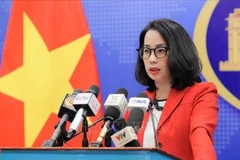
In response to actions violating Vietnam’s waters, theMinistry of Foreign Affairs’ spokesperson has repeatedly affirmed: “Vietnam has sufficient legal foundationand historical evidence testifying to its sovereignty over Hoang Sa and TruongSa archipelagoes.” The official has also clarified Vietnam’s consistent policyof resolutely persistently fighting, through peacefulmeasures in line with international law and the UNCLOS 1982, actions violatingthe sovereignty, sovereign rights and jurisdiction of Vietnam over watersdefined by the UNCLOS 1982.
With a spirit of upholding law and a goodwill, Vietnam askscountries in the East Sea region to respect sovereignty and legitimate interestof states, and follow international law, especially the UNCLOS 1982,contributing to peace, security, stability and cooperation in the region.-VNA
VNA