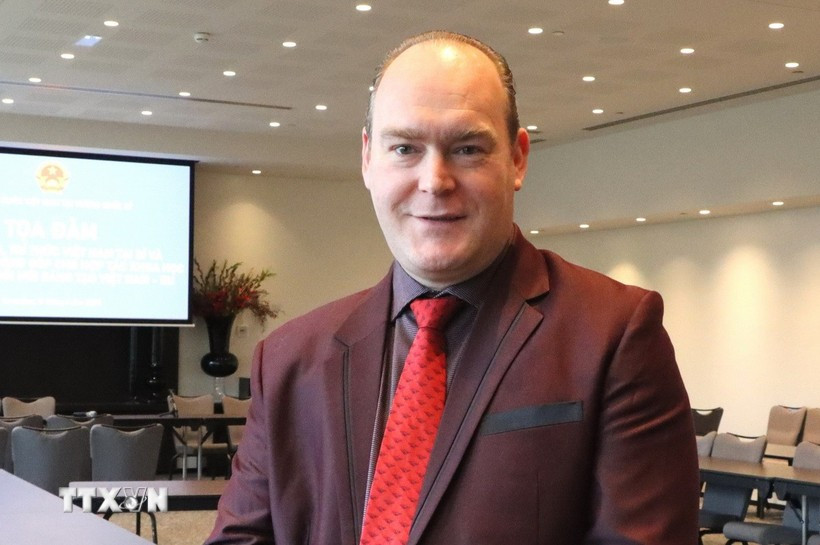
Brussels (VNA) - Vietnam has a real opportunity to achieve rapid growth through 2045, provided it fundamentally changes the way value is created and ensures a sufficiently strong and reliable energy foundation, said Eric Van Vaerenbergh, an energy expert and lecturer at the Brussels Engineering School (ECAM).
Speaking to a Vietnam News Agency (VNA) correspondent in Brussels, Van Vaerenbergh noted that the targets Vietnam has set for the 2026–2045 period are highly ambitious but not risky. Maintaining high growth over the coming decades and striving to become a high-income country by 2045 are consistent with the country’s existing advantages, including deep international integration, an established industrial base, a population still in its “golden demographic period,” and relatively effective policy management capacity.
However, he stressed that the world is entering a phase of fragmentation in trade and technology, while climate-related requirements, traceability and compliance standards are becoming increasingly stringent. At the same time, physical constraints such as energy, water and material resources are becoming more apparent. Therefore, the core issue is no longer how fast Vietnam can grow, but how it grows, how to create more value with fewer resources, while enhancing resilience to external shocks.
Assessing prospects for the 2026–2030 period, the scholar outlined three possible growth scenarios for Vietnam. The baseline scenario ranges from 6.5–7.5% per year; the high-growth scenario could reach 8–9%; while growth close to 10%, though not impossible, cannot be taken for granted without meeting key conditions. Sustaining double-digit growth in a durable manner would require the simultaneous fulfilment of many fundamental prerequisites.
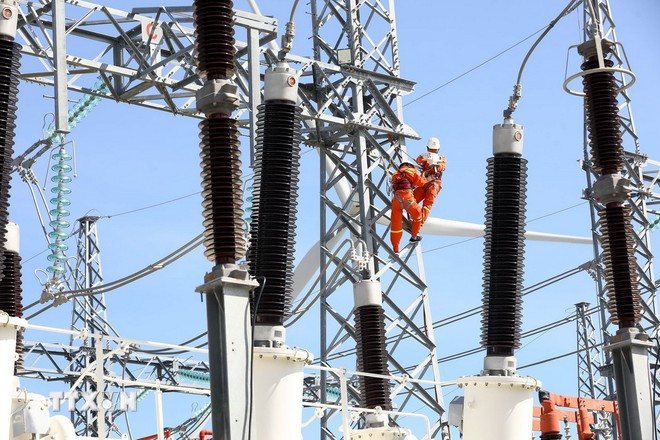
First and foremost is rapid, well-targeted and effective public investment in infrastructure, particularly energy systems, seaports, roads and railways. Electricity, he said, is the “lifeblood” of the modern economy. Vietnam needs power that is affordable, safe, readily available on demand and scalable, not only in generation capacity but also in transmission networks. He warned that without a robust power grid and reliable supply contracts, electricity-intensive sectors such as electronics, semiconductors and data centres will struggle to develop as expected.
Beyond infrastructure and energy, another critical condition is genuine improvement in total factor productivity, rather than continued reliance on expanding labour and capital inputs. This is closely linked to large-scale skills upgrading, especially for engineers, technicians and industrial managers. In parallel, the legal environment must be simplified, stable and predictable, so that businesses and investors have sufficient confidence to take long-term risks.
The energy expert spoke highly of external drivers such as the EU–Vietnam Free Trade Agreement (EVFTA), the Comprehensive and Progressive Agreement for Trans-Pacific Partnership (CPTPP), the Regional Comprehensive Economic Partnership (RCEP), and the “China+1” strategy. However, he cautioned that these agreements will only deliver tangible benefits if Vietnam significantly increases its domestic value added. Conversely, a frequently underestimated risk lies in the economy’s high degree of openness, which exposes Vietnam to stricter rules of origin, trade fraud investigations, suspicions of “transshipment,” and new carbon-related barriers.
According to the expert, becoming a high-income country is not simply about crossing a nominal income threshold, which is adjusted annually. The greatest challenge lies in sustaining a stable development trajectory over two decades, as population growth slows and the advantage of low-cost labour fades. In this context, productivity must become the “central engine” of growth.
To achieve this, Vietnam needs a sufficiently strong institutional push, including ensuring legal security, simplifying procedures, accelerating decision-making, and effectively combating corruption without paralysing the administrative apparatus. This should be accompanied by a deliberate strategy to upgrade value chains, gradually shifting from assembly to design, component manufacturing, industrial software development, higher-margin services, and ultimately brand building.
Van Vaerenbergh particularly emphasised the role of human capital, describing it as the highest-return investment. Vietnam needs to train and attract large numbers of engineers and technicians, while organising continuous retraining to keep pace with new technological waves, from nanotechnology and biotechnology to information technology and cognitive sciences. However, he warned that all efforts in human resources and technology would be difficult to sustain without a competitive, reliable, low-emission energy system capable of meeting demand. The energy disruptions faced by many Western countries, especially those overly dependent on intermittent renewable sources, offer lessons Vietnam should heed.
According to the scholar, Vietnam must move away from a growth model based on scale and cheap labour towards one driven by productivity, quality and innovation, aligned with a circular economy. This requires substantive and transparent administrative reforms, unlocking the private sector, reforming state-owned enterprises so they do not crowd out private capital, reallocating resources to avoid excessive bias toward real estate and credit, and implementing the circular economy in a meaningful way from production to consumption.
Equally important are modernising education and skills, reducing industrial carbon emissions in line with Power Development Plan VIII, upgrading the power grid, developing energy storage technologies, and improving energy efficiency. In his view, Vietnam’s future competitiveness will ultimately be determined by electricity, grid infrastructure and the way resources are used.
Amid increasingly complex geopolitical dynamics, he recommended that Vietnam pursue a strategy of “multi-alignment,” proactively diversifying partners and strengthening its capacity to demonstrate compliance with international standards. Compliance, he said, should not be seen as a burden but as a competitive advantage, particularly in the context of new EU mechanisms such as the Carbon Border Adjustment Mechanism (CBAM), the EU Deforestation Regulation (EUDR), and the Corporate Sustainability Due Diligence Directive (CSDDD).
The expert affirmed that Vietnam can indeed embark on a path of rapid and sustainable growth through 2045 if it places productivity, energy and institutions at the core of its development strategy. A 2045 vision underpinned by clear indicators on productivity, value added, workforce skills, power system reliability and institutional quality will help translate ambition into concrete action, while strengthening confidence among citizens, businesses and international partners./.