Vietnam strengthens trade promotion to tap Halal market potential

Halal products for export require critical international certification and adherence to Halal standards, heard a conference on trade performance held on November 14 in Ho Chi Minh City as part of the Vietnam Foodexpo 2024.

halal.jpeg
Vietnamese products at the fair (Photo: VNA)

Hanoi (VNA) - Halal products for export require critical international certification and adherence to Halal standards, heard a conference on trade performance held on November 14 in Ho Chi Minh City as part of the Vietnam Foodexpo 2024.

The global Muslim community exceeds 2 billion, representing around 25% of the world’s population. Most Muslims reside in Asia, particularly in ASEAN. Over recent years, the demand for Halal-certified products has surged, evolving into a global trend.

According to the UN Food and Agriculture Organisation (FAO), global Muslim spending on Halal food is projected to reach 1.9 trillion USD in 2024 and 15 trillion USD by 2050. Notably, Halal products appeal not only to Muslims but also to broader markets, thanks to their quality, safety, and sustainability credentials.

Nguyen Minh Phuong, head of the Asia-Africa Market Department at Vietnam's Ministry of Industry and Trade, noted that regions like the Middle East, with nearly 600 million residents, depend heavily on food imports. Similarly, North Africa’s food demands are largely met through imports. These regions present significant opportunities for Vietnam’s Halal exports, particularly seafood, agricultural products, and processed foods.

In 2024, Vietnam’s Halal exports are expected to approach 700 million USD, with the UAE, Saudi Arabia, and Egypt being key markets. Vietnam’s total food export value to these areas is estimated to comprise 30–35% in value.

Despite being a global export powerhouse, Vietnam is not yet among the top 30 global suppliers of Halal products. Le Chau Hai Vu, Director of Consultech, attributes this to fragmented efforts by Vietnamese enterprises. Meeting Halal standards requires strict adherence to guidelines such as using materials free of Haram components and ensuring that production and packaging maintain Halal integrity.

To address these challenges, businesses must obtain Halal certification from internationally recognized bodies. This certification assures buyers that products meet the necessary standards for Halal compliance.

Vietnam ranks among the top 20 global food exporters and is a leading exporter of agricultural products. Additionally, Vietnam has signed 17 free trade agreements (FTAs), including next-generation pacts, positioning it favorably in global supply chains.

However, competition is fierce, particularly from countries like Malaysia, Indonesia, and Thailand, which have established reputations in Halal exports. Vietnamese exporters also face cultural and consumer preference differences in regions like the Middle East and Africa. Adjusting marketing strategies, packaging, and product development to suit these preferences is essential.

Nguyen Minh Phuong advised leveraging trade promotion activities, including international fairs and government-led trade delegations, to strengthen access to these markets. She also highlighted the importance of understanding import regulations, customs procedures, and tax structures in target countries.

Nguyen Thi Ngoc Hang, Marketing Director at the Halal Certification Agency, emphasises the importance of accurate and honest information during the Halal certification process. Certified products must avoid designs, logos, or symbols that contradict Islamic principles. Product names should not imply association with non-Halal items or Christian celebrations, such as "Christmas" or "Valentine."

Vietnamese businesses should choose certification bodies recognized by major Halal authorities, such as Malaysia’s JAKIM or Indonesia’s BPJPH. Currently, Vietnam has only one internationally recognised certification body, the Halal Certification Agency (HCA). The limited availability of reliable certification information is challenging for enterprises.

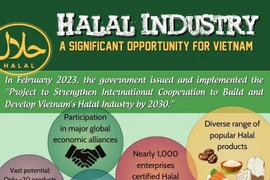
In February 2023, the Vietnamese government approved a national strategy to develop the Halal industry by 2030. This plan aims to enhance Vietnam's capacity to integrate into global Halal supply chains, enabling deeper participation in international markets.

A credible certification system and robust trade promotion initiatives will help Vietnamese businesses not only penetrate Halal markets but also build global brand recognition. By aligning with international standards and tapping Vietnam’s strengths, the country can position itself as a significant player in the Halal food industry./.
See more

Vice Chairman of the Ho Chi Minh City People’s Committee Hoang Nguyen Dinh delivers remarks at the working luncheon themed “Vietnam International Financial Centre in Ho Chi Minh City (VIFC-HCMC) – Vision and Investment Opportunities”. (Photo: VNA)

Ho Chi Minh City strengthens global engagement at WEF Davos 2026

Vice Chairman of the Ho Chi Minh City People’s Committee Hoang Nguyen Dinh presented the city’s strategic vision, policy orientation and development priorities for building a modern, transparent and globally connected finance – technology ecosystem, with science – technology, data, artificial intelligence and fintech identified as core pillars.

The VSS reported that total accumulated reserves across the social, health, and unemployment insurance funds now top 1.5 quadrillion VND. (Illustrative photo: VNA)

VSS pledges tighter fund management, diversified investments

The VSS will also impose stricter financial discipline in fund management, while pursuing broader diversification of investment portfolios, as guided by the principle of “safety, sustainability, and efficiency”. This approach aims to secure strong liquidity for prompt benefit payouts and support growth in Vietnam’s capital markets and overall economy.

The ceremony unveiling AFT Connect portal (Photo: nhandan.vn)

AFT Connect portal links Vietnamese clean food producers

The platform is expected to serve as shared digital backbone enabling stakeholders in the clean food sector to gradually digitise, standardise, and publicly disclose information, ultimately aiding the fight against unsafe products and protecting consumer interests.

A Vietcombank employee guides a client in biometric process (Photo: qdnd.vn)

Vietnam's biometric surge powers digital banking overhaul

As the Party identified breakthroughs in science – technology and innovation as a key driver of national progress, the mastery and adoption of biometric technologies must go hand in hand with safeguarding public trust, data security, and citizens’ interests, all aligned with the people-first philosophy guiding the country's digital agenda.

A spring fair kicks off in the central Da Nang city on January 22, 2026 (Photo: VNA)

Da Nang 2026 spring fair features 200 booths

The fair features a diverse range of products and services, focusing on items for Tet such as food and beverages, regional specialties, OCOP products, and rural and industrial goods; fashion, footwear, cosmetics, and sports equipment; health care products and beauty services; household items, interior and exterior décor, and handicrafts; as well as equipment, technology, and services in sectors like electronics, automobiles, and telecommunications.

The Ministry of Finance is working to establish a mechanism for regular and ongoing dialogue with international credit rating agencies, including Fitch, Moody’s and S&P. (Illustrative image: VNA)

Fitch Ratings upgrades Vietnam’s senior secured long-term debt rating to BBB-

The rating for Vietnam’s secured long-term debt was raised to BBB-, equivalent to investment grade, one notch higher than the country’s long-term foreign-currency rating on unsecured debt, which remains at BB+. The upgrade followed Fitch’s review under its revised Sovereign Rating Criteria issued in last September, said the Ministry of Finance.

A view of the site where the Ninh Thuan 1 Nuclear Power Plant is located in Phuoc Dinh commune, Khanh Hoa province (Photo: VNA)

Nuclear experts urge century-long commitment at 14th Party Congress

VietNuc’s executive board, including Chairman Bui Nguyen Hoang from the Électricité de France SA (EDF) (EDF), Ung Quoc Hung from Setec Nucléaire Group, and Vu Minh Ngoc from French National Radioactive Waste Management Agency Andra, hoped that the Congress would refine mechanisms and policies to better tap OV nuclear talents.

Ahmad Haikal Hasan, Head of the Halal Product Assurance Organising Agency (BPJPH) of Indonesia, speaks at the seminar (Photo: VNA)

Indonesia ready to cooperate with Vietnam in halal sector

Ahmad Haikal Hasan, Head of the Halal Product Assurance Organising Agency (BPJPH) of Indonesia, described Vietnam as a “potential supplier” of halal products with the capacity to play a larger role in the market, particularly in the fast-moving consumer goods (FMCG) sector. He revealed a plan to visit Vietnam next week to discuss the country’s progress in the global halal industry.

Delegates perform the opening ceremony. (Photo: VNA)

Thailand Week 2026 opens in Hanoi

The event brings together more than 100 companies, including Thai enterprises and Vietnamese importers, across about 120 booths. It features a wide range of Thai products aligned with consumer trends in Vietnam, including food and beverages, health and beauty, mother-and-baby and pet products, fashion and jewellery, household goods and tourism services.