Vietnam, US look to strengthen comprehensive energy cooperation

Vietnam’s consistent policy is to foster a balanced, sustainable, stable, and win-win economic relationship with the US, the minister stated. Vietnam does not intend to create any barriers that could negatively impact the US’s workers or its economic and national security, Minister of Industry and Trade Nguyen Hong Dien said.

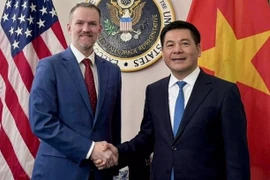
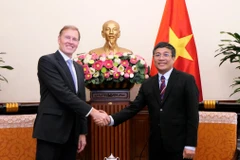
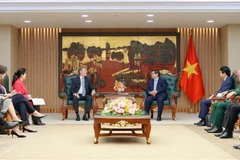
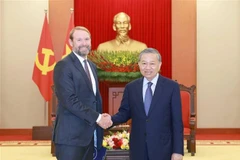
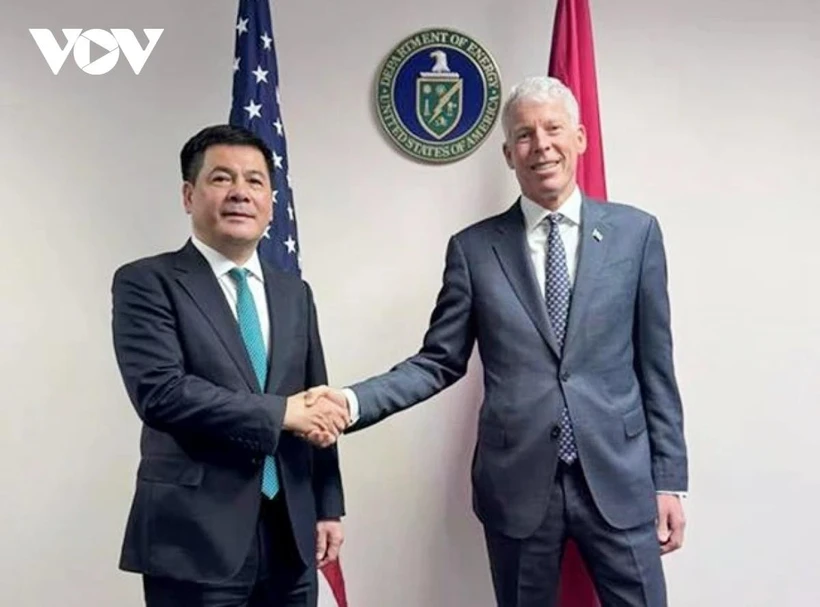
Minister of Industry and Trade Nguyen Hong Dien (L) and US Secretary of Energy Chris Wright in Washington D.C. on March 13. (Photo: VOV)

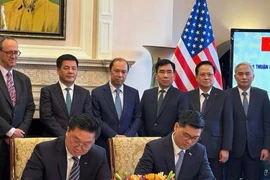
Washington D.C. (VNA) – Vietnamese Minister of Industry and Trade Nguyen Hong Dien met with US Secretary of Energy Chris Wright in Washington D.C. on March 13 to discuss bilateral economic and trade relations, focusing on ways to spur comprehensive energy cooperation.

In the meeting, Dien affirmed Vietnam considers the US a key strategic partner and wants to deepen the comprehensive strategic partnership between the two countries in a sustainable and effective manner.

He highlighted the complementary nature of the two nations’ economies and trade structures, noting that bilateral trade has steadily increased over the years, ensuring mutual benefits and national interests.

Vietnam’s consistent policy is to foster a balanced, sustainable, stable, and win-win economic relationship with the US, the minister stated. Vietnam does not intend to create any barriers that could negatively impact the US’s workers or its economic and national security, he said.

Dien also noted that, according to Vietnam’s national power development plan, the country needs to triple its total power capacity by 2030, requiring an additional 150-160 GW within five years. Vietnam is also pursuing an ambitious energy transition to achieve net-zero carbon emissions by 2050, necessitating substantial investment in capital, technology, and materials for gas-fired power plants, nuclear energy, smart grids, and transmission systems.

He affirmed Vietnam’s stance on viewing the US as a crucial energy supplier and expressed a strong desire to enhance collaboration with US investors in the energy sector. He added that increasing imports of US machinery, equipment, and raw materials would contribute to a more balanced and sustainable trade relationship between the two nations.

For his part, Wright stated that US energy firms have a keen interest in the Vietnamese market and proposed Vietnam facilitate major US energy projects. He encouraged the Southeast Asian nation to implement policies that support a diversified electricity sources, thereby fostering increased energy imports from the US.

Both ministers agreed to assign technical teams to explore the possibility of signing an energy cooperation agreement aimed at strengthening future collaboration. They also reviewed specific power projects in Vietnam and discussed strategies to expedite their implementation.

On the same day, Dien held talks with Senator Dan Sullivan of Alaska to explore potential energy partnerships between Vietnam and the state.

They suggested the two sides’ businesses sign long-term agreements for the supply of liquefied natural gas (LNG) with suitable prices and methods. Alaska is capable of providing stable LNG supplies without disruption at competitive prices, while in the next two decades, Vietnam has an increasing demand for LNG to fuel its 13 planned gas-fired power plants, which will have a combined capacity of 26,000 MW. Both sides acknowledged the significant potential and feasibility of energy cooperation.

At the conclusion of the two meetings, both Secretary Wright and Senator Sullivan accepted invitations to visit Vietnam in the near future to further discussions on bilateral energy cooperation./.

VNA

See more

Thanks to digital transformation among local officials, Tam Dao commune of Phu Tho province has achieved an almost 100% on-time rate for processing administrative applications, helping improve public services for residents. (Photo: VNA)

Institutional reform fuels private sector's growth in Phu Tho province

The private sector is increasingly emerging as a key growth engine of the economy. To unleash its potential and ensure sustainable development, the northern province of Phu Tho is stepping up institutional and administrative reforms to cut costs, shorten procedures, and build a more transparent, business-friendly investment climate.

Hoa Phat Wharf inside the Dung Quat Economic Zone (Photo: VNA)

Dung Quat EZ, Quang Ngai IPs draw nearly 19.4 bln USD

The Dung Quat Economic Zone and Quang Ngai industrial parks have so far attracted 441 projects worth around 19.4 billion USD, according to the Dung Quat Economic Zone and Quang Ngai Industrial Parks Authority (DEZA).

The Kim Long Motor Hue factory (Photo: VNA)

Hue courts capital to turn industrial zones into growth engine

The economic and industrial zones in Hue city host more than 200 active investment projects worth over 152 trillion VND (5.84 billion USD), with 139 already operational. Since the start of 2026, they have generated about 32 trillion VND, contributed 4.2 trillion VND to the state budget and brought in 730 million USD in exports, while employing more than 46,000 workers.

Processing cashew nuts for export at Nguyen Thong Co., Ltd. in Dak Lak province. (Photo: VNA)

Vietnam’s exports to New Zealand post strong growth

According to the Customs Department, two-way trade reached 844 million USD in the first half of 2026, of which Vietnam’s exports to New Zealand totaled 399.7 million USD, up 18.8% year-on-year, while imports stood at 444 million USD.

Starting from September 2026, agricultural products from the Mekong Delta are expected to be transported directly from Cai Cui Port to Guangxi, China. (Photo: VNA)

Investing in logistics to boost agricultural production and exports

Logistics is increasingly becoming a major bottleneck for exports as transport costs rise and requirements for data management, low emissions and supply chain transparency become more stringent, requiring coordinated investment in logistics infrastructure, data infrastructure and transport capacity.

Harvesting rice in the Mekong Delta (Photo: VNA)

Vietnam seen as gateway for Canadian farm produce to ASEAN

As Canada steps up trade diversification and seeks to reduce its dependence on the North American market, Vietnam could serve both as a market for Canadian goods and a base for Canadian businesses to build production capacity and expand operations in the region.

Illustrative image (Photo: VNA)

Turkish cooperatives open sourcing channel for Vietnamese businesses

The Vietnam Trade Office recommended that Vietnamese businesses in agriculture and food actively study cooperative networks in different localities in Türkiye and consider them an additional channel for accessing raw materials, processing partners, and distribution networks.

Delegates at the signing ceremony (Photo: VNA)

VPI, Beicip-Franlab Asia deepen oil, gas cooperation

Under the MoU, VPI and Beicip-Franlab Asia will undertake advanced studies in geology, geophysics, and reservoir engineering to support exploration, field development, and oil and gas resource assessment.

A visitor explores Vietnamese coffee at the expo. (Photo: VNA)

Vietnam pushes coffee, farm produce at Hong Kong food expo

After nearly 200 years, especially since the Doi Moi (renewal) began in 1986, Vietnamese coffee is now exported to more than 100 countries and territories and supports about 2.6 million jobs. Vietnam remains the world’s second largest coffee exporter, holding roughly 19-21% of the global market, and is the top producer of Robusta coffee.

Delegates at the event (Photo: VNA)

Da Nang hosts 2026 International Logistics Forum

Co-hosted by the Ministry of Industry and Trade and the Da Nang People’s Committee, the forum put modern logistics, strategic infrastructure, digital transformation, green growth and international connectivity at the centre of discussions.