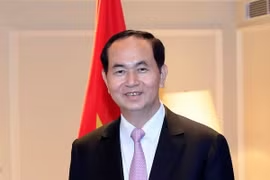
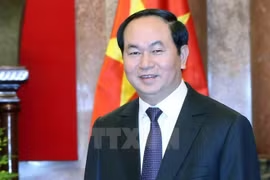
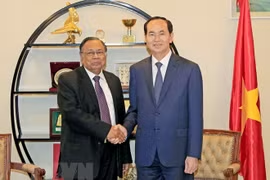
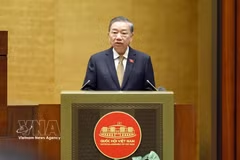
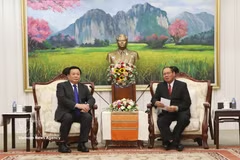
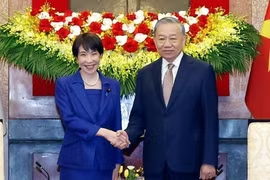
President Tran Dai Quang and Bangladeshi Prime Minister Sheikh Hasina. (Source: VNA)
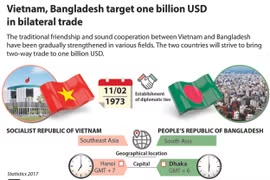
Dhaka,March 5 (VNA) – President Tran Dai Quang and Bangladeshi Prime Minister SheikhHasina agreed to exert greater efforts to double the two countries’ two-waytrade, which stood at nearly 900 million USD in 2017, during their talks inDhaka on March 5.
At the talks, which took place during the State visit to Bangladesh byPresident Tran Dai Quang from March 4-6, the leaders outlined majororientations as well as specific measures for bilateral relations acrosssectors in the future.
Tothat end, they said that the two countries should bring into full play theiradvantages to gain better cooperative results as both are potential marketswith huge population, young labour force and dynamic business communities, andthe gate way of Southeast Asia and South Asia.
PMHasina stated she is impressed by Vietnam’s socio-economic developmentachievements, believing that President Quang’s visit on the occasion of the 45th anniversary of diplomatic ties will open up more opportunities to raise therelations into a new height.
Bothhost and guest discussed the possibility of cooperation in garment andtextiles, leather shoes and leather products, food processing andpharmaceuticals on the basis of each country’s strengths, while pledging tospeed up the opening of a direct air route connecting the two countries.
TheBangladeshi leader committed to creating all favourable conditions to helpVietnamese enterprises expand investments in her nation.
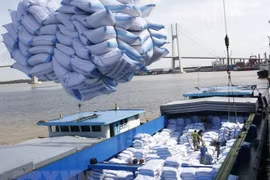
Sheexpressed her hope to learn from Vietnam’s experience in agriculturalproduction, affirming to continue importing Vietnamese rice.
Thetwo leaders reached a consensus on strengthening collaboration in defence,security, education, tourism, culture and people-to-people diplomacy, andmaintaining good relationship at regional and international forums, includingthe United Nations, Non-Aligned Movement, ASEAN Region Forum, and Asia-EuropeMeeting (ASEM).
Discussingregional and global situations of mutual concern, they expressed their supportfor the promotion of peace, stability, security, and aviation and maritimefreedom and safety in the East Sea, as well as the settlement of disputes bypeaceful means on the basis of international law, including the United NationsConvention on the Law of the Sea 1982, the implementation of the Declaration onthe Conduct of Parties in the East Sea, and the formation of a practical Codeof Conduct in the East Sea.
PresidentQuang took this occasion to invite PM Hasina to visit Vietnam at an appropriatetime.
Afterthe talks, the two leaders witnessed the signing of several cooperativedocuments: a memorandum of understanding (MoU) on aquaculture and husbandrycooperation during 2018-2022 between the Vietnamese Ministry of Agriculture andRural Development and Bangladesh’s Ministry of Fisheries and Livestock, an MoUon machinery manufacturing cooperation between Vietnam’s Ministry of Industryand Trade and Bangladesh’s Ministry of Industries, and an agreement on culturalexchange programmes between Vietnam’s Ministry of Culture, Sports and Tourismand Bangladesh’s Ministry of Culture.
At the post-talks press conference, PM Hasina stressed that Vietnamis one of the closest neighbors of Bangladesh, which shares the same aspirationsof promoting peace and development, as well as similarities in terms of cultureand traditional social values with her country.
She affirmed the Bangladeshi Government encourages enterprises ofthe two countries to seek business and investment opportunities in each other’smarkets.
The Bangladeshi Government wishes to set up a dialogue partnershipby sector with ASEAN, and join the Mekong-LancangCooperation forum, she said.
Highlighting the fruitful development of the bilateral relations, President Quangstressed that on the solid basis of the diplomatic ties over the past 45 years,and great potentials of the two nations, the leaders agreed to seek suitablemeasures for creating breakthroughs, towards deepening the bilateral relationsin a more intensive, practical and effective manner, for the sake of theirpeople.
He said along with agreeing on key orientations for the relations, manyspecific measures have been outlined to promote cooperation across fields frompolitics-diplomacy; defence-security; economy-trade-investment; agriculture –breeding; to education-training; culture and tourism.
The two sides will enhance exchange of high-level visits and fully tapbilateral cooperation mechanisms, as well as exploit possibilities ofconnections in defence-security, especially in defence industry, logistics andmilitary health care, he noted.
Meanwhile, they also proposed ways to lift the two-way trade to 2billion USD in 2020, as well as considered the possibility of forming jointventures, associations, and production chains; and apply high technologies inagricultural production, he added.
President Quang praised Bangladesh for its support for Vietnam's candidacy tothe UN International Law Committee for the2017-2021 tenure and to the Executive Council of the Universal Postal Union (UPU)in 2017-2021.
On the morning of the same day, President Quang and his entourage paid a floraltribute to the National Martyrs' Memorial in Savar, which commemoratesanonymous martyrs that scarified their lives for Bangladesh’s independence andfreedom.
The Vietnamese delegation also laid a wreath at the NationalMemorial Museum in Dhaka which commemoratesBangladesh’s Father of Nation Bangabandhu SheikhMujibur Rahman – the first President of the country.-VNA
VNA