Vietnam’s adoption of cyber security law essential: Russian academic

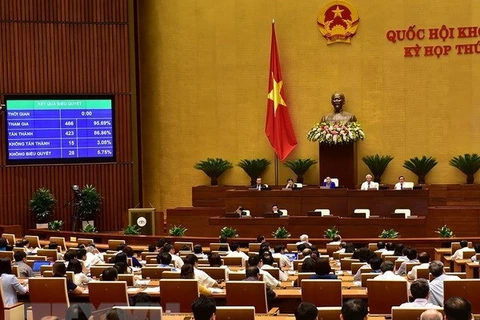
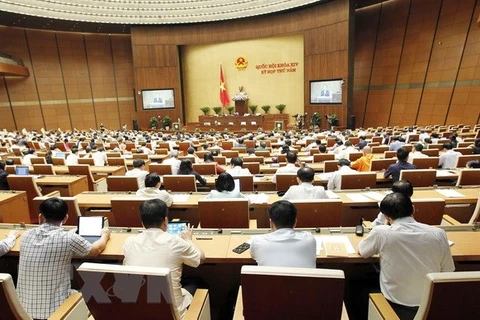
The adoption of the Law on Cyber Security at the recent fifth sitting of the 14th National Assembly of Vietnam is essential, according to Professor Vladimir Kolotov, director of Ho Chi Minh Institute under the St Petersburg University.
 Vietnam’s adoption of cyber security law essential: Russian academic ảnh 1Professor Vladimir Kolotov, director of Ho Chi Minh Institute under the St Petersburg University (Photo: VNA)

Hanoi (VNA) –
The adoption of the Lawon Cyber Security at the recent fifth sitting of the 14th National Assembly ofVietnam is essential, according to Professor Vladimir Kolotov, director of HoChi Minh Institute under the St Petersburg University.

In an interview with Sputnik news agency,Vladimir Kolotov said cyberspace is the sovereignty domain of any country liketerritorial sovereignty, airspace sovereignty and territorial waterssovereignty.

Moreover, cyberspace is where hostile actionstake place that are just as dangerous as in real life and where terroristsexchange information, he said.

He warned that many terrorists are betterequipped with knowledge about cyber security than some countries in SoutheastAsia.

While evaluating cyber security in Vietnam,Professor Kolotov said Vietnam was ranked 100th in the global cyber securityindex.

The low cyber security has led to some regrettable cases, he noted, saying thatthe opposition to the approval of the law lends a hand to the country’s cybersafety, posing risks to not only the cyberspace sovereignty but also the actualsovereignty of the nation.

The adoption of the Law on Cyber Security doesnot violate or interfere with free speech, he said, adding that the law coversdifferent things which are related to the infrastructure of the internet andthe management of metadata.

Similar laws are being implemented in multiplecountries around the world, including Russia, with the purpose of protectingcitizens’ interests, he said.-VNA
VNA
See more

The “I Love My Fatherland" Journey 2026 kicks off in Nghe An province on May 16. (Photo: VNA)

"I Love My Fatherland” journey features diverse activities

The “I Love My Fatherland” journey will span seven stages across historical and cultural sites and “red addresses” nationwide. There will be a combination of education on traditions, field-based programmes, and digital communications.

At the handover of 33 Chinese nationals who had violated Vietnamese law to Chinese authorities in Quang Ninh on May 15, 2026. (Photo: VNA)

Vietnam hands over 33 law violators to China

Investigations found that the individuals had violated Vietnamese laws relating to illegal entry and unlawful residence in Vietnam. The handover was conducted safely and in compliance with Vietnamese law and international practice.

At the talks between authorities of the northern province of Lang Son and Pingxiang city in the Guangxi Zhuang Autonomous Region of China (Photo: VNA)

Vietnam, China seek to build modern, smart border gates

Authorities of the northern province of Lang Son and Pingxiang city in the Guangxi Zhuang Autonomous Region of China held talks on May 15 at Tan Thanh (Vietnam) – Po Chai (China) clearance point near markers 1090–1091 in Hoang Van Thu commune of Lang Son to promote trade, develop smart border gates and expand cross-border tourism cooperation.

The Vietnam Association for Victims of Agent Orange (VAVA) has carried out various activities to support Agent Orange/dioxin victims. (Photo: VNA)

Over 9.3 billion VND raised for AO/dioxin victims in 2025

VAVA President Lieutenant General Nguyen Huu Chinh said that although the war ended more than 50 years ago, the consequences of toxic chemicals remain severe and long-lasting, with millions of people affected during the war and hundreds of thousands continuing to suffer serious physical impacts in peacetime.

An overview of the meeting (Photo: VNA)

Measures sought to accelerate construction of inter-level boarding schools in border areas

The construction of boarding schools in land border communes is a particularly important political task receiving close attention from the Politburo and Party General Secretary and State President To Lam. The programme not only aims to improve learning conditions for students in border areas, but also carries strategic significance for social welfare, human development, national defence and security, and safeguarding territorial sovereignty.

An overview of the court on May 14 (Photo: VNA)

Man gets life sentence for terrorism, anti-State activities

The People’s Court of Ho Chi Minh City on May 14 handed down life imprisonment to Dao Minh Quan on charges of “terrorism aimed at opposing the people’s administration” and “activities aimed at overthrowing the people’s administration”.

Secretary of the Ho Chi Minh Communist Youth Union Central Committee and VYF President Nguyen Tuong Lam addresses the event (Photo: VNA)

“I love my fatherland” journey 2026 launched

The “I Love My Fatherland” journey will comprise seven stages linked to historical, cultural and revolutionary sites across the country. The journey will begin in Nghe An on May 16 to mark President Ho Chi Minh’s birthday, before continuing through Hue city, Tuyen Quang–Lung Cu Flag Tower, Dien Bien, Khanh Hoa, Ca Mau and Ho Chi Minh City, and concluding in Hanoi in October.

Students in the Mekong Delta city of Can Tho are honoured for their outstanding performance in startup activities. (Photo: VNA)

Education ministry targets five digital technology incubators at universities

A key target under the new plan is the establishment of five digital technology incubators, or Deeptech Hubs, at universities and research institutes with strong potential. The education ministry also plans to launch a training programme for 1,000 outstanding technology entrepreneurs and develop criteria for selecting and supporting startup ecosystems within educational institutions.