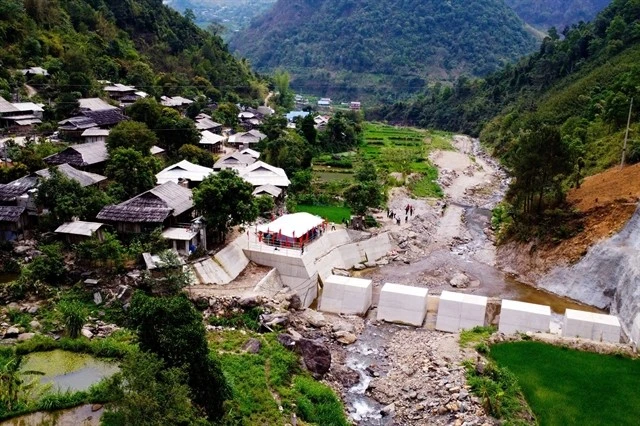
Son La (VNA) - Vietnam's first Sabo dam was officially inaugurated on April 16 in Pieng hamlet, Nam Pam commune, Muong La district, in the northern mountainous province of Son La.
A Sabo dam is considered one of the most effective civil engineering solutions, typically built in the upper reaches of rivers with steep slopes and high flow speeds. The dam helps to capture debris, rocks and logs, preventing damage to areas downstream.
The Sabo dam in Son La, which cost about 9 billion VND (348,000 USD), was built in September 2024, after the rainy season, under Japanese standards.
It is a gap-type concrete dam with a length of 61m, a width of three metres at the top and a height of nine metres.
The dam is part of the Technical Cooperation Project for Strengthening Capacity for Debris Flow and Landslide Risk Mitigation in the Northern Mountainous Areas, under the Japan International Cooperation Agency (JICA).
The inauguration ceremony was co-organised by the Department of Dike Management and Natural Disaster Prevention and Control, under the Ministry of Agriculture and Environment, the provincial Department of Agriculture and Environment and the JICA Vietnam Office.
Speaking at the founding ceremony, Nguyen Truong Son, Deputy Head of the Directorate for Dike Management and Flood and Storm Prevention, said that as early as the mid-19th century, Japan had developed stone and wood structures to reduce the speed of debris flows, thus minimising damage to downstream areas.
The Sabo dam concept, designed to allow water to flow through while retaining soil, rocks and vegetation, has proven highly effective and is now implemented worldwide, including in countries like the Republic of Korea and other regions prone to landslides.
Son said Vietnam, which frequently faces severe damage from mudslides, especially in the northern mountainous region, has recognised the effectiveness of Sabo dams.

At the inauguration ceremony (Photo courtesy of JICA Vietnam Office)
The Sabo dam, designed as a pilot project in the Nam Pam stream basin in Son La, is expected to serve as a model for future dam construction in the region.
“The dam is anticipated to protect 28 households, a local kindergarten and a cultural house located downstream on the left bank,” Son said.
However, due to its small scale as a pilot project, it is clear that the Sabo dam alone may not fully protect the area, he added.
Therefore, the ministry has urged the Japanese Government to continue supporting Vietnam in building a comprehensive system of Sabo dams all along the Nam Pam River.
If fully integrated, the system could serve as a model for Vietnam to assess its effectiveness and consider mobilising resources for the broader implementation of Sabo dams in other high-risk areas, he said.
“We hope Japan will continue to strengthen its assistance to help Vietnam enhance its resilience to natural disasters, especially debris flows and landslides and safeguard vulnerable populations in remote areas,” Son said.
Also at the event, the Deputy Director of the provincial Department of Agriculture and Environment Le Thi Thu Hang said that the project, including the pilot Sabo dam, holds significant importance.
“It marks a new step forward in disaster prevention efforts, safeguarding both lives and property in Son La province,” she added.
The inauguration of the Sabo dam is not only a milestone in the completion of the critical infrastructure but also a symbol of the strong, enduring partnership between Vietnam and Japan, as well as between Son La province and JICA.
Head of the JICA Vietnam Office, Kobayashi Yosuke, said it was wonderful to support the Vietnamese people, applying Japanese technical standards, he warned: "No single Sabo dam could effectively reduce debris flow.
“We hope that the pilot construction of this dam is the reference for the Government of Vietnam in formulating the technical standard for the construction of other Sabo dams in Nam Pam River basin and in other high-risk areas."
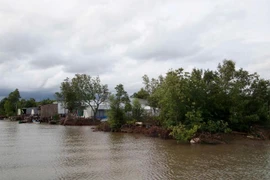
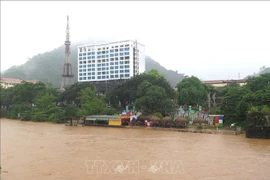
Landslides and debris flows caused by heavy rainfall are common and have devastating effects in northern Vietnam.
In early August 2023, continuous heavy rainfall led to debris flows and landslides in Muong La district, Son La, damaging 134 homes.
In August 2017, a series of debris flows and landslides resulted in 15 deaths, 15 injuries and an economic loss of 705 billion VND in Muong La district./.