Vietnam’s seafood exports gain momentum in Singapore

The year 2025 marked a significant breakthrough for Vietnamese seafood exports, reflecting Singapore’s growing demand and increasing confidence in the quality and branding of Vietnam’s seafood products.

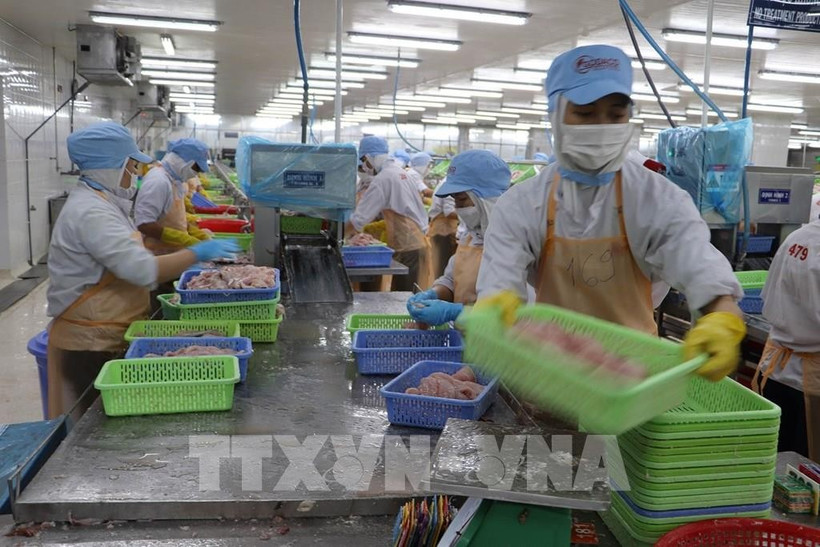
Illustrative photo (Photo: VNA)

Singapore (VNA) – Vietnamese seafood has recorded strong growth in the Singapore market over the past two years, with import values rising sharply, opening up new opportunities for bilateral cooperation and contributing to the deepening of the Vietnam–Singapore Comprehensive Strategic Partnership.

The year 2025 marked a significant breakthrough for Vietnamese seafood exports, reflecting Singapore’s growing demand and increasing confidence in the quality and branding of Vietnam’s seafood products.

Statistics from Singapore’s Accounting and Corporate Regulatory Authority show that in 2024, Vietnam climbed from sixth to fifth place among Singapore’s largest seafood exporters for the first time. The upward momentum continued into the first quarter of 2025, with Vietnam rising to fourth place. Over the first nine months of the year, Vietnam further advanced to become Singapore’s third-largest seafood supplier and maintained this position, underscoring the increasingly important role of Vietnamese seafood in the market.

Kenneth Chia, President of the Seafood Industries Association Singapore, noted that trade between Vietnam and Singapore has grown steadily for more than two decades. Many Singaporean companies regard Vietnam as a key seafood sourcing market, with several firms stationing staff in Vietnam to procure products directly. This has helped build strong relationships and mutual trust.

Singaporean consumers use and trust Vietnamese products. Many Vietnamese companies have met their requirements very well, Chia said.

Singapore produces little agricultural output and imports around 90% of its food supply. With its high per capita income, the city-state has strong demand for high-quality food products. Its relatively small but diverse population also makes it an ideal test market for new products before global rollout. As such, Vietnam’s seafood growth in Singapore reflects the combined success of effectively leveraging free trade agreements, implementing export promotion policies, close coordination among ministries, local authorities and industry associations, and the dynamism of Vietnamese seafood enterprises. The role of the Vietnam Trade Office in Singapore as a bridge for bilateral trade connectivity has also been significant.

Cao Xuan Thang, Trade Counsellor of Vietnam in Singapore, stressed that Singapore is an open market pursuing supply diversification to ensure food security. To remain competitive, he advised Vietnamese seafood firms to strengthen quality management across the entire value chain, from aquaculture and processing to traceability and sustainable farming, while adopting advanced technologies. He highlighted the importance of digital transformation, e-commerce, and modern payment solutions to boost productivity and reduce costs, alongside enhancing value chains, market diversification, and industry collaboration.

ASEAN remains a major partner and a global transshipment gateway for Vietnam. Within the bloc, Singapore serves as a key logistics and global seafood trading hub, offering strong advantages in ports, warehousing, logistics, and financial services.

Therefore, strengthening cooperation with Singapore can help Vietnam sustain stable export growth and expand its reach to regional and global markets.

Chia added that Vietnam should invest more in research and development to create value-added seafood products tailored to Singapore’s restaurant and food service sector, benefiting trade on both sides.

In reality, Vietnamese seafood products are increasingly sought after by Singaporean consumers, making the market a strategic springboard for Vietnam’s seafood industry to expand further into the region and beyond./.
VNA

See more

From 4 billion USD in 2015, the size of the e-commerce market increases eightfold to reach 32 billion USD last year. (Photo: VNA)

Hanoi leads 2025 Vietnam eBusiness Index

​The average score of the rankings is 9.3 points. The gap in e-commerce development between the two major economic centres–Hanoi and HCM City–and the remaining provinces and cities is very large.

An aircraft of Vietnam Airlines - Illustrative image (Photo: VNA)

Vietnam Airlines adds 270 flights to during 2026 New Year holiday

Vietnam Airlines said the swift deployment of additional flights during the New Year holiday demonstrates the carrier’s proactive approach and readiness in mobilising resources to serve passengers during peak travel periods at the end of 2025 and the beginning of 2026.

Prime Minister Pham Minh Chinh (second from right) conducts an aerial inspection of the Ca Mau–Dat Mui expressway, the road leading to Hon Khoai, and the dual-use Hon Khoai port from a helicopter. (Photo: VNA)

PM urges faster progress on key infrastructure projects in Dat Mui, Ca Mau

During an aerial survey of Dat Mui commune, home to the five islands of Hon Khoai, Hon Sao, Hon Go, Hon Doi Moi and Hon Da Le, the Prime Minister underscored the area’s strategic importance for national defence, economic development and connectivity across the province, the Mekong Delta and the wider southern region.

Dao Ngoc Tien, Vice Rector of Foreign Trade University, speaks at the event. (Photo: doanhnghiepvn.vn)

High standards key for businesses to unlock VEFTA benefits

The EFTA bloc, comprising Switzerland, Norway, Iceland, and Liechtenstein, has a relatively small population but a combined GDP of about 1.3 trillion EUR (1.5 trillion USD), high living standards, and strong demand for high-quality products.

Workers make products for the Lunar New Year (Tet) in Hanoi's Bat Trang commune. (Photo: hanoimoi.vn)

Hanoi craft villages bustle as Lunar New Year approaches

Hanoi is home to the largest number of craft villages nationwide, with about 1,350 villages and craft-based communities, accounting for roughly 56% of rural villages in the capital. Of these, 318 are officially recognised as traditional craft villages.

Four seaports and four inland waterway ports are currently in operation within the Cai Mep Ha free trade zone. (Photo: VNA)

​ HCM City seeks new growth drivers as megacity takes shape

As traditional growth engines show signs of reaching their limits, HCM City is recalibrating its long-term development strategy in search of new drivers capable of sustaining momentum and reinforcing its role as the economic nucleus of the southern region.

Garment production for export at Hoa Tho Garment JS Corporation. (Photo: nhandan.vn)

Textile, garment industry secures role in global supply chain

By diversifying markets, products and customers, the sector has mitigated risks and responded proactively to market fluctuations, despite numerous challenges such as disrupted supply chains, rising shipping costs, and rapidly changing purchasing policies in many markets.

Visitors check a new car model of VinFast at the Vietnam Mobility Show 2025. (Photo: VNA)

Vietnam Mobility Show 2025 opens in Hanoi

Taking place at a time when Vietnam’s automobile industry is undergoing strong transformation towards electrification and emission reduction, the show aims to introduce advanced technologies, eco-friendly vehicles, and sustainable mobility models.

Delegates at the opening ceremony of the Hanoi shopping festival 2025. (Photo: VNA)

Hanoi shopping festival 2025 opens to boost domestic consumption

Featuring around 120 standard booths, the festival has attracted nearly 110 enterprises from 14 provinces and cities nationwide, including Dien Bien, Lao Cai, Son La, Ninh Binh, Thai Nguyen, Quang Ninh, Hai Phong, Bac Ninh, Hung Yen, Hanoi, Thanh Hoa, Da Nang, Ho Chi Minh City and Khanh Hoa.