Work starts on more inter-level boarding schools in border communes

The construction carries profound political and social significance, reflecting the State’s attentiveness to the educational needs of students in those areas, an effort to secure equitable access to education, narrow regional disparities, and bolster national defence – security.

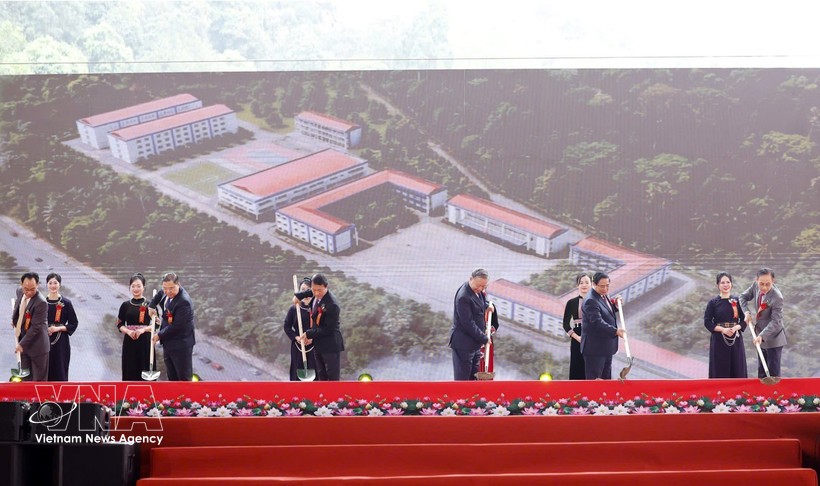
Party General Secretary To Lam (front, third from right), Prime Minister Pham Minh Chinh (front, second from right) and officials mark the start of work on inter-level boarding schools in land border communes on March 19 morning. (Photo: VNA)

Hanoi (VNA) – The Ministry of Education and Training (MoET) teamed up with state broadcaster Vietnam Television, telecom giants VNPT and Viettel, and authorities of 17 cities and provinces to kick off simultaneous construction of combined primary and secondary boarding schools in land border communes on March 19 morning.

The in-person and virtual ceremony had its main site at the Dong Dang Primary and Lower-Secondary Boarding School in Dong Dang commune, Lang Son province. Attending the event were Party and Government leaders, Cabinet members, heads of ministries and agencies, and officials from localities where the new facilities are to rise.

The groundbreaking is a major move to follow the Politburo’s Conclusion 81-TB/TW, dated July 18, 2025, on the building of such integrated boarding facilities for border areas. It carries profound political and social significance, reflecting the State’s attentiveness to the educational needs of students in those areas, an effort to secure equitable access to education, narrow regional disparities, and bolster national defence – security.

Vietnam now has 22 cities and provinces with land borders, within which lie a total of 248 border communes and wards, with plans to construct 248 inter-level boarding schools.

This round hits 121 schools spread across 17 provinces and cities, including Cao Bang, Lang Son, Tuyen Quang, Lao Cai, Lai Chau, Dien Bien, Thanh Hoa, Nghe An, Ha Tinh, Quang Tri, Hue, Quang Ngai, Dak Lak, Lam Dong, Tay Ninh, Dong Thap, and An Giang.

Localities are pushing for 30 trillion VND (1.1 billion USD) to get these 121 schools built, with roughly 28 trillion VND from the central budget and 2 trillion VND from local sources.

The MoET is working with the Ministry of Finance to finalise and submit local proposals to competent authorities for budget allocation under regulations. The target is to complete all schools in this phase before August 30, 2027, in time for the 2027–2028 academic year.

Under the same policy, construction began in 2025 on 108 inter-level boarding schools in border communes, slated for completion by August 30, 2026. Of these, 99 schools are financed by the central budget, one via public donations, six solely by Quang Ninh province, and two others in Dien Bien and Cao Bang supported by Hanoi.

The MoET has also taken steps to refine the regulatory framework, built organisational and operational models, introduce tailored mechanisms and policies, and line up the right resource, all to make sure these schools run efficiently once built and put into use in accordance with regulations./.


VNA

See more

A number of youth union members at the Vietnam Academy of Social Sciences visit the exhibition space showcasing books and materials on culture. (Photo: VNA)

Book week underscores role of knowledge in policymaking

The highlight is a series of activities on April 21, including a book and document exhibition on culture, the launch of a special publication titled “Special scientific information for leadership” and initiatives promoting reading culture, including a book donation programme and a book review contest.

Hanoi has over 1,100 libraries and numerous cultural and educational spaces in the community. (Photo: VNA)

Spreading value of books, building foundations of learning society

Each weekend in Hanoi, the “Reading with Children” Club brings together students to practise reading, explore language, and express ideas creatively. According to founder of the club Nguyen Thuy Anh, the club encourages children to reflect, retell stories, and connect books with personal experiences, making reading more vivid and meaningful.

Automated ticketing system is used on the urban railway Cat Linh-Ha Dong line in Hanoi. (Photo: VNA)

Digital transformation powers Hanoi metro expansion

Beyond convenience, stable fares and the elimination of fuel, parking and maintenance costs have made urban rail increasingly attractive. The growing preference for metro travel is also contributing to a greener, more modern urban lifestyle.

Delegates cut the ribbon to inaugurate the operation of electric bus route No. 43. (Photo: VNA)

Hanoi accelerates shift to green buses, targets 100% by 2030

In the 2027–2030 period, the city will accelerate the transition towards the complete phase-out of fossil fuel-powered buses. The share of electric and green energy-fueled buses is projected to reach 79–89% by 2029 and 100% by 2030.

At the second session of the Ho Chi Minh City People’s Council (Photo: VNA)

Ho Chi Minh City greenlights central square, administrative centre in Thu Thiem

The new central city square and administrative centre will create a modern, centralised political-administrative complex for Ho Chi Minh City, designed to house around 8,000 officials, civil servants, and employees. It will also handle daily traffic of 1,500- 2,000 citizens and business representatives through a unified one-stop-shop administrative service system.

A working session at the job fair (Photo: VNA)

Vietnamese students flock to Seoul Job Fair 2026

The second annual Job Fair 2026 was held for Vietnamese students in the Republic of Korea. Organisers pitched it as a straight-up bridge between eager students and bosses hungry for young talent who can actually handle multicultural workplaces.

Defendants at the court (Photo: VNA)

Ho Chi Minh City court opens trial over Agribank lending scandal

The investigation revealed that multiple credit files were incomplete or riddled with inaccurate information, while some pledged assets lacked proper legal standing yet were accepted and grossly overvalued. As a result, the loans became high-risk and largely unrecoverable, leading to losses surpassing 1 trillion VND.