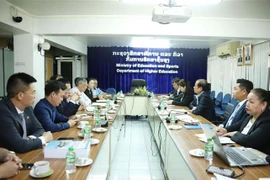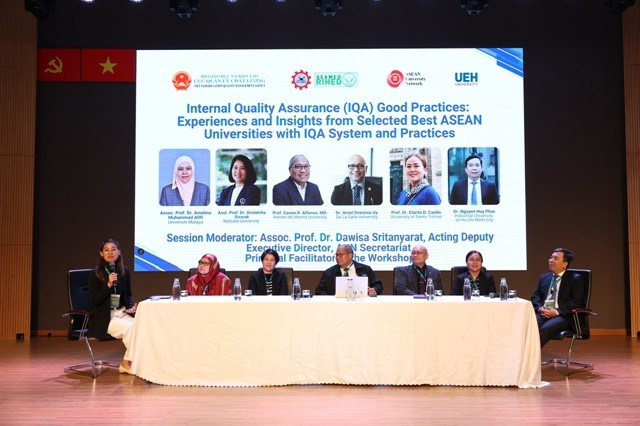
HCM City (VNS/VNA) - Leaders of higher education institutions and leading quality assurance experts from ASEAN countries exchanged knowledge and shared experiences and solutions for effective implementation of Internal Quality Assurance (IQA) systems in higher education institutions at a workshop that opened in HCM City on August 18.
The two-day workshop on “Implementing Internal Quality Assurance Systems - For a Sustainable Future of ASEAN Higher Education” is aimed at supporting universities in building, adapting, and operating IQA systems that are well-suited to their specific contexts and characteristics.
It contributes to enhancing academic quality, fostering a quality culture, and strengthening adaptability in the face of emerging developments in higher education across the region.
The Ministry of Education and Training affirms that quality assurance in higher education is not merely about accreditation, but about cultivating a quality ecosystem based on internal reviews, objective monitoring, open data, and societal feedback, Deputy Minister of Education and Training Assoc. Prof. Hoang Minh Son said.
“The revised Law on Higher Education, currently under development, recognises IQA as a legal obligation for all higher education institutions. It mandates transparent, stakeholder-driven systems aligned with national standards and international good practices,” Son said.
“The revised law distinguishes the layers of QA: IQA forms the foundational layer, external quality assurance (EQA) via accreditation serves as the validation mechanism, and institutional rankings and post-accreditation evaluations function as tools for social accountability,” he said.
Prof. Dr. Huynh Van Chuong, director general of the ministry's Quality Management Department, said that over the years, Vietnam's higher education system has undergone many significant reforms and innovations in both scale and quality.
Quality management, including internal quality assurance and accreditation, has been implemented for both the university and the training programme level, Chuong said.
The Law on Higher Education in 2012 and its amendments in 2018 have reaffirmed the important role of quality assurance and accreditation as a tool to support university governance, promote autonomy and strengthen accountability, he said.
As of July, Vietnam had 213 higher education institutions and 2,609 programmes accredited according to domestic standards and standards of international accreditation organisations.
There is a shortage of experts for assurance systems at university and accreditation centres and an absence of long-term professional development for quality assurance experts, which also affects the quality and availability of external reviewers in many higher education programmes.
The database regarding the quality assurance and accreditation at universities and accreditation centres is still not available online and convenient for all stakeholders, he said.
In this context, today’s workshop reaffirmed Vietnam’s commitment to building a quality assurance system that is systematic, substantive and sustainable.
Assoc. Prof. Dr. Thanapan Laiprakobsup, Executive Director of ASEAN University Network, said that while most universities already have some form of internal quality assurance, too often these systems are seen as an administrative requirement or a checklist rather than a mindset that drives improvement.
“From our collective experience, we have seen that when IQA is embedded into the university’s strategy, culture, and daily operations, it becomes a powerful engine for transformation,” Laiprakobsup said.
The workshop is aimed at helping universities set up, enhance, and sustain IQA systems that are not just compliant, but truly meaningful, he said.
The event is co-organised by the Quality Management Department, the ASEAN University Network Secretariat (AUN), the Southeast Asian Ministers of Education Organisation Regional Centre for Higher Education and Development (SEAMEO-RIHED) and the University of Economics HCM City (UEH)./.
PM calls on Phenikaa University to become model for new-generation private universities
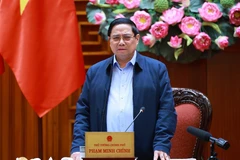
Phenikaa University should build its own cultural identity and brand based on the philosophy that students are the centre, the university is the foundation, and teachers are the driving force. Its culture is inseparable from the national culture, said Prime Minister Pham Minh Chinh.