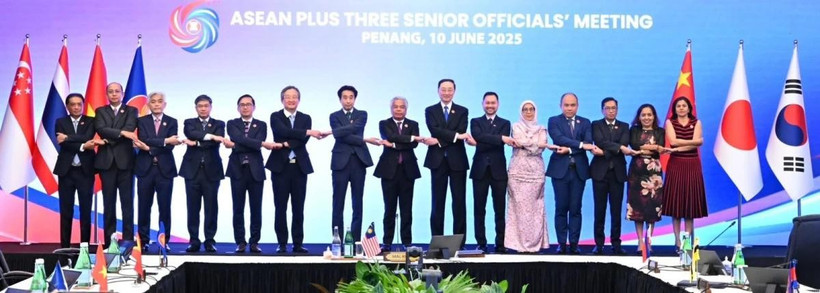
Kuala Lumpur (VNA) –The senior officials’ meetings (SOM) within the frameworks of ASEAN, ASEAN Plus 3, the East Asia Summit (EAS), and the ASEAN Regional Forum (ARF) took place in Penang, Malaysia, on June 10–11, drawing delegates from all the 10 ASEAN countries and 17 dialogue partners.
Ambassador Tran Duc Binh, Director of the ASEAN Department under the Ministry of Foreign Affairs, led the Vietnamese delegation to the events.
Participants congratulated Malaysia on the success and significant outcomes of the 46th ASEAN Summit and related summits in May and reaffirmed ASEAN’s central role in shaping regional cooperation. They welcomed the “resilient, dynamic, innovative, and people-centred” approach of the ASEAN Community Vision 2045, calling it the guiding principle for collaboration both within ASEAN and between the bloc and parnters.
They also discussed preparations for Timor-Leste’s admission as the 11th ASEAN member in October 2025. They worked to finalise procedures for the country's accession to the ASEAN Charter and build roadmaps for its engagement in other legal documents across the political-security, economic, and socio-cultural pillars, helping Timor-Leste capitalise on benefits of the integration.
The ASEAN Secretariat reported continued progress across ASEAN-led mechanisms. Over 60% of the action lines under the ASEAN Plus 3 Cooperation Work Plan (2023–2027) are underway, covering trade, investment, SMEs, tourism, and supply chain connectivity.
The EAS Plan of Action (2024–2028) has yielded positive initial results in such fields as climate, environment, energy, health, maritime, and connectivity cooperation. Meanwhile, the ARF-related mechanisms have also advanced in accordiance with the outlined work plan, with many practical activities recorded in areas such as maritime security, disaster management and mitigation, transnational crime response, and counter-terrorism, the Secretariat noted.
Countries particularly stressed the importance of maintaining constructive dialogue, bridge differences, boost common points, and promote strategic trust. In turbulent global and regional landscapes, they underscored the role of multilateral cooperation based on mutual trust and respect, pledged support for ASEAN's centrality, and vowed to implement concrete and substantive cooperation programmes to contribute to peace, stability, and sustainable development.
The theme "Inclusivity and Sustainability" of ASEAN Year 2025 should continue to be consistently reflected in and guide regional cooperation processes, they said.
The meetings straightforwardly exchanged views on many international and regional issues, including those related to the East Sea, Myanmar, the Korean Peninsula, the Middle East, and Ukraine. Delegates emphasised the peaceful resolution of disputes in accordance with international law, particularly the 1982 United Nations Convention on the Law of the Sea (UNCLOS). They also voiced support for ASEAN’s principled stance on the East Sea issue, along with the role and efforts of ASEAN, the ASEAN Chair, and the Special Envoy in implementing the Five-Point Consensus in the Myanmar issue.
They also emphasised the importance of promoting cooperation in responding to non-traditional challenges such as climate change, cybersecurity, population aging, and transnational crimes, and in capitalising on emerging fields like digital economy, green transition, clean energy, food security, and artificial intelligence and other emerging technologies.
Countries agreed to step up cooperation frameworks such as the Digital Economy Framework Agreement, the ASEAN Power Grid, the ASEAN - China Free Trade Area 3.0 upgrade, the ASEAN Plus Three Emergency Rice Reserve, the e-vehicle ecosystem, and the cross-border payment connectivity.
At the meetings, Ambassador Binh highlighted the resilience of the ASEAN Plus 3, EAS, and ARF frameworks through crises, including the 1997 financial crisis and the COVID-19 pandemic.
Amid growing geopolitical and geoeconomic challenges, he urged focusing on new growth drivers such as digital transformation, innovation, smart agriculture, renewable energy, harmonising cross-border data regulations, increasing support for SMEs, and boosting investment in infrastructure connectivity and sustainable finance.
The Vietnamese diplomat also reiterated ASEAN’s principle stance and highlighted the role of international law and the 1982 UNCLOS. He affirmed the importance of maintaining peace, stability, security, safety, and freedom of navigation and overflight in the East Sea, stressing the principle of exercising self-restraint and not taking any action that may complicate the situation. He called for stronger efforts to soon finalise an efficient and substantive code of conduct (COC) in the East Sea that is in line with international law and the 1982 UNCLOS, and to push ahead with the full and effective implementation of the Declaration on the Conduct of Parties (DOC) in the East Sea, thereby helping secure a conducive environment for COC negotiations.
Binh also affirmed support for efforts to assist Myanmar to find a feasible and sustainable solution matching the Five-Point Consensus. He proposed the parties concerned to expand and extend the ceasefire nationwide to facilitate humanitarian aid.
On the sidelines, the ambassador met with heads of several delegations to discuss issues of mutual interest./.
ASEAN remains China’s biggest trading partner
ASEAN remained China's largest trade partner, with bilateral trade volume reaching 3.92 trillion CNY (546.6 billion USD) in the first seven months, up 10.5% from a year ago, according to statistics by the Chinese General Administration of Customs (GAC).