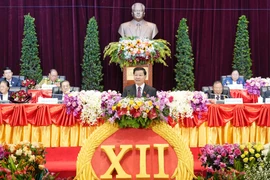
Vientiane (VNA) – Lao Prime Minister Sonexay Siphandone has highlighted six major goals and 26 focal work plans for 2026–2030 while presenting the country’s 10th five-year socio-economic development plan at the 12th National Congress of the Lao People’s Revolutionary Party (LPRP).
The first goal is to develop an independent and self-reliant economy by capitalising on the country’s potential and advantages, thus ensuring stable, sustainable, and quality economic growth. To achieve this goal, Laos is set to carry out six key work plans, including tapping into potential to bolster continuous, strong, and quality economic growth; boosting strong and stable macroeconomic development; improving investment efficiency and effectiveness; developing micro, small and medium-sized enterprises to a new quality level so that they are capable of competing with others in the region and the world; developing quality and strong state-owned enterprises and collective economy; and fostering a strong digital economy to support socio-economic development and achieve sustainable growth.
The second goal is to develop high-quality and tech-savvy human resources. It encompasses four key plans: developing high-quality education to meet the country's development needs; developing high-quality and universal healthcare services; developing labour skills in both quantity and quality to meet development demand; and developing high-quality personnel in the public sector.
In its third goal, Laos plans to improve people’s living standards, ensure harmonious development between urban and rural areas, and gradually reduce poverty. To this end, the country is set to implement six focal plans: developing rural areas and alleviating poverty in a higher quality manner (including upgrading and building a strong political foundation); improving food security and comprehensive nutrition with higher quality; promoting and developing youth, women, children, and gender equality; developing modern and swift information services, promoting the country's distinctive culture, boosting progress, and building a united and civilised society; building a comprehensive and quality social security and social protection system; and addressing unexploded ordnance-related issues and gradually improving the living conditions of affected people.
The fourth is to protect natural resources, ensure a sustainable environment, and enhance preparedness for climate change and natural disasters. It consists of three key plans: managing and utilising natural resources such as forests, land, water, and minerals in a planned, economical, and sustainable manner to gain maximum benefits; promoting green growth and climate change response solutions to minimise and enhance greenhouse gas absorption; and strengthening disaster prevention, control, and recovery.
The fifth goal in Laos' five-year plan is to develop broad and effective regional and international connectivity. Four key plans will be implemented to achieve this, namely developing infrastructure that connects domestically, regionally, and internationally to facilitate production, services, trade, and investment; bolstering more active and widespread cooperation and integration in trade and investment with the region and the world; developing balanced and robust regions and localities in accordance with their potential; and developing urban areas and special economic zones into centres of production, investment, trade, and tourism connected with the region and the world.
In its sixth goal, Laos plans to ensure effective state governance, political stability, and a safe, orderly, equitable, and civilised society through the implementation of three key plans. They consist of improving the efficiency of state governance; improving the mechanisms and rules for public-private cooperation towards greater uniformity and speed; and ensuring political stability, security, social order, and promoting a united, democratic, equitable, and civilised society.
The 12th National Congress of the LPRP took place in Vientiane from January 6 to 8./.
Laos steps up drive to move beyond least developed country status
The Lao Government will also work to foster strong development momentum by mobilising public participation, encouraging self-reliance among citizens and businesses, and improving the quality of human resources, while building an independent and self-reliant economy capable of deeper regional and global integration.