Jakarta (VNA) - Indonesia's Ministry of Marine Affairs and Fisheries, through its marine conservation area agency in Kupang, rescued 34 stranded pilot whales on Mbadokai Beach in Rote Ndao district, East Nusa Tenggara province.
The agency's head Imam Fauzi said his team conducted rescue operations for a total of 55 stranded whales from March 9 night to March 10 in a coordinated effort involving local security forces, conservation agencies, officials, and residents. Twenty-one whales were declared dead after stranding, he said.
Fauzi highlighted that his team promptly conducted identification, measurement, and necropsies on the dead whales for documentation, research, and further analysis, aiming to determine the exact cause of death.
He added that closer examinations revealed the marine mammals to be short-finned pilot whales, scientifically known as Globicephala macrorhynchus. Of the 21 carcasses examined, eight were identified as males and 13 as females, with 17 confirmed to be adults while the remainder were calves.
In terms of measurement, the official pointed out that the largest specimen was a male measuring about 5.1 metres, while the smallest was only around 2.4 metres in length.
Furthermore, he assured that the rescue team had exerted all-out efforts to save all 55 stranded whales, guiding them back into deeper waters with the assistance of vessels. Despite the extensive endeavor, 21 whales ultimately did not survive the stranding.
Local authorities also coordinated with local officials in Rote Ndao district to bury the dead whales using excavators to prevent environmental pollution. The marine conservation agency urged residents not to collect or use any parts of the whales, as the species is protected under the Indonesian law.
Scientists are continuing to investigate the causes of the mass stranding, which may be linked to factors such as changing ocean currents, underwater acoustic disturbances or illness within a whale pod that led it into shallow waters./.
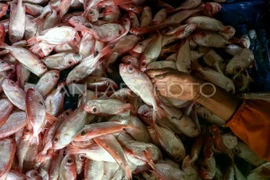
Indonesia tightens oversight of imported aquatic products
Despite tightening oversight on imports, Indonesia remains one of the world’s major net exporters of aquatic products.