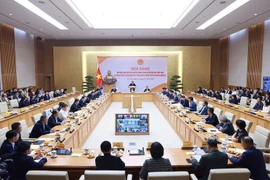
Deputy Prime Minister Vu Duc Dam at the meeting (Photo: VNA)
 Hanoi (VNA) - Deputy Prime Minister VuDuc Dam said on April 24 that people should be happy with the current situationsurrounding COVID-19 but insisted that the risk of transmission in thecommunity is still quite high despite Vietnam’s great efforts to date.
The National Steering Committee for COVID-19 Preventionand Control reported that Vietnam has not recorded any new cases since April 17 and225 out of 268 patients infected have now been given the all-clear.
The three most severe cases - 20, 91 and 161 - haveshown improvements over recent days. Twenty-one patients have tested negativefor the coronavirus at least once, with nine testing negative at least twice.
At a meeting of the committee on April 24, Tran Dac Phu, asenior adviser to Vietnam’s public health emergency operations centre, said thatin the initial phase the country succeeded in preventing the disease enteringthe country from elsewhere. The second phase began when community transmission wasfound, and the Prime Minister decided to introduce socialdistancing in a timely and strict manner, which prevented COVID-19 frombreaking out on a large scale.
Social distancing alone, however, cannot stop thepandemic or community transmission, since it only minimises contact between peopleand limits the spread, he said.
Citing the results of a study on 245 of the 268COVID-19 cases in Vietnam, Phu said that more than 40 percent did not exhibit anysymptoms while others only had a cough or a fever. Many tested negative for thevirus but then positive at a later date, which has also been seen in othercountries.
He said it is difficult to identify cases of infectionin the community as some do not exhibit symptoms or only exhibit commonsymptoms such as a fever or a cough. These people will remain unknown if theydo not visit hospital for a check-up, and if they have close contact withothers the coronavirus will continue to spread.
With social distancing measures now eased, COVID-19may still spread in the community, he said, adding that there could be newinfections in the time ahead and large outbreaks must be prevented.
Ministries, sectors, and localities should takeappropriate action to develop the economy and ensure social security, Phu recommended.
Deputy PM Dam, who is also head of the national steering committee, told the meeting of the need for continued vigilance because while Vietnam’slevel of control over the pandemic is good news, there are more than 50,000 newinfections and 5,000 deaths around the world every day, and the disease has brokenout again in many places previously thought to have controlled it thoroughly.
He quoted experts as saying risks remain highall around the world and there are still people with the virus in thecommunity.
“We can be happy about the outcome to date and havetrust in our leadership, but we should not forget that we have only won individualbattles, not the whole fight,” he said, while calling on people to continuecomplying with the PM’s directions and the health sector’s guidance./.
The National Steering Committee for COVID-19 Preventionand Control reported that Vietnam has not recorded any new cases since April 17 and225 out of 268 patients infected have now been given the all-clear.
The three most severe cases - 20, 91 and 161 - haveshown improvements over recent days. Twenty-one patients have tested negativefor the coronavirus at least once, with nine testing negative at least twice.
At a meeting of the committee on April 24, Tran Dac Phu, asenior adviser to Vietnam’s public health emergency operations centre, said thatin the initial phase the country succeeded in preventing the disease enteringthe country from elsewhere. The second phase began when community transmission wasfound, and the Prime Minister decided to introduce socialdistancing in a timely and strict manner, which prevented COVID-19 frombreaking out on a large scale.
Social distancing alone, however, cannot stop thepandemic or community transmission, since it only minimises contact between peopleand limits the spread, he said.
Citing the results of a study on 245 of the 268COVID-19 cases in Vietnam, Phu said that more than 40 percent did not exhibit anysymptoms while others only had a cough or a fever. Many tested negative for thevirus but then positive at a later date, which has also been seen in othercountries.
He said it is difficult to identify cases of infectionin the community as some do not exhibit symptoms or only exhibit commonsymptoms such as a fever or a cough. These people will remain unknown if theydo not visit hospital for a check-up, and if they have close contact withothers the coronavirus will continue to spread.
With social distancing measures now eased, COVID-19may still spread in the community, he said, adding that there could be newinfections in the time ahead and large outbreaks must be prevented.
Ministries, sectors, and localities should takeappropriate action to develop the economy and ensure social security, Phu recommended.
Deputy PM Dam, who is also head of the national steering committee, told the meeting of the need for continued vigilance because while Vietnam’slevel of control over the pandemic is good news, there are more than 50,000 newinfections and 5,000 deaths around the world every day, and the disease has brokenout again in many places previously thought to have controlled it thoroughly.
He quoted experts as saying risks remain highall around the world and there are still people with the virus in thecommunity.
“We can be happy about the outcome to date and havetrust in our leadership, but we should not forget that we have only won individualbattles, not the whole fight,” he said, while calling on people to continuecomplying with the PM’s directions and the health sector’s guidance./.
VNA