Vietnam ranks 4th in health self-care readiness

Self-care is an essential component of primary healthcare, with WHO defining it as the ability of individuals, families, and communities to promote and maintain health, prevent disease, and cope with illness with or without the support of healthcare professionals.

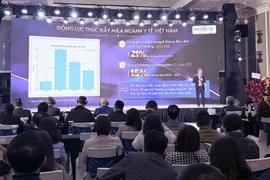
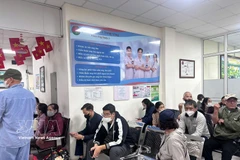
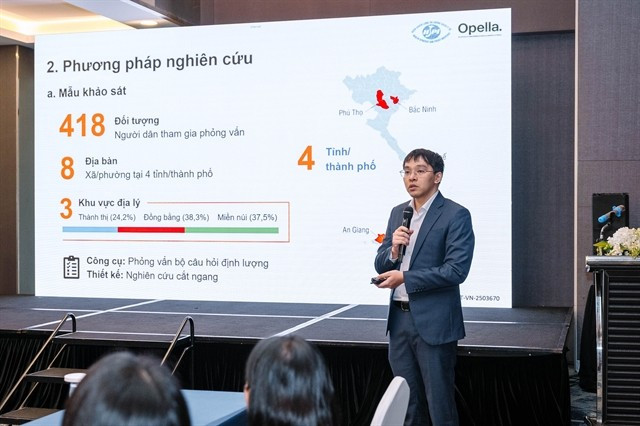
A representative of the Health Strategy and Policy Institute shares the results of a study titled “Assessment of Vietnam’s Readiness for Self-Care and Its Influence Factors”. (Photo courtesy of the organiser)

HCM City (VNS/VNA) – Vietnam ranks fourth in international comparisons for self-care readiness, with an overall score of 3.04 out of 4, behind only Singapore, Australia and Germany, according to a recent study.

Self-care is an essential component of primary healthcare, with WHO defining it as the ability of individuals, families, and communities to promote and maintain health, prevent disease, and cope with illness with or without the support of healthcare professionals.

The Ministry of Health’s Health Strategy and Policy Institute, in collaboration with Opella Vietnam, announced the findings of the study, titled “Assessment of Vietnam’s Readiness for Self-Care and Its Influencing Factors”, on December 15.

Conducted since June, it applied the Global Self-Care Federation’s Self-Care Readiness Index, which comprises four key enablers and 14 component indicators.

The assessment framework has been used in 20 countries worldwide. The research combined desk reviews with field studies in four localities representing different regions of Vietnam: Phu Tho, Bac Ninh, Hue, and An Giang.

Fieldwork employed both qualitative and quantitative methods, including five exhaustive interviews with policymakers, 28 focus group discussions involving health officials, healthcare providers and the general public, and structured questionnaire interviews with 171 healthcare providers and 418 consumers.

Vietnam’s scores across the four key enablers were: Stakeholder Support and Adoption (2.79), Consumer and Patient Empowerment (3.06), Self-Care Health Policy (3.05), and Regulatory Environment (3.26).

Of the 14 component indicators, nine recorded scores between 3 and 3.75, indicating relatively strong overall readiness, although development remains uneven across different areas.

Although Vietnam’s readiness for self-care is relatively strong compared to the region, the study highlights the need to further enhance public awareness, strengthen healthcare workers’ counselling capacity, and improve access to reliable information.

Priority areas include expanding mainstream communication on self-care; accelerating the rollout of electronic health records integrated with VNeID to enable people to access medical histories, test results, and medication information; promoting electronic labelling for medicines, particularly over-the-counter products; and piloting community-based self-care models as a foundation for a future national self-care strategy.

Dr Nguyen Khanh Phuong, director of the Health Strategy and Policy Institute, said the findings show that Vietnam has built a solid foundation for advancing self-care, while also identifying clear opportunities to strengthen mainstream communication, healthcare counselling, and safe access to reliable information.

“This provides a strong basis for developing practical models and national directions for self-care in Vietnam.”

Dr Valentina Belcheva, country head of Opella Vietnam and Cambodia, described the study as an important milestone, noting that it offers, for the first time in Vietnam, a systematic view of the needs and barriers people face in their self-care journey./.
VNA

See more

A proton machine in a hospital in Singapore. Proton beam therapy provides more options for cancer patients. (Photo courtesy of IHH Healthcare Singapore)

Proton therapy, an alternative method for cancer patients

In recent years, Vietnam's Ministry of Health has held numerous meetings with relevant units to assess the progress in developing proton therapy centres in the country. The project for establishing proton therapy centres is set to commence preparations in 2025 and aims for completion between 2026 and 2030.

At the event (Photo: VNA)

First hospital in Mekong Delta earns US AACI accreditation

Nam Can Tho University Hospital on December 15 hosted a ceremony to announce its accreditation by the American Accreditation Commission International (AACI), a US-based body, becoming the first facility in the Mekong Delta and among a select few in Vietnam to earn the distinction.

A health worker administer IPV polio vaccine to a child in Dong Thap province. (Photo: VNA)

Vietnam proactively takes polio prevention measures amid outbreak in Laos

The meeting took place following an assessment by the World Health Organisation (WHO) warning that Vietnam is facing a very high risk of polio import and re-emergence. The risk arises after neighbouring Laos officially declared a polio outbreak on October 7, following the detection of circulating vaccine-derived poliovirus type 1 (cVDPV1).

A view of the International Conference on Molecular Diagnostics in Microbiology and Diseases, organised by Rencontres du Vietnam and the International Centre for Interdisciplinary Science and Education (ICISE) in the central province of Gia Lai on December 11. (Photo: VNA)

Nearly 100 international scientists attend molecular diagnostics conference in Vietnam

The conference features almost 80 presentations across plenary sessions, parallel sessions and poster sessions, focusing on leading research trends such as point-of-care diagnostics; predictive biomarkers used to anticipate individual responses to therapy; and the development of new tools and platforms for rapid molecular-level detection and diagnosis.

Digital transformation in healthcare is being strongly promoted. (Photo: Organising Committee of the 2024 “Technology with Heart” Award, co-hosted by Vietnam News Agency and Viettel)

AI and precision medicine: Emerging prospects for Vietnam-Canada cooperation

Canada has strong experience in compiling and analysing genomic data, while Vietnam has a large population with diverse genetic structures. This complementarity can help Vietnam narrow its technological gap and enhance its capacity to treat rare diseases — an area many countries are prioritising for development.

Maternal and child healthcare in Tuyen Quang province. (Photo: VNA)

Vietnam on path to become a healthy nation

Resolution 72 not only focuses on health care but is also closely interlinked with other sectors, helping to build a solid foundation for sustainable national development and create momentum for Vietnam to “take off” and further integrate into the world.

Sen. Lieut. Gen. Vongsone Inpanphim, Lao Deputy Minister of National Defence and Director of the General Department of Politics presents the Friendship Order of Laos to Vietnam’s Central Military Hospital 108. (Photo: VNA)

Vietnam, Laos expand cooperation in military medicine

Over the past two decades, many Vietnamese experts have undertaken long-term missions at the Central Hospital 103 to provide training and technical assistance, contributing to the successful treatment of complex cases. The Central Military Hospital 108 has also trained 206 Lao doctors, six nurses and two engineers — a clear demonstration of substantive, long-standing cooperation.

Deputy Minister Do Xuan Tuyen (left) and Alberto Anaya Gutiérrez, General Secretary of the Mexican Workers' Party (PT). (Photo: VNA)

Vietnam, Mexico boost medical cooperation

As both nations look to keep their long-standing partnership in good health, the health ministries of Vietnam and Mexico have been accelerating cooperation, especially in traditional medicines.

The opening of Vietnam Medi-Pharm 2025 and Vietmedicare Expo in Ho Chi Minh City on November 27, 2025. (Photo: VNA)

Major medical, pharmaceutical exhibitions kick off in HCM City

The 33rd Vietnam International Medical and Pharmaceutical Exhibition (Vietnam Medi-Pharm 2025) and the International Exhibition on Pharmaceuticals, Medical Devices and Healthcare (Vietmedicare Expo 2025) kicked off at the Saigon Exhibition and Convention Centre on November 27.

Doctors Do Thi Ngoc Linh (left) and Le Diep Linh at the RCS membership certificate award ceremony in London. (Photo: VNA)

Vietnamese surgeons honoured with prestigious Royal College Fellowship

The fact that the Vietnamese doctors have been awarded with FRCS certificate proves Vietnam’s surgical expertise has met international standards, contributing to improving the quality of treatment at home, expanding academic cooperation with world leading medical institutions and inspiring younger doctor to pursue higher standards.